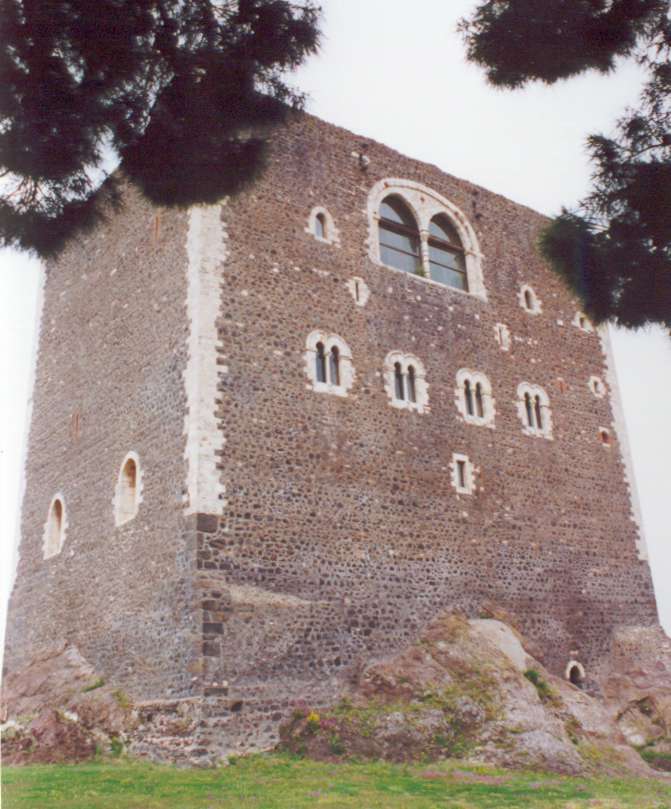
Poira Castle
Poira Castle is a medieval hill castle located in Paternò, Italy, with origins dating back to the 13th century. Built on a site with a long history of human occupation, including Greek and Roman periods, the castle represents a layered historical and architectural heritage. Although now in ruins, the remains of Poira Castle provide valuable insights into medieval defensive architecture and local noble life during the High Medieval period.
Historical background and early occupation
The site of Poira Castle was inhabited long before the medieval fortress was constructed. Archaeological evidence shows that the area was occupied during the Greek and Roman ages, with a nearby Greek necropolis dating to the 6th and 5th centuries BCE discovered in 1995. This illustrates the strategic and cultural importance of the location for ancient communities. Additionally, the proximity of the "Slave’s Cave," linked to Roman slavery practices, highlights the complex social history surrounding the site.
During the medieval era, the castle was erected by a local society that succeeded earlier inhabitants, including the Siculi, an indigenous people predating classical civilizations. The castle's construction in the 13th century reflects the typical medieval practice of reusing historically significant sites for fortification and habitation.
Medieval architecture and castle layout
Poira Castle was designed as a hill castle, taking advantage of its elevated position overlooking the road between Paternò and Centuripe. This strategic location was ideal for monitoring and controlling movement through the region, a common feature of medieval fortifications.
The castle complex originally included four substantial buildings serving multiple functions: residential quarters, storage facilities, animal shelters, and a chapel. The presence of a chapel indicates the integration of spiritual life within the castle’s daily activities, a characteristic of many medieval noble residences.
Defensive features are evident in the ruins, including double walls constructed for enhanced protection. The walls contain arrow slits, narrow vertical openings that allowed defenders to fire arrows while remaining shielded from attackers. The castle also features splayed windows, which widen inward to increase interior light and visibility, demonstrating thoughtful architectural design for both defense and comfort.
One of the most significant surviving elements is a large cistern, which was essential for collecting and storing water, ensuring the castle's sustainability during sieges or dry spells. Fireplaces found within the ruins suggest designated areas for cooking and heating, vital for the inhabitants’ daily life.
The construction employed robust stone masonry typical of the region and period, designed to withstand both military assault and the test of time. Despite centuries of decay and plundering, the castle’s layout remains discernible, providing a window into medieval fortification and domestic arrangements.
Later history and notable events
In later centuries, Poira Castle became associated with local nobility, particularly the Spitaleri barons of Adernò, who managed the estate. The castle’s role evolved to include agricultural functions, serving as a farmstead well into the late 20th century.
A significant event in the castle's recent history is the "Spitaleri seizure" at the end of the 19th century. During this episode, the Banda Maurina, a notorious band active in the rural areas around Catania and Messina, captured the baron residing at Poira Castle. They demanded a ransom of 50,000 lire, which was paid, but the bandits proceeded to raid and pillage the castle before escaping. This incident underscores the turbulent social conditions in Sicily during that period.
Archaeological significance and preservation status
The ruins of Poira Castle stand as an archaeological site revealing multiple layers of history, from ancient Greek settlements to medieval fortification. The castle’s remains include the foundations of its four main buildings, defensive walls, arrow slits, splayed windows, cistern, chapel, and fireplaces.
Despite suffering from extensive looting and neglect in recent decades, the site retains enough structural evidence to allow for study and interpretation. The castle’s hilltop position and surviving features make it an important location for understanding medieval military architecture and rural noble estates in Sicily.
Today, Poira Castle is in a ruined state, with only partial remains visible. Its preservation is challenged by natural decay and human impact, but ongoing archaeological interest highlights its value as a cultural heritage site.
Cultural context and surrounding landmarks
The castle’s location near Paternò situates it within a region rich in history and archaeological discoveries. The nearby Greek necropolis provides context for the ancient communities that once inhabited the area, while the "Slave’s Cave" offers insight into the darker aspects of Roman-era slavery practices.
Poira Castle’s historical narrative intertwines with the broader cultural and social developments of Sicily, reflecting the island’s complex past from antiquity through the medieval period and into modern times.
Frequently asked questions (FAQ)
- What is the historical significance of Poira Castle?
- Poira Castle was built in the 13th century on a site with ancient Greek and Roman occupation, serving as a medieval fortress and noble residence in Sicily.
- Can I visit the ruins of Poira Castle today?
- Yes, the ruins of Poira Castle are accessible, but visitors should be aware that the site is in a ruined condition with limited facilities.
- What defensive features does Poira Castle have?
- The castle features double walls, arrow slits for archers, and a strategic hilltop location overlooking important regional roads.
- When was Poira Castle constructed?
- Poira Castle was constructed in the 13th century during the High Medieval period.
- Are there any notable events associated with Poira Castle?
- Yes, the "Spitaleri seizure" in the late 19th century involved bandits capturing the local baron and raiding the castle.
Information
Loading map...
Visitor reviews
No reviews yet. Been here? Write the first review and help other travelers!
Write the first reviewVisited this castle? Share your experience
Your review helps other travelers and adds first-hand knowledge to our encyclopedia.