Paralio Astros Castle
Paralio Astros Castle stands as a significant hill castle in the Peloponnese region of Greece, strategically perched on a narrow hill overlooking the town of Astros and the Aegean Sea. This fortress embodies centuries of turbulent history, reflecting the shifting powers from the Venetian to the Ottoman Empire and ultimately the emergence of modern Greece. Its commanding position with steep cliffs on one side and fortified walls on the other exemplifies the integration of natural geography with military architecture designed for defense and control.
Historical context and construction phases
The castle's origins trace back to the 17th century, during the waning years of the Second Venetian Rule over the Peloponnese, which ended in 1715. This period was marked by intense rivalry between the Venetians and the Ottoman Empire, each vying for dominance in the region. Following the Ottoman reconquest, the fortress was reinforced to serve as a critical outpost securing Ottoman control against both local insurgencies and potential Venetian attempts to reclaim lost territories.
The fortifications were adapted over time, incorporating defensive features suitable for the era's evolving military technology, including embrasures for firearms and artillery. These enhancements reflect the castle's ongoing strategic importance during the 17th and 18th centuries, as the Peloponnese remained a contested frontier.
Role in the greek war of independence
In the early 19th century, Paralio Astros Castle gained renewed significance during the Greek War of Independence. The fortress became a bastion of resistance under the stewardship of the Zafeiropoulos brothers—Panagiotis, Konstantinos, and Ioannis—prominent merchants and members of the secret society Filiki Eteria. Between 1824 and 1825, they fortified the castle further and established their residences within its walls, transforming it into a center of revolutionary activity.
The castle's defenses were notably tested on August 4, 1826, when approximately 1,200 Greek fighters successfully resisted a siege by the Egyptian forces led by Ibrahim Pasha. Despite facing a numerically superior army, the defenders leveraged the castle's robust fortifications and advantageous position to hold out, underscoring its strategic and symbolic importance in the struggle for Greek independence.
Following the war, in 1833, Panos Zafeiropoulos formally dedicated the fortress to the newly established Kingdom of Greece and its monarch, King Otto, marking a transition from a military stronghold to a national emblem. However, by the early 20th century, the castle was largely abandoned and fell into a state of disrepair.
Architectural features and layout
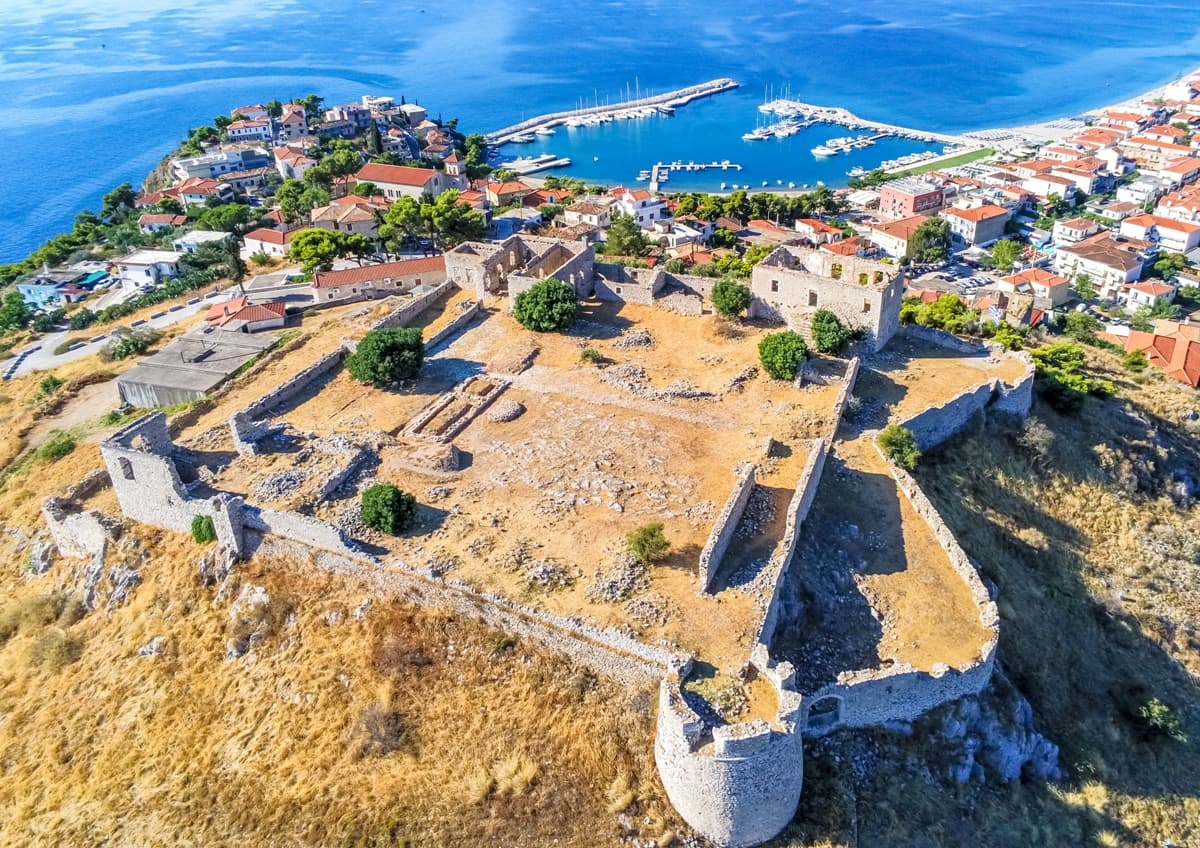
Paralio Astros Castle occupies an almost square-shaped area atop a narrow hill, with steep cliffs protecting its western flank and the Aegean Sea bordering the east. This natural topography provided formidable defensive advantages that were augmented by man-made fortifications.
The castle is accessed through two main gates. The northwestern gate is fortified by a large circular tower, designed to repel attackers from that direction. The eastern gate connects the fortress to the upper town of Paralio Astros, facilitating movement and control over the surrounding area.
The stone curtain walls still stand up to six meters high on the eastern side and feature battlements and embrasures along the southern walls, indicative of adaptations for musket and artillery defense prevalent in the 17th to 19th centuries. These openings allowed defenders to fire upon attackers while remaining protected behind the walls.
Residential and operational structures
At the highest point within the castle's enclosure lie the ruins of several buildings that served both military and domestic purposes. These include storage rooms and water cisterns, essential for sustaining inhabitants during prolonged sieges.
Among these ruins are three distinct residences attributed to the Zafeiropoulos brothers. Panagiotis's house is characterized by a rectangular foundation built atop older structures, suggesting a layering of construction phases. Konstantinos's residence is the best preserved, comprising four rooms with auxiliary spaces such as a latrine and cisterns, reflecting a well-planned domestic environment within the fortress. Ioannis's home, while less intact, shares architectural similarities with Konstantinos's, preserving fragments that hint at its original layout.
These combined elements illustrate how the castle functioned not only as a defensive bastion but also as a living space for its occupants during times of conflict.
Cultural significance and preservation status
Today, Paralio Astros Castle remains a poignant symbol of the Peloponnese's complex history, embodying layers of Venetian, Ottoman, and Greek national heritage. Its ruins offer valuable insights into the military architecture and domestic life of the period spanning the 17th to 19th centuries.
The castle's condition is classified as ruins, with significant portions of its walls and structures surviving, though many buildings have deteriorated over time. Preservation efforts have focused on maintaining the integrity of the remaining fortifications and archaeological remains, allowing visitors to explore the site and appreciate its historical context.
Its location overlooking the Aegean Sea and the town of Astros makes it a popular destination for those interested in history, architecture, and scenic views, contributing to the cultural tourism of the region.
Visitor information and accessibility
While specific visiting hours and ticket prices may vary, the castle is generally accessible to the public and provides an evocative experience of Greece's tumultuous past. Visitors can explore the castle grounds, examine the surviving defensive features, and learn about its role in the Greek War of Independence through onsite informational displays.
Its hilltop position requires a moderate ascent, making it suitable for visitors with reasonable mobility. The site is best visited during spring and autumn when the weather is mild, enhancing the overall experience of the historical and natural surroundings.
Frequently asked questions (FAQ)
- When was Paralio Astros Castle built and by whom?
- Paralio Astros Castle was primarily constructed during the 17th and 18th centuries, initially under Venetian influence and later reinforced by the Ottoman Empire to secure control over the Peloponnese region.
- What role did the castle play in the Greek War of Independence?
- During the Greek War of Independence, the castle served as a key stronghold for the Zafeiropoulos brothers and local fighters, successfully resisting a siege by Ibrahim Pasha's Egyptian forces in 1826.
- What architectural features are notable at Paralio Astros Castle?
- The castle features a nearly square layout with steep cliffs on the west, stone walls up to six meters high, battlements, embrasures for firearms, two main gates including a circular tower gate, and ruins of residential buildings within.
- Is Paralio Astros Castle accessible to visitors today?
- Yes, the castle is open to the public and offers a glimpse into Greece's historical military architecture. Visitors should be prepared for a moderate hill climb and can enjoy panoramic views of the Aegean Sea and Astros town.
- What is the current condition of Paralio Astros Castle?
- The castle is classified as ruins, with significant wall sections and building remains preserved but many structures deteriorated over time.
Photo gallery

Information
Loading map...
Visitor reviews
No reviews yet. Been here? Write the first review and help other travelers!
Write the first reviewVisited this castle? Share your experience
Your review helps other travelers and adds first-hand knowledge to our encyclopedia.