Larisa Castle
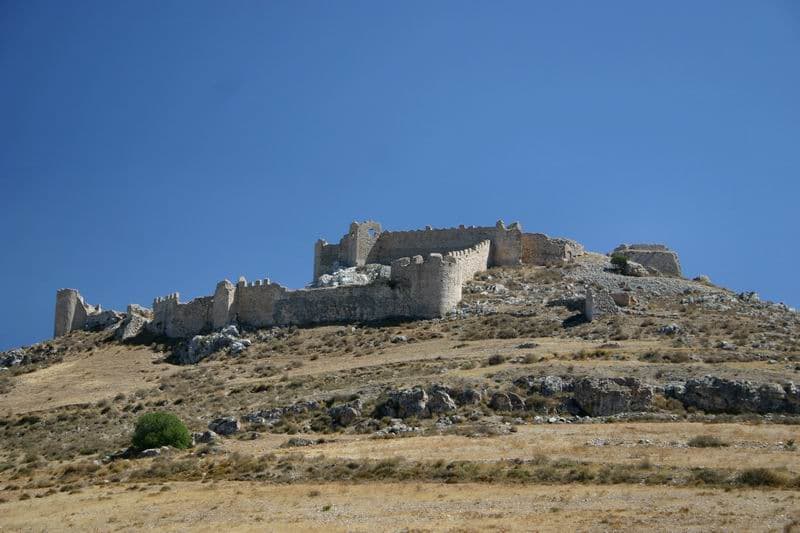
Larisa Castle, also known as the ancient and medieval acropolis of Argos, stands prominently on a high rocky hill within the modern town's western boundaries. This hill castle has a rich history of continuous occupation and fortification spanning nearly two millennia, making it one of the most significant military sites in the Peloponnese region of Greece. The castle's strategic position atop Larisa hill, rising approximately 289 meters above sea level, provided commanding views over the surrounding plains and the Argolic Gulf, underscoring its vital role in regional defense and control.
The site of Larisa Fortress reveals a remarkable layering of historical periods, beginning with traces of Mycenaean fortifications dating back to the 13th century BC. These early defensive walls, characterized by massive monolithic blocks, form the foundation of the castle's citadel and were reused in subsequent medieval constructions. The castle as it appears today primarily reflects its high medieval origins, with significant modifications and reinforcements made during the Byzantine, Frankish, Venetian, and Ottoman periods.
The ancient origins and classical fortifications
Larisa hill was originally the acropolis of ancient Argos, a city with a continuous habitation history from prehistoric times through the classical era. The name "Larisa" is linked to the Pelasgians, an ancient people who, according to Strabo, were expelled and later founded a settlement of the same name in Italy. During the Late Bronze Age, Dorian settlers occupied the eastern slopes of Larisa hill and the nearby plains, laying the groundwork for the Classical city of Argos.
In the 5th century BC, around 421 BC, the city undertook major fortification efforts, including the construction of long walls connecting Argos to its port at Nauplion. These walls, built by Athenian craftsmen, were destroyed by Spartan forces led by King Agis II, illustrating the intense military conflicts of the period. Later, before 272 BC, the city was re-fortified with walls that enclosed both Larisa and the neighboring Aspis hill, integrating the acropolis into a broader defensive system. This classical fortification featured strategically placed gates such as the Deiras Gate to the west and the Nemean Gate to the north, forming a comprehensive defense network for the city.
Byzantine and medieval transformations
Following the classical period, Larisa continued to serve as a vital military and administrative center. In the early medieval period, the fortress endured invasions and occupations by Ostrogoths under Alaric I in 395 AD and later by Slavic groups around 600 AD. These upheavals reflect the broader migrations and power struggles in the region during late antiquity.
By the 12th century, the Byzantines constructed a new castle atop Larisa hill, establishing the core of the medieval fortress that survives today. This Byzantine castle formed the nucleus of the citadel, with walls reinforced by triangular and quadrilateral towers. The castle's military importance persisted through the Crusader period when it was captured in 1212 by Geoffrey of Villehardouin and later passed to Otto de la Roche, Duke of Athens. It became a key stronghold within the Lordship of Argos and Nauplia, with repairs and fortification enhancements carried out in the 14th century to withstand threats such as the Catalan Company.
Venetian and Ottoman periods
The late 14th and 15th centuries marked significant political and military changes for Larisa Castle. In 1388, Venice acquired Argos and Nauplia but soon lost control to Despot Theodore I Palaiologos and Nerio I Acciaioli, who held the fortress with Ottoman support. Venice reclaimed Argos in 1394, but the castle suffered damage during an Ottoman sack following their 1395 victory at Nicopolis. The fortress remained under Venetian control until it fell to the Ottomans during the First Ottoman–Venetian War in 1463.
During the 15th century, the castle underwent extensive modifications to adapt to the advent of gunpowder artillery. Large cylindrical towers with gun loops were added to the curtain walls, and the citadel walls were heightened and reinforced with a mix of triangular, quadrilateral, and an oval tower. The Byzantine gate was blocked, replaced by a new gate further west, enhancing the castle's defensive capabilities. A notable addition was a cylindrical central tower built in the southwestern corner of the citadel, although it was later destroyed in a gunpowder explosion in the early 18th century and replaced by a bastion.
Architectural features and layout
The fortress is composed of two main sections: the citadel at the summit and an extensive curtain wall enclosing the outer precinct. The walls are reinforced by towers of various shapes, including triangular, quadrilateral, cylindrical, and oval forms, reflecting architectural adaptations across centuries. The curtain wall enclosed a residential area, although archaeological exploration of this zone remains limited.
Water management was a critical aspect of the castle's design, with large cisterns located within both the citadel and the outer enclosures, ensuring a reliable water supply during sieges. The 16th-century additions included a partition wall south of the citadel gate, creating an inner courtyard with a passage featuring double gates on the eastern side. Another partition cut off the southern section of the exterior precinct, marking a strategic spatial organization within the fortress.
Religious structures within the castle
Within the citadel, archaeological evidence has revealed the presence of a church dating back to the first millennium, underscoring the site's spiritual significance alongside its military role. A smaller church dedicated to the Virgin Mary was constructed in 1174 on the same site, reflecting Byzantine religious influence. Additionally, the northern section of the inner fortifications houses a small Byzantine church that has survived through the centuries.
Later history and modern significance
Larisa Castle maintained military relevance well into the early modern period. During the Greek War of Independence in 1821, the fortress was seized by Demetrios Ypsilantis, marking its role in the struggle for Greek liberation. Although the castle saw limited military use after this period, the surrounding slopes became home to religious establishments: an 18th-century nunnery and a 19th-century male monastery. The latter briefly functioned as a national mint during the War of Independence before operations moved to Aegina.
Today, the castle remains a prominent historical landmark in Argos. Archaeological excavations initiated in the early 20th century and ongoing conservation efforts by the 25th Ephorate of Byzantine Antiquities have focused on stabilizing the fortress's foundations and restoring its outer walls and gates. The castle's silhouette, visible from nearly every vantage point in Argos, showcases a unique blend of Hellenistic, Byzantine, Frankish, Venetian, and Ottoman architectural elements. Its polygonal Venetian bastions and Ottoman round towers stand as testament to the fortress's long and varied history.
Nearby religious sites such as the Panagia Katakekrymeni-Portokalousa monastery and the Monastery of Agia Marina further enrich the cultural landscape surrounding the castle. These historical and architectural treasures make Larisa Castle a vital destination for those interested in the military, religious, and urban history of the Peloponnese.
Frequently asked questions (FAQ)
- What is the historical significance of Larisa Castle?
- Larisa Castle, located in Argos, Greece, dates back to the Byzantine era and has played a crucial role in the region's defense throughout history. It has witnessed numerous battles and sieges, serving as a stronghold for various empires, including the Venetians and Ottomans. Today, it stands as a testament to the rich historical tapestry of Argos.
- When was Larisa Castle built?
- The construction of Larisa Castle began in the 5th century AD, with significant modifications occurring through the centuries. Its strategic location on a hilltop allowed it to be an important military site, and various architectural styles can be seen in its structure due to the many periods of occupation. This blend of history makes it a fascinating site for visitors.
- What are the opening hours for Larisa Castle?
- Larisa Castle is typically open to visitors from 8:00 AM to 8:00 PM during the summer months and from 8:00 AM to 5:00 PM in the winter. However, it is advisable to check the official website or local resources for any seasonal changes or special closures. Planning your visit during these hours ensures you have ample time to explore the site.
- Is it possible to access Larisa Castle with mobility issues?
- While Larisa Castle offers stunning views and historical insights, its ancient structure includes uneven paths and steep inclines that may pose challenges for visitors with mobility issues. There are some areas that can be accessed with assistance, but it is recommended to contact the site in advance to inquire about specific accessibility options. Ensuring your comfort will enhance your visiting experience.
- Can I take photographs inside Larisa Castle?
- Yes, photography is allowed at Larisa Castle, and visitors are encouraged to capture the stunning views and intricate architecture. However, it is important to be respectful of other visitors and the site's historical significance while taking pictures. Be sure to share your experiences on social media to inspire others to visit this remarkable landmark.
- What is the best time to visit Larisa Castle?
- The best time to visit Larisa Castle is during the spring (April to June) and fall (September to October) when the weather is mild and pleasant. These seasons also tend to see fewer tourists, allowing for a more relaxed exploration of the castle and its surroundings. Visiting during these times enhances your overall experience at this historical site.
- Are there any nearby attractions to Larisa Castle?
- Yes, there are several nearby attractions to Larisa Castle, including the ancient theater of Argos and the archaeological site of Mycenae. These sites offer additional insights into the rich history of the region and are easily accessible from the castle. Exploring these attractions can provide a more comprehensive understanding of ancient Greek civilization.
- What are the ticket prices for Larisa Castle?
- Ticket prices for Larisa Castle are quite reasonable, typically ranging from €3 to €5 for adults, while reduced rates may be available for students and seniors. Children under a certain age may enter for free. It’s advisable to check current prices before your visit, as they can vary based on special events or exhibitions.
Photo gallery

Information
Website
Visit websiteSources & official resources
Verify the information above using these authoritative references.
Loading map...
Visitor reviews
No reviews yet. Been here? Write the first review and help other travelers!
Write the first reviewVisited this castle? Share your experience
Your review helps other travelers and adds first-hand knowledge to our encyclopedia.