Paleokastro of Malevizio
Paleokastro of Malevizio stands as a significant hill castle on the island of Crete, Greece, embodying centuries of military history and architectural evolution. Constructed originally in 1206 by the Genoese pirate Enrico Pescatore, it formed part of a strategic network of fifteen fortresses designed to protect Heraklion Bay from maritime threats. This fortress is a remarkable example of medieval defensive architecture adapted to the rugged topography of Crete.
Historical background and strategic role
The initial establishment of Paleokastro was driven by the need to secure the northern coast of Crete during a period marked by frequent pirate raids and shifting political control. Enrico Pescatore's construction of the fortress was a tactical move to assert control over the bay and safeguard Genoese interests in the eastern Mediterranean. The fortress’s placement on a hill provided a commanding view of the surrounding sea and land, making it a formidable defensive position.
In 1211, during the Venetian campaign to conquer Crete, Paleokastro gained prominence as the last stronghold held by Pescatore against the advancing Venetian forces. Its eventual surrender marked a turning point in the island's history, leading to Venetian dominance. Under Venetian rule, the fortress's military importance waned initially due to the Republic's naval supremacy but was later revitalized in response to Ottoman threats.
Venetian reconstruction and military enhancements
Between 1573 and 1595, Paleokastro underwent extensive reconstruction under the direction of General Latino Orsini. This renovation was part of a broader Venetian effort to fortify Crete against the expanding Ottoman Empire. The fortress was reinforced with sloped walls designed to deflect artillery fire, and its artillery placements were optimized to coordinate with the defenses of Heraklion city, creating a crossfire zone across the bay.
The fortress's layout was adapted to the natural landscape, featuring three distinct levels connected by rock-hewn stairs. The northern section’s higher walls compensated for the cliffs, ensuring balanced defense. The inclusion of a water reservoir and an armory with a gunpowder magazine on the lower level highlights the advanced logistical planning for sustained defense and siege resistance.
Architectural features and defensive structures
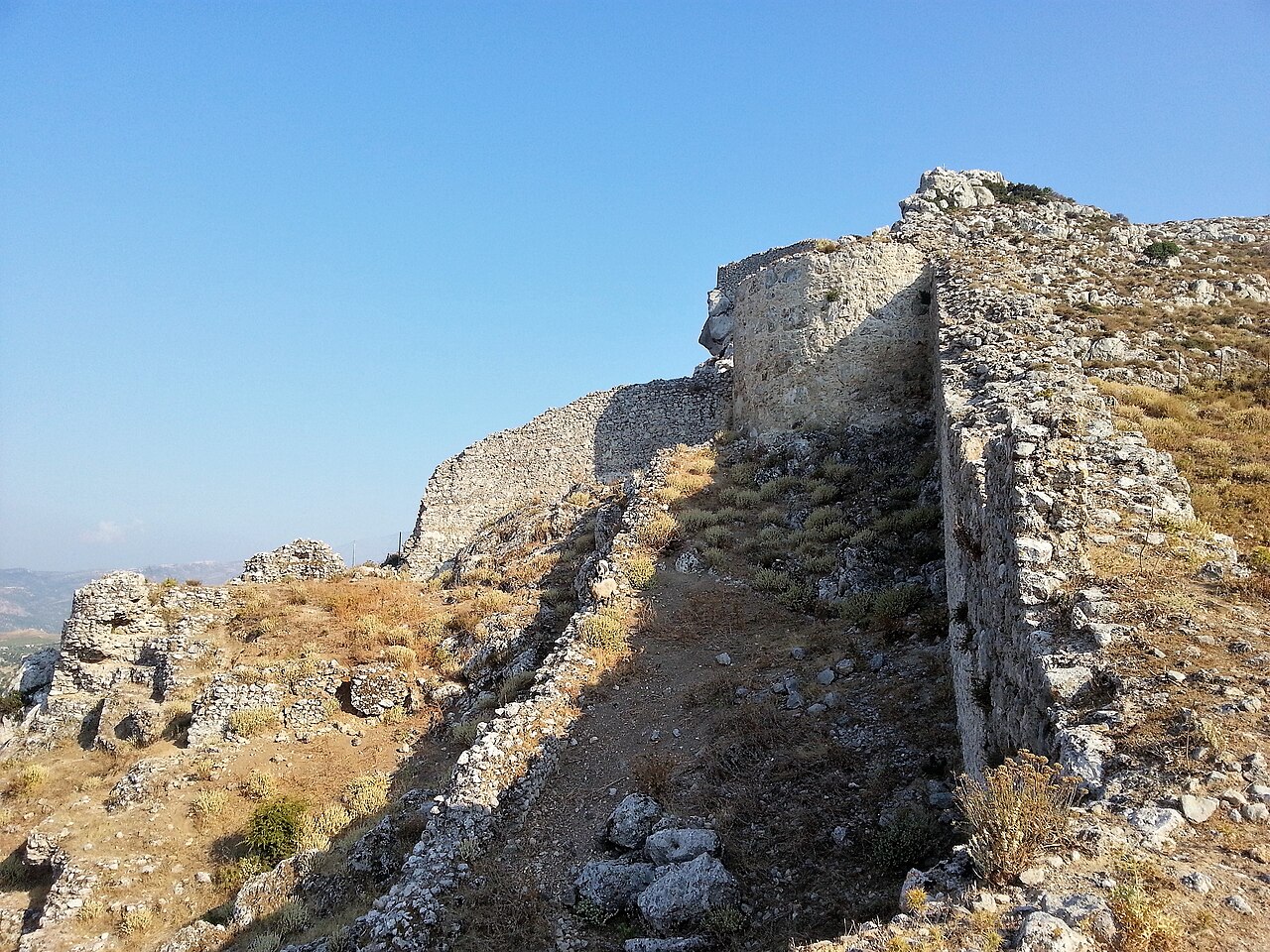
The fortress's perimeter is defined by outward-sloping walls, a characteristic design element intended to better absorb and deflect enemy attacks. The southern gate, measuring approximately two by five meters, provided controlled access to the lower level, which housed essential facilities such as barracks and storage rooms.
At the highest level, a church built concurrently with the fortress reflects the integration of religious practice within the military complex. Flanking the fortress are two tall watchtowers on the southern and northern extremities, providing extensive surveillance capabilities over both land and sea approaches.
Artillery played a crucial role in Paleokastro's defense, with various cannon types positioned strategically, including a notable columbiad cannon effective against naval targets. The eastern wall’s sloped embankments further enhanced the fortress’s resilience against attackers.
A distinctive feature of the fortress is the carved winged Lion of Saint Mark located at the northeast corner, symbolizing Venetian authority and the cultural imprint of Venetian rule on Crete.
Decline and current status
The fortress's active military use ended during the Cretan War (1645–1669). In 1669, it was deliberately destroyed by Venetian forces to aid their campaign against the Ottoman-held city of Heraklion. Since then, Paleokastro has remained in ruins, a silent witness to the island’s turbulent history.
Today, efforts by the municipality of Malevizio, the 13th Ephorate of Byzantine Antiquities, and the Paleokastro Cultural Association aim to preserve and promote the site. These initiatives focus on securing funding for restoration and enhancing public awareness of Paleokastro’s historical and architectural significance.
Visiting Paleokastro: what to see
Visitors to Paleokastro can explore the fortress’s remains spread across three terraced levels, each offering unique insights into medieval military architecture. The surviving walls, watchtowers, and the church provide a tangible connection to the past. The site’s elevated position affords panoramic views of Heraklion Bay and the surrounding landscape, emphasizing its strategic importance.
The winged Lion of Saint Mark carving remains a highlight, symbolizing the Venetian legacy on Crete. The fortress’s water reservoir and gunpowder magazine remnants reveal the ingenuity of its designers in addressing the challenges of siege warfare.
Architectural significance and legacy
Paleokastro exemplifies the adaptation of medieval fortress design to the natural environment, utilizing the hill’s contours to maximize defensive capabilities. Its layered construction with interconnected levels demonstrates sophisticated planning to accommodate troops, artillery, and supplies effectively.
The fortress’s combination of Genoese origins and Venetian modifications reflects the complex history of Crete as a contested maritime crossroads. Its preservation as a ruin allows scholars and visitors alike to study the evolution of military architecture in the eastern Mediterranean during the Middle Ages and Renaissance.
Frequently asked questions (FAQ)
- When was Paleokastro of Malevizio built and by whom?
- Paleokastro of Malevizio was originally built in 1206 by the Genoese pirate Enrico Pescatore as part of a defensive network to protect Heraklion Bay.
- What role did Paleokastro play during Venetian rule?
- During Venetian rule, Paleokastro was initially less significant but was extensively rebuilt between 1573 and 1595 to strengthen defenses against Ottoman naval threats, becoming a key part of Crete's coastal fortifications.
- Can visitors see the winged Lion of Saint Mark at Paleokastro?
- Yes, the winged Lion of Saint Mark carving, symbolizing Venetian authority, is prominently visible at the northeast corner of the fortress and is a notable feature for visitors.
- What are the main architectural features of Paleokastro fortress?
- The fortress features three terraced levels with sloped defensive walls, rock-hewn stairs, a water reservoir, an armory with a gunpowder magazine, two watchtowers, and a church at the highest level.
- Is Paleokastro accessible to visitors today?
- Paleokastro remains a ruin but is accessible to visitors who can explore the fortress remains and enjoy panoramic views of Heraklion Bay, though facilities may be limited.
Information
Website
Visit websiteSources & official resources
Verify the information above using these authoritative references.
Loading map...
Visitor reviews
No reviews yet. Been here? Write the first review and help other travelers!
Write the first reviewVisited this castle? Share your experience
Your review helps other travelers and adds first-hand knowledge to our encyclopedia.