Heraklion Fortress
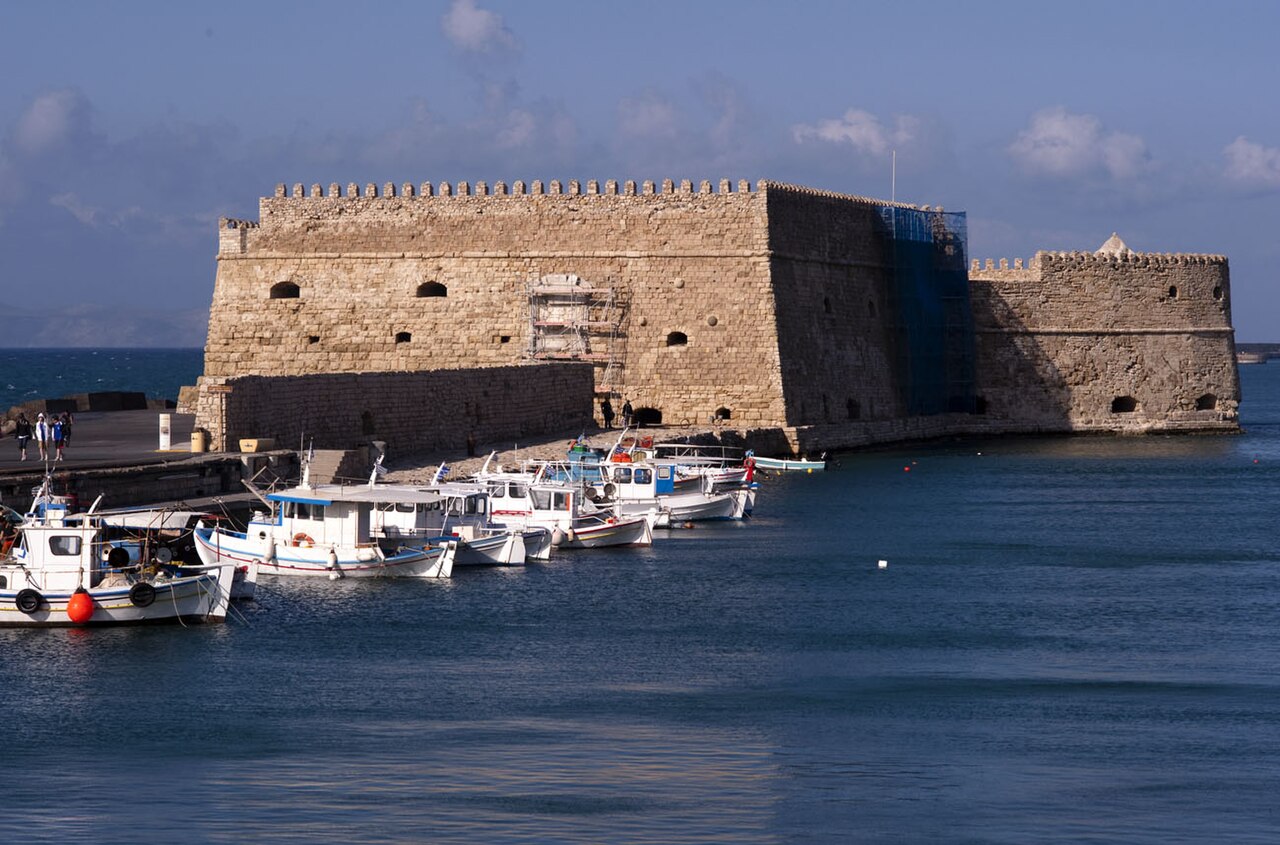
Heraklion Fortress, commonly known as Koules, stands as a formidable marine fortress at the entrance of the old port of Heraklion on the island of Crete, Greece. This late medieval fortress was constructed by the Republic of Venice between 1523 and 1540 to replace an earlier tower that had proven inadequate against evolving military threats, particularly the increasing power of cannon artillery. Its strategic location at the northern end of the old port pier was designed to protect the harbor from naval invasions and to secure the bay of Ammoudara in conjunction with the Castle of Palaiokastro.
Historical background and strategic importance
The site of Koules has a long history of fortification, possibly dating back to the 9th or 10th centuries when Arab forces may have first fortified the natural bay. During the Byzantine period, a tower known as Castellum Comunis occupied this critical position. This tower was severely damaged in the catastrophic 1303 earthquake but was repaired and later replaced by Venetian fortifications.
In 1462, the Venetian Senate approved a program to enhance the fortifications of Candia (the Venetian name for Heraklion). The existing Byzantine tower was eventually demolished in 1523 after being judged inadequate against modern cannon fire. The Venetians then undertook the ambitious project to build the new fortress, which would become the Castello a Mare, or Koules.
Construction and architectural features
The construction of Koules was a remarkable engineering feat. To create a stable foundation in the sea, the Venetians sank old ships filled with stones from nearby islands such as Dia and Fraskia, forming a breakwater and expanding the platform on which the fortress was built. By November 1530, approximately 16 meters of foundation had been laid. The fortress was completed in 1540, featuring a robust square plan with a large semicircular protrusion on the eastern side.
The fortress covers an area of about 3,600 square meters and is spread over two floors. The outer walls are exceptionally thick, measuring up to 8.7 meters on the east, west, and northeast sides, and about 7 meters thick on the north side. Internal walls range from 1.4 to 3 meters thick. The massive stone blocks used in construction were sourced from the islands of Fraskia and Dia, ensuring durability against the harsh marine environment.
The main entrance is located on the west side, opening onto a descending corridor 10.5 meters long and 3 meters wide, defended by three doors. This corridor expands into two branches, leading to auxiliary entrances and the semicircular eastern ledge. The ground floor housed 26 rooms used for storing food, ammunition, and also served as prison cells. It included a large water tank, vaulted ceilings with openings for ventilation and light, and on the upper floor, officers' quarters, a mill, an oven, and a small church. The fortress was heavily armed, with 18 large cannons on the ground floor and 25 smaller ones on the upper floor by 1630.
Defensive design and armament
Koules was designed to withstand intense naval assaults, with thick walls and cannon embrasures facing the sea on three sides. The ramparts, rebuilt by the Ottomans after their conquest, feature two levels with varying heights to optimize defense. The fortress also had an inclined plane to facilitate moving heavy artillery and supplies between floors. Marble reliefs of the winged lion of Venice, though mutilated, still adorn the exterior walls, symbolizing Venetian power.
Repairs, modifications, and military history
Due to constant exposure to sea waves, Koules required frequent and costly repairs throughout its history. The Venetians reinforced the northwest side repeatedly and rebuilt breakwaters to protect the foundations. Despite these efforts, parts of the fortress and its protective structures suffered damage from storms and sedimentation in the port.
During the prolonged Siege of Candia (1648–1669), the fortress played a limited role. Ottoman forces neutralized its firepower by positioning artillery in surrounding areas, ultimately leading to the Venetian surrender of the city. After the Ottoman conquest, the fortress was repaired and adapted for new uses, including serving as a prison and a lighthouse. The Ottomans added battlements and embrasures but largely preserved the Venetian structure. A smaller fortification known as Little Koules was built on the landward side but was demolished in 1936 during urban modernization.
Under Egyptian rule in the early 19th century, a lighthouse was constructed at the northeast corner of Koules. This lighthouse was modernized in the 20th century but was destroyed during World War II bombings and later rebuilt. Restoration efforts began in 1959, focusing on removing later additions and restoring the fortress's original form. Further renovations in the 1970s enhanced the fortress's accessibility and visitor experience, including the construction of gunner doors, parapets, and a perimeter corridor.
Architectural significance and cultural heritage
Koules is an outstanding example of Venetian military architecture adapted to a maritime environment. Its design reflects the evolution of fortification techniques in response to the advent of gunpowder artillery. The fortress's massive walls, vaulted interiors, and integrated defensive features showcase the ingenuity of Renaissance military engineers. The use of sunken ships as foundations is an innovative solution to building on a marine site.
Today, Koules stands as a well-preserved monument and a symbol of Heraklion's rich history. It is open to the public and hosts cultural events, including art exhibitions. Visitors can explore its extensive chambers, ramparts, and enjoy panoramic views of the old port and the city. The fortress's blend of Venetian and Ottoman influences offers insight into the complex history of Crete and the eastern Mediterranean.
Visitor experience and accessibility
The fortress is accessible year-round and provides a unique glimpse into maritime defense architecture. Its location at the harbor entrance makes it a prominent landmark in Heraklion. Visitors can walk along the ramparts, enter the vaulted rooms, and see the remnants of the armaments and reliefs. The site is also a venue for cultural events, enhancing its role as a living heritage site.
Frequently asked questions (FAQ)
- How do I get to Heraklion Fortress?
- Heraklion Fortress is conveniently located in the heart of Heraklion, Greece. You can easily reach it by walking from the city center or using local public transport services such as buses or taxis.
- What is the historical significance of Heraklion Fortress?
- Heraklion Fortress, also known as Koules, was built by the Venetians in the 16th century to protect the city from pirates and invaders. Its strategic location and robust architecture played a crucial role in the defense of Heraklion during various historical conflicts.
- When was Heraklion Fortress constructed?
- Construction of the Heraklion Fortress began in 1540 and was completed in 1560. The fortress stands as a testament to the Venetian architectural style and military engineering of its time.
- Can I enter the fortress and explore its interiors?
- Yes, visitors can enter Heraklion Fortress and explore its various sections, including the bastions and the central courtyard. The site often hosts exhibitions and cultural events, providing a deeper insight into its history.
- Why is Heraklion Fortress a popular attraction?
- Heraklion Fortress is popular due to its impressive architecture, rich history, and stunning views of the harbor. It offers visitors a unique glimpse into the past while being a picturesque spot for photography and leisurely walks.
- Is it possible to visit Heraklion Fortress year-round?
- Yes, Heraklion Fortress is open to visitors year-round, although hours may vary depending on the season. It's advisable to check the official website for the most accurate opening hours before planning your visit.
- What are the ticket prices for Heraklion Fortress?
- As of the latest information, the ticket prices for Heraklion Fortress are quite affordable, with discounts available for students and seniors. Children under a certain age may enter for free, making it accessible for families.
- When is the best time to visit Heraklion Fortress?
- The best time to visit Heraklion Fortress is during the spring and fall months when the weather is mild and pleasant. Summer can be quite hot, so visiting early in the morning or later in the afternoon can enhance your experience.
- Are there any nearby attractions to see after visiting the fortress?
- Yes, nearby attractions include the Heraklion Archaeological Museum, which houses artifacts from the Minoan civilization, and the Venetian Harbor, perfect for a scenic stroll. Additionally, the vibrant local market offers a taste of Cretan culture and cuisine.
Information
Loading map...
Visitor reviews
No reviews yet. Been here? Write the first review and help other travelers!
Write the first reviewVisited this castle? Share your experience
Your review helps other travelers and adds first-hand knowledge to our encyclopedia.