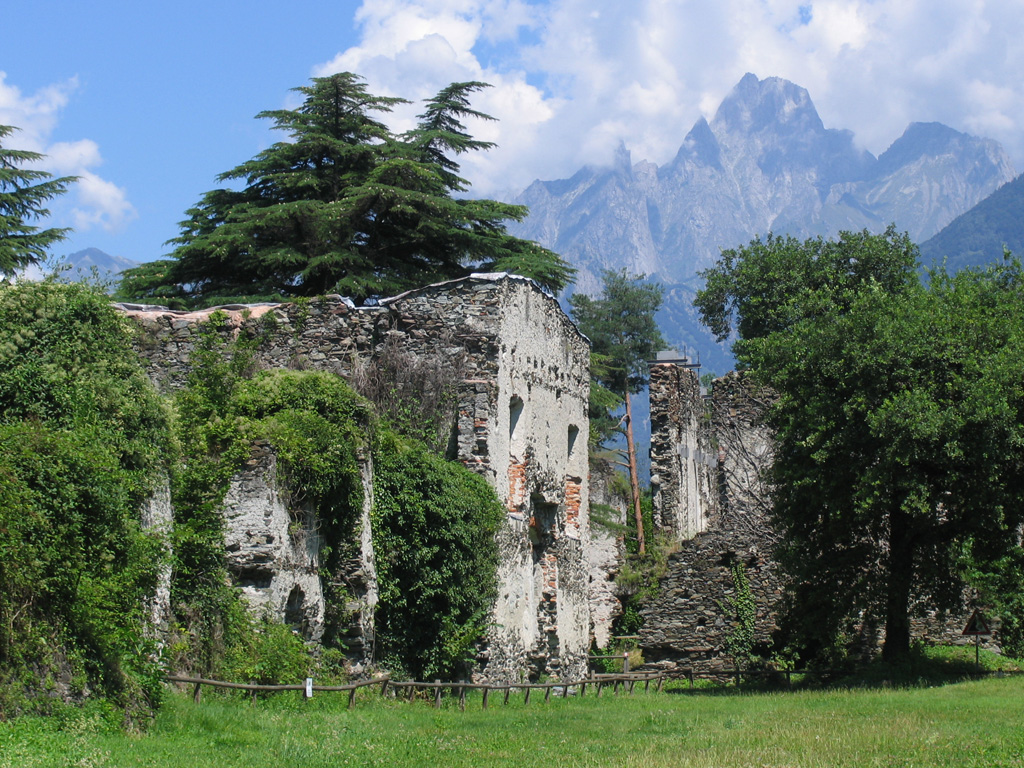
Palazzo Gallio
Palazzo Gallio stands as a remarkable example of a hill castle in the municipality of Gravedona, nestled in the scenic region of Lombardy, Italy. This imposing structure is deeply rooted in history, occupying the site of an early medieval fortress dating back to the 12th century. The castle's foundations incorporate remnants of this original fortification, which served as a strategic defensive position overlooking Lake Como and the surrounding valleys.
The transformation from a medieval fortress to a grand Renaissance palace began in the late 16th century, when Cardinal Tolomeo Gallio was granted control over the territory known as the Tre Pievi by Philip II of Spain between 1579 and 1580. Intent on establishing a residence that reflected his status and power, the Cardinal commissioned the construction of a new palace on the site of the old fortress. The first stone was laid between 1586 and 1587, marking the beginning of a significant architectural project that would blend the fortress's defensive characteristics with the elegance of Renaissance villa design.
Architectural evolution and design
The design of Palazzo Gallio is attributed more credibly to Giovanni Antonio Piotti, rather than the previously suggested Pellegrino Tibaldi. The master builder overseeing construction was Giacomo Curti from Gravedona, whose craftsmanship ensured the integration of robust defensive elements with refined architectural features.
The castle's layout is dominated by a sturdy square edifice featuring four corner towers, a nod to its medieval origins. These towers reinforce the building's fortress-like appearance, emphasizing its role as a stronghold. Contrasting with this defensive aspect are two open loggias facing the lake and mountains, which introduce Renaissance aesthetics and provide panoramic views, blending functionality with beauty.
Inside, the palace centers around a large central hall that runs the full length of the building, connecting the two loggias and serving as a unifying spatial element. The first floor houses a chapel adorned with frescoes, underscoring the Cardinal's ecclesiastical significance and adding an artistic dimension to the residence.
Historical significance and transformations
Despite Cardinal Gallio's ambitious vision, he passed away in 1607 before the palace was completed and never occupied the residence. Ownership passed to his nephews, the Dukes of Alvito, who also did not make it their primary home. By 1620, the palace entered a period of neglect.
The 17th century was marked by turmoil, with the palace serving various roles amid regional conflicts. It was used as a hospital during occupations by French and Spanish forces. In 1636, the palace suffered significant damage when it was set on fire by Henri II de Rohan, a French military leader, during the ongoing conflicts between these powers.
The following 18th century saw efforts to restore the palace and its grounds. The gardens were redesigned in the formal style typical of the period, reflecting contemporary tastes in landscape architecture.
19th-century adaptations and modern use
In the 19th century, the gardens underwent another transformation, adopting the English landscape style, which emphasized naturalistic layouts and informal plantings. This change mirrored broader European trends in garden design.
During this time, part of Palazzo Gallio was repurposed for industrial use as a silk mill, reflecting the economic shifts of the era. Despite these changes, the palace retained much of its historical character.
Today, Palazzo Gallio serves a communal role, housing the Comunità Montana Valli del Lario e del Ceresio. It has been officially recognized as one of Italy's National Monuments, underscoring its cultural and historical importance.
Gardens and preserved features
The extensive gardens surrounding Palazzo Gallio have been significant since at least the 1500s. Historically noted for hosting rare plant species, these gardens extend uphill and are currently renowned for their collection of camellia trees. This botanical richness is celebrated annually through a Camellia Exhibition held in the week before Easter, attracting visitors and horticultural enthusiasts alike.
Within the garden walls, fragments of the original 12th-century medieval fortifications remain, offering a tangible connection to the site's early defensive role. These preserved elements highlight the castle's continuous occupation and evolution over centuries.
Architectural and cultural legacy
Palazzo Gallio exemplifies the architectural transition from medieval fortress to Renaissance palace, combining defensive features with elegant residential design. The four corner towers and square plan recall its military origins, while the loggias and frescoed chapel reflect Renaissance humanism and artistic patronage.
The palace's layered history—from a strategic stronghold to a noble residence, a hospital, an industrial site, and finally a cultural monument—illustrates the dynamic role such structures played in Italy's historical landscape.
Its preservation as a well-maintained hill castle and its integration into the natural and cultural fabric of Gravedona make Palazzo Gallio a significant destination for those interested in medieval and Renaissance architecture, Italian history, and landscape design.
Frequently asked questions (FAQ)
- When was Palazzo Gallio constructed?
- Construction of Palazzo Gallio began between 1586 and 1587, initiated by Cardinal Tolomeo Gallio on the site of a 12th-century fortress.
- What architectural style characterizes Palazzo Gallio?
- Palazzo Gallio primarily exhibits Renaissance architectural features, blending fortress elements with elegant villa design.
- Can visitors explore the gardens at Palazzo Gallio?
- Yes, the extensive gardens are open to visitors and are especially known for their camellia trees and the annual Camellia Exhibition held before Easter.
- What is the current use of Palazzo Gallio?
- Today, Palazzo Gallio houses the Comunità Montana Valli del Lario e del Ceresio and serves a communal and cultural function.
- Is Palazzo Gallio recognized as a historic monument?
- Yes, Palazzo Gallio is officially designated as one of Italy’s National Monuments, highlighting its historical and cultural significance.
Information
Sources & official resources
Verify the information above using these authoritative references.
Loading map...
Visitor reviews
No reviews yet. Been here? Write the first review and help other travelers!
Write the first reviewVisited this castle? Share your experience
Your review helps other travelers and adds first-hand knowledge to our encyclopedia.