Palau-castell de Betxí
The Palau-castell de Betxí stands as a significant example of architectural evolution from medieval fortress to Renaissance palace in the municipality of Betxí, Spain. This site reflects a rich historical layering that spans from Islamic occupation through Christian reconquest to noble residence development. Originally a medieval fortress from at least the mid-14th century, it was transformed during the late 16th century into a fortified palace that combined defensive features with Renaissance residential luxury.
Historical background and site origins
The location of Palau-castell de Betxí holds archaeological evidence of occupation dating back to the Islamic period between the 11th and 13th centuries. Excavations uncovered remains of an Islamic necropolis, indicating the presence of Muslim communities before the Christian reconquest of the region. This early phase included burial grounds and likely a settlement that contributed to the area's strategic importance.
By the mid-14th century, the site hosted a medieval fortress featuring a defensive tower, integral to the local military system. This fortress formed part of the network of fortifications securing the territory during a period marked by territorial conflicts and consolidation of Christian rule in the Kingdom of Valencia.
Transformation into a Renaissance palace
In the late 16th century, the fortress underwent a significant transformation commissioned by Christian noble families. The redesign aimed to convert the austere medieval stronghold into a more comfortable and prestigious residence. This period coincided with the Renaissance architectural movement influencing the Valencian region, blending classical elements with local traditions.
The palace was constructed around a rectangular plan centered on a courtyard typical of Renaissance urban palaces. The courtyard features carpanel arches—arches with a flattened curve—resting on Ionic columns, a classical order revived during the Renaissance. Each side of the courtyard is framed by multiple arches, decorated with heraldic shields and medallions in the spandrels, adding symbolic and ornamental value. Inscriptions and emphasized keystones further enrich the decorative scheme, highlighting the Renaissance attention to detail and symbolism.
Architectural elements and influences
The oldest part of the complex is a rectangular vaulted hall aligned north to south, with a barrel vault made of bricks. This hall connects to the main courtyard through a pointed arch passage, linking the residential and defensive parts of the structure.
The palace's main entrance is notable for its rusticated stonework, where rough-textured blocks create a visually striking facade. The doorway is framed by a wide semicircular arch composed of large wedge-shaped voussoirs and flanked by Tuscan pilasters with irregular stone drums. This portal reflects the influence of Sebastiano Serlio, a prominent Italian Renaissance architect whose treatises shaped Valencian architectural trends in the 1560s, distinguishing it from other regional portals such as those inspired by the Farnese Palace.
Defensive features and archaeological discoveries
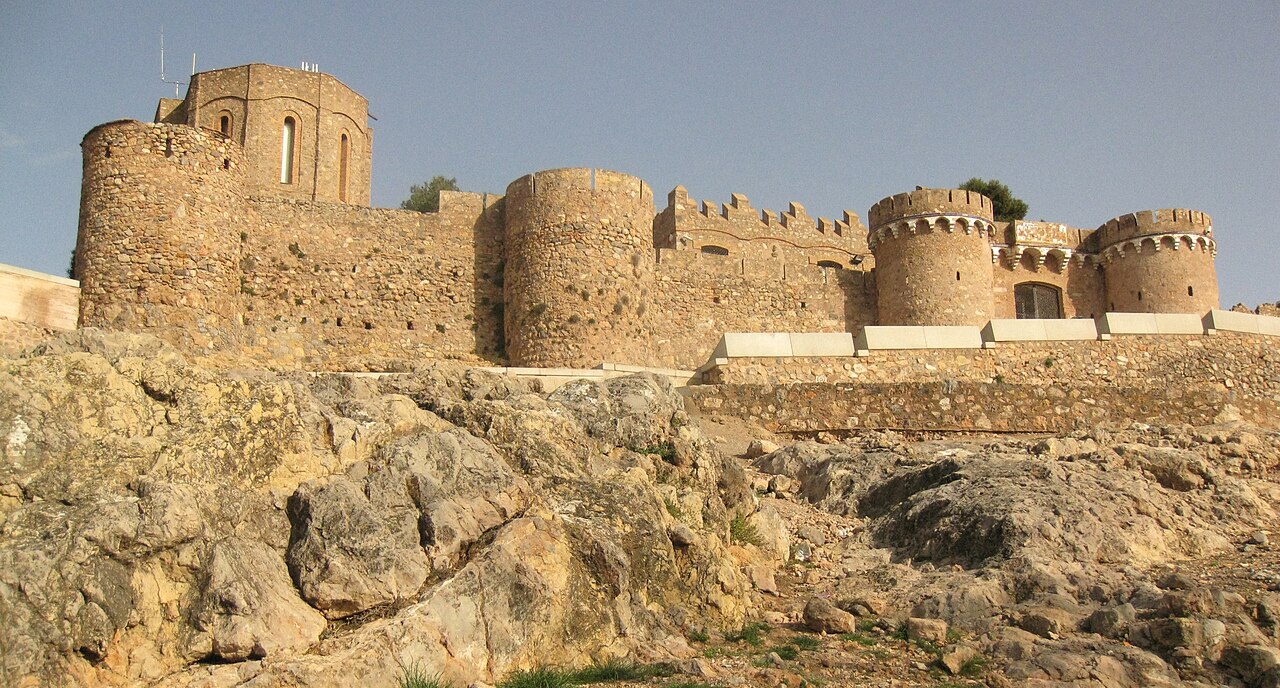
Originally, the fortress included a defensive moat and four corner towers, emphasizing its military function. Archaeological excavations have revealed that only two rear towers partially survive at ground level, constructed on sloped ashlar masonry with projecting moldings marking their bases. The front towers survive only as foundation traces uncovered during recent digs, illustrating the site's layered construction phases.
Excavations in 2008 uncovered the stone foundations of an earlier 14th-century medieval tower beneath the current palace structure. These findings provide valuable insight into the site's original defensive layout and its subsequent adaptation into a noble residence.
Additionally, human skeletal remains associated with the Islamic necropolis were discovered, confirming the site's significance during the Muslim period and its transition through the Christian reconquest.
Later modifications and preservation efforts
Over the centuries following its Renaissance transformation, the Palau-castell de Betxí experienced various modifications by successive owners. Some changes altered or diminished the original Renaissance architectural features, while others added new constructions that impacted the building's integrity.
By the 19th century, the palace remained largely intact, but later additions and attached structures led to deterioration. Recognizing its cultural and historical value, the building was declared a Cultural Heritage Site in 1997.
In 2003, the Betxí town council acquired the property and initiated preservation efforts. In 2007, demolition of adjacent corrals revealed one of the original corner towers, shedding light on the palace's medieval military past and prompting further archaeological investigations.
Current condition and significance
Today, Palau-castell de Betxí is considered a well-preserved example of a fortified Renaissance palace that integrates elements of medieval military architecture. Its combination of defensive structures and elegant residential features illustrates the architectural transition during the late 16th century in the Valencian region.
The site offers valuable insights into the historical layering of cultures, from Islamic to Christian, and the evolution of fortress design into noble palatial architecture. It remains an important monument for understanding regional history and architectural heritage.
Frequently asked questions (FAQ)
- What is the historical significance of Palau-castell de Betxí?
- Palau-castell de Betxí is a significant example of medieval architecture in Spain, reflecting the region's rich history and cultural heritage. Built in the 13th century, it served both as a fortress and a residence, showcasing the strategic importance of Betxí during the Middle Ages.
- When was Palau-castell de Betxí built?
- The construction of Palau-castell de Betxí began in the 13th century, around the time when the area was repopulated after the Reconquista. Its architecture has evolved over the centuries, with various modifications that reflect different historical periods.
- Can I visit Palau-castell de Betxí?
- Yes, visitors are welcome to explore Palau-castell de Betxí. Guided tours are available to provide insights into its history, architecture, and the surrounding landscape, making it an enriching experience for all visitors.
- What are the opening hours for Palau-castell de Betxí?
- Palau-castell de Betxí is typically open to visitors from Tuesday to Sunday, with specific hours that may vary by season. It is advisable to check the official website or contact the castle for the most current opening times before your visit.
- Is it possible to access Palau-castell de Betxí with mobility aids?
- While Palau-castell de Betxí has made efforts to improve accessibility, certain areas may still present challenges for visitors with mobility aids. It is recommended to inquire in advance about specific accessibility options and available assistance during your visit.
- What is the best time to visit Palau-castell de Betxí?
- The best time to visit Palau-castell de Betxí is during the spring and fall months when the weather is mild and pleasant. These seasons also feature fewer tourists, allowing for a more enjoyable and intimate exploration of the castle.
- Are there any nearby attractions to see while visiting the castle?
- Yes, there are several attractions near Palau-castell de Betxí, including beautiful natural parks and charming towns that offer a glimpse into local culture. Visitors can also explore nearby historical sites, enhancing their overall experience in the region.
- What are the ticket prices for visiting Palau-castell de Betxí?
- Ticket prices for Palau-castell de Betxí are generally affordable, with discounts available for children, students, and seniors. It is advisable to check the official website for updated pricing and any special promotions before planning your visit.
Information
Website
Visit websiteSources & official resources
Verify the information above using these authoritative references.
Loading map...
Visitor reviews
No reviews yet. Been here? Write the first review and help other travelers!
Write the first reviewVisited this castle? Share your experience
Your review helps other travelers and adds first-hand knowledge to our encyclopedia.