Palacio de los Zúñiga
The Palacio de los Zúñiga stands prominently in the municipality of Curiel de Duero, Spain, as a significant example of a fortified noble residence with a complex history spanning several centuries. Established by the influential Zúñiga family, this palace served not only as a home for the aristocracy but also as a crucial center of local governance and judicial authority. Its role as the Palacio de Justicia Mayor during the late medieval period underscores its importance in the administration of justice for Curiel and its surrounding territories.
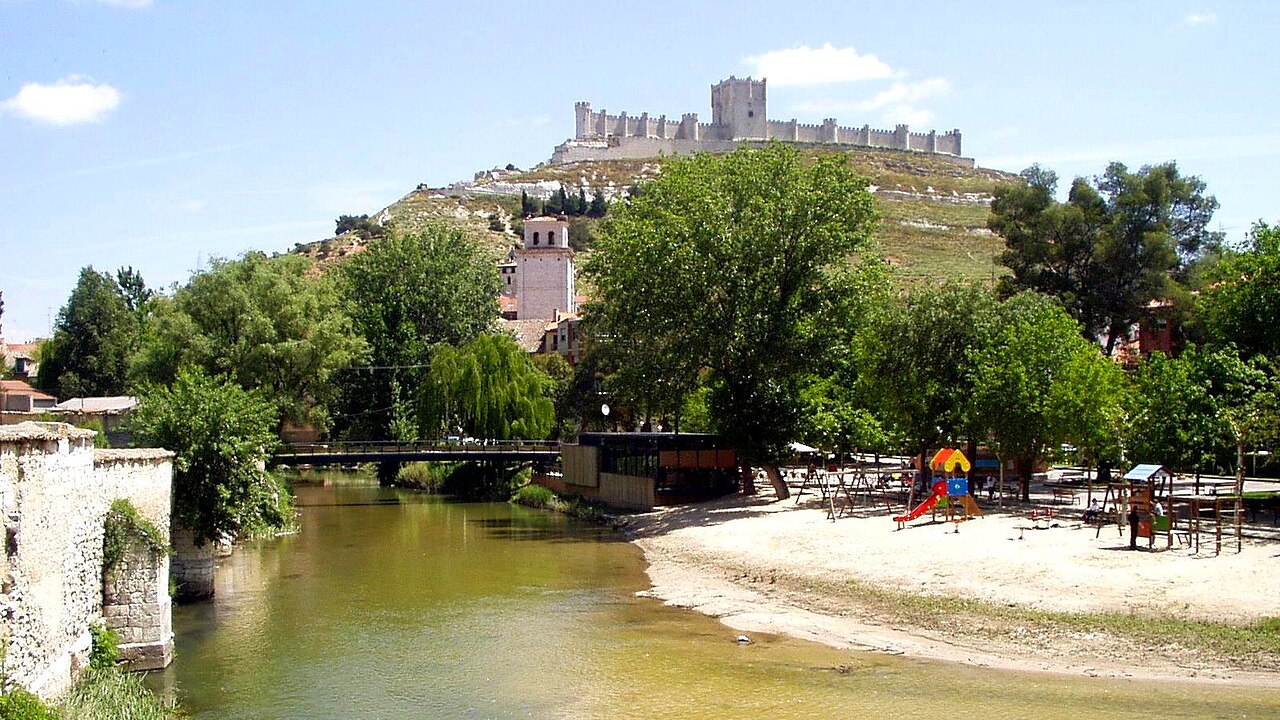
Situated strategically on a hilltop, the palace is part of a larger network of fortifications that include the nearby Castillo de Curiel and the Castillo del Llano. The latter was completed in 1410 by Diego López de Zúñiga, the founder of the House of Zúñiga, highlighting the family's long-standing territorial and military influence. This network of castles and palaces reinforced the region's defensive capabilities and the nobility's control over the area.
Historical significance and noble lineage
The Zúñiga family played a pivotal role in the political and social landscape of the region. The palace's function as a judicial seat continued until the early 19th century, ending with the abolition of the Old Regime after 1812. This marked a significant shift in Spain's political structure, as feudal and monarchical judicial privileges were dismantled.
The palace also served as a prison for notable detainees, including the sons of King Pedro I of Castile, the English nobleman John Hastings, 2nd Earl of Pembroke, and James IV of Mallorca. These imprisonments reflect the palace's dual role in governance and control during periods of political tension and conflict.
Architectural features and defensive design
The Palacio de los Zúñiga is characterized by a rectangular floor plan fortified with substantial towers at each corner, emphasizing its defensive purpose. The construction predominantly uses ashlar stone masonry, especially visible in the main entrance, which features a pointed Gothic arch crafted from precisely cut voussoirs. This entrance not only served a functional role but also symbolized the palace's status and authority.
The palace originally enclosed a central courtyard surrounded by octagonal columns, a distinctive architectural detail that combined elegance with structural support. Above the main doorway projects a prominent defensive structure approximately thirty-five feet high, equipped with six openings and narrow slits designed for archers' arrows. This feature likely functioned as a barbican, allowing defenders to pour boiling water or drop stones on attackers during sieges.
Adjacent to the palace stood the Rollo de Justicia, or Justice Pillory, a stone symbol of local judicial authority. Although only the stone steps remain today, this structure once served as a public emblem of law and order in Curiel de Duero.
Interior and artistic elements
While the interior of the palace has suffered significant deterioration, with much of its original decoration lost or removed, historical records indicate it once contained ornate plasterwork and distinctive wooden coffered ceilings. Unfortunately, many of these decorative elements were stripped away during the early 20th century and dispersed to various locations, including the National Archaeological Museum in Madrid, the Alcázar of Segovia, and private collections as far as California, USA. This dispersal reflects the challenges in preserving noble residences amid changing social and economic circumstances.
Legend and cultural heritage
A notable legend associated with the palace involves chains said to have been captured from the tent of Miramamolín, the Arab leader defeated at the Battle of Las Navas de Tolosa in 1212. According to tradition, these chains were seized by Christian knights during this decisive battle of the Reconquista and later displayed at the palace. This artifact symbolized the Christian victories over Muslim forces and underscored the palace's connection to broader historical narratives of medieval Spain.
Preservation and current condition
Today, the Palacio de los Zúñiga stands as a partially preserved monument, with its façade and two adjacent towers remaining largely intact. These surviving elements offer valuable insight into the palace's architectural character and historical significance. The palace's location near the Castillo de Curiel, perched on a high promontory, and its association with the Castillo del Llano highlight its role within a broader defensive and noble complex that shaped the region's history.
Despite the loss of much of its interior decoration and the dispersal of its artistic treasures, the palace continues to attract interest for its architectural features and its role in the history of Spanish nobility and justice. Its combination of Gothic architectural elements, strategic defensive structures, and historical function as a judicial center make it a noteworthy site in the study of medieval and early modern Spanish castles and palaces.
Frequently asked questions (FAQ)
- How do I visit the Palacio de los Zúñiga?
- The Palacio de los Zúñiga is located in Curiel de Duero, Castile and León, Spain. Visitors can explore the exterior and surrounding area year-round, but access to the interior may be limited due to preservation efforts. Check local tourism information for guided tours and opening hours.
- What is the historical significance of the Palacio de los Zúñiga?
- The palace served as the judicial seat for Curiel de Duero and surrounding lands during the late medieval period. It was also a prison for notable historical figures, reflecting its role in governance and control in the region.
- What architectural style characterizes the Palacio de los Zúñiga?
- The palace features Gothic architectural elements, including a pointed arch entrance with ashlar masonry and defensive towers at each corner, highlighting its fortified nature.
- Is the Palacio de los Zúñiga accessible for visitors with mobility issues?
- Due to the palace's historical structure and partial preservation state, accessibility may be limited. Visitors with mobility concerns should inquire locally about available accommodations and access routes.
- When is the best time to visit the Palacio de los Zúñiga?
- The best time to visit is during spring and autumn when the weather in Castile and León is mild. These seasons provide comfortable conditions for exploring the palace's exterior and nearby historical sites.
Information
Current owner
Municipality
Loading map...
Visitor reviews
No reviews yet. Been here? Write the first review and help other travelers!
Write the first reviewVisited this castle? Share your experience
Your review helps other travelers and adds first-hand knowledge to our encyclopedia.