Palace of Placentia
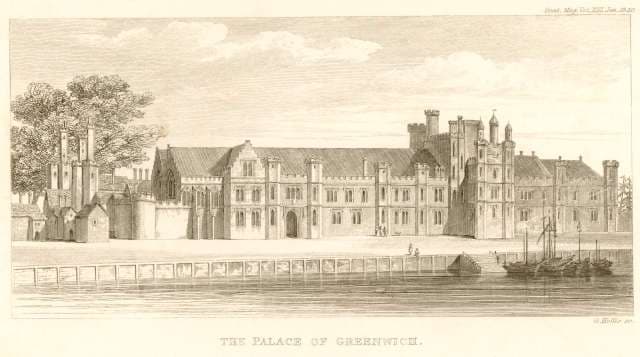
The Palace of Placentia, commonly referred to as Greenwich Palace, was a significant English royal residence located in Greenwich on the south bank of the River Thames, downstream from London. Established in the 15th century by Prince Humphrey, Duke of Gloucester in 1443, it served as a favored retreat for pleasure, entertainment, and escape from the bustling city life of London.
The palace originally began as a riverside residence, but over the centuries it underwent multiple transformations reflecting the tastes and needs of successive monarchs. The site was notable not only for the main palace buildings but also for the surrounding estate, which included the Duke Humphrey's Tower, later known as Greenwich Castle. This tower was situated on a hill behind the palace, providing a commanding view of the Thames. Although the castle was demolished in the late 17th century to make way for the Royal Observatory, Greenwich, it remains an important part of the site's layered history.
Historical development and royal significance
The palace saw its most significant architectural development during the reign of King Henry VII around 1500, who extensively rebuilt the original riverside residence. This reconstruction reflected the late medieval style transitioning into early Renaissance influences, emphasizing grandeur and comfort suitable for a royal court. The palace became a favored residence for Tudor monarchs, including Henry VIII, who was born there and used it as a principal royal home.
In the early 17th century, a detached residence known as the Queen's House was constructed on the palace estate. This building, which still survives today, was designed in the classical style and marked a shift towards Renaissance architectural ideals in England. The Queen's House is notable for its elegant proportions and was one of the first classical buildings in the country, designed by the architect Inigo Jones.
Demolition and transformation into Greenwich Hospital
Following the English Civil War and the Restoration of the monarchy, the original palace fell into disrepair. In 1660, King Charles II ordered the demolition of the old main palace to make way for a new royal palace. However, this ambitious project was never fully realized, with only the east wing partially constructed.
Nearly four decades later, under the reign of Queen Mary II, the site underwent a dramatic transformation. The partially built east wing was remodeled and expanded to become the Greenwich Hospital, a charitable institution for retired sailors. This redevelopment, completed in the late 17th and early 18th centuries, was designed by prominent architects including Christopher Wren and Nicholas Hawksmoor. The hospital buildings, now known as the Old Royal Naval College, stand as an architectural masterpiece of the Baroque style and are a major historic landmark on the Greenwich riverside.
Architectural features and site layout
The original Palace of Placentia featured a complex layout typical of late medieval royal residences, including multiple courtyards, halls, chambers, and service buildings. The riverside location was strategically chosen for both defense and leisure, with gardens and promenades along the Thames.
Duke Humphrey's Tower was a distinctive feature of the estate, serving as a fortified lookout and symbol of the duke's status. The palace's architectural style was predominantly late medieval with some early Renaissance elements introduced during Henry VII's reconstruction.
The surviving Queen's House contrasts with the medieval palace ruins by showcasing clean classical lines, symmetry, and proportion, highlighting the evolution of royal architecture in England.
Current condition and heritage status
Today, the Palace of Placentia exists primarily as archaeological ruins. The site is of great historical and cultural importance, reflecting the layered history of English royal residences and architectural development from the late medieval period through to the Baroque era.
The Old Royal Naval College, built on the palace grounds, continues to be a major tourist attraction and heritage site, preserving the legacy of the palace and its transformation over centuries.
Legacy and cultural impact
The Palace of Placentia played a pivotal role in the Tudor dynasty, being the birthplace of monarchs and a center of court life. Its ruins and surviving structures like the Queen's House offer valuable insights into royal life, architectural trends, and urban development along the Thames.
Greenwich itself remains a key historic area, with the palace site contributing to the rich tapestry of England's royal and maritime heritage.
Visiting the site
The archaeological remains of the palace are accessible as part of the Greenwich area, with nearby attractions including the Royal Observatory, the Queen's House, and the Old Royal Naval College. Visitors can explore the layers of history visible in the architecture and landscape, gaining a deeper understanding of England's royal past.
Frequently asked questions (FAQ)
- How do I get to the Palace of Placentia?
- The Palace of Placentia is located in Greenwich, London, easily accessible by public transport. You can take the Docklands Light Railway (DLR) to Greenwich station or use the London Underground to reach the nearby Cutty Sark station.
- What is the historical significance of the Palace of Placentia?
- The Palace of Placentia was a royal palace built in the 15th century and served as the birthplace of several Tudor monarchs, including Henry VIII and Elizabeth I. It played a crucial role in English history, representing the power and influence of the Tudor dynasty.
- When was the Palace of Placentia built?
- Construction of the Palace of Placentia began in 1443, commissioned by Humphrey, Duke of Gloucester. It underwent various renovations and expansions over the centuries until it fell into decay in the late 17th century.
- Can I visit the Palace of Placentia today?
- Unfortunately, the Palace of Placentia no longer exists as a complete structure, but you can visit the grounds where it once stood. The area is now part of Greenwich Park, offering beautiful views and a glimpse into its historic past.
- Why is the architecture of the Palace of Placentia notable?
- The architecture of the Palace of Placentia is notable for its blend of medieval and Tudor styles, showcasing the evolving design trends of the time. Its grandeur and elaborate features reflected the wealth of the Tudor court and set a standard for subsequent royal residences.
- Is it possible to explore nearby attractions from the Palace of Placentia?
- Yes, the Palace of Placentia is surrounded by several attractions, including the National Maritime Museum, the Royal Observatory, and the Cutty Sark. These sites provide a rich historical context and are easily reachable within a short walking distance.
- What are the opening hours for visiting the grounds of the Palace of Placentia?
- Greenwich Park, where the Palace of Placentia once stood, is open to the public year-round. The park itself is generally accessible from 6 AM to dusk, allowing visitors to enjoy the historic site at their leisure.
- What are the ticket prices to visit the Palace of Placentia grounds?
- There is no ticket price to visit the grounds of the Palace of Placentia, as it is part of Greenwich Park. Enjoying the park and its historical significance is free, making it a wonderful option for visitors of all ages.
- When is the best time to visit the Palace of Placentia grounds?
- The best time to visit the grounds of the Palace of Placentia is during spring and summer when the gardens are in full bloom. The pleasant weather allows for a comfortable exploration of the park and surrounding attractions.
Photo gallery

Public domain
Information
Loading map...
Visitor reviews
No reviews yet. Been here? Write the first review and help other travelers!
Write the first reviewVisited this castle? Share your experience
Your review helps other travelers and adds first-hand knowledge to our encyclopedia.