Paderne Castle
Paderne Castle, locally known as Castelo de Paderne, is a remarkable historic fortress located south of the village of Paderne in the Algarve region of Portugal. This castle stands as one of the oldest surviving examples of taipa construction—a military rammed earth technique used by the Moors during the Almoravid period. Built primarily of compacted earth mixed with lime and sandstone, the walls demonstrate the durability and ingenuity of medieval Islamic military architecture in the Iberian Peninsula.
Perched on a prominent hilltop peninsula approximately 100 meters above sea level, the castle overlooks the deep valley of the Ribeira de Quarteira river. Its strategic location on three sides surrounded by steep valleys provided a natural defense, which was further enhanced by the castle’s robust fortifications. The fortress follows an irregular trapezoidal layout with ten sides, covering an internal area of about 3,250 square meters, oriented northeast to maximize defensive advantage.
Historical background and significance
The origins of Paderne Castle trace back to a Lusitanian hillfort or castro, established during the transition from the late Neolithic to the early Chalcolithic periods. This prehistoric settlement was later absorbed into the Roman Empire in the mid-2nd century BCE, when the site was developed into a military and administrative center known as Paderne or Paderna. The castle’s location has therefore been of strategic importance for millennia.
During the 11th or 12th century, under Almohad Muslim rule, the existing structures were transformed into a fortified rural stronghold or hisn. This fortress was designed to serve both defensive and residential purposes and was part of a secondary line of fortifications aimed at resisting the advancing Christian forces during the Reconquista of the Algarve region.
The castle’s first documented mention dates to 1189, when King Sancho I of Portugal captured it with the assistance of English crusaders. However, the Christian hold was brief as Muslim forces soon recaptured the fortress. The castle was finally taken during the Christian reconquest of the Algarve in 1248 by knights of the Order of Santiago led by Paio Peres Correia during the reign of King Afonso III. This marked a decisive moment in the consolidation of Portuguese control over the Algarve.
Following the conquest, a Christian chapel dedicated to Our Lady of the Assumption was established within the castle grounds, likely replacing an earlier mosque. In 1305, King Denis granted the castle to Lourenço Anes, master of the Order of Avis, who undertook significant restoration and reorganization of the castle’s interior using stone construction techniques.
Between the 15th and 16th centuries, the strategic importance of Paderne Castle declined as coastal defenses became paramount. The nearby settlement of Paderne gradually relocated in the early 1500s, leading to the fortress’s abandonment. The devastating 1755 Lisbon earthquake caused severe damage, including the partial collapse of the castle’s albarrana tower and walls. By 1858, the castle was officially closed, and the chapel ceased to function due to deterioration and isolation from the local population.
Recognized for its cultural and historical value, Paderne Castle was classified as a Property of Public Interest in 1971. Since the 1980s, archaeological excavations and conservation efforts have stabilized the ruins and partially restored key features such as the albarrana tower’s connecting arch. Ongoing research into the castle’s multiple occupation phases has enriched understanding of its layered history from the Almohad period through the 17th century.
Architectural features and construction techniques
Fortifications and layout
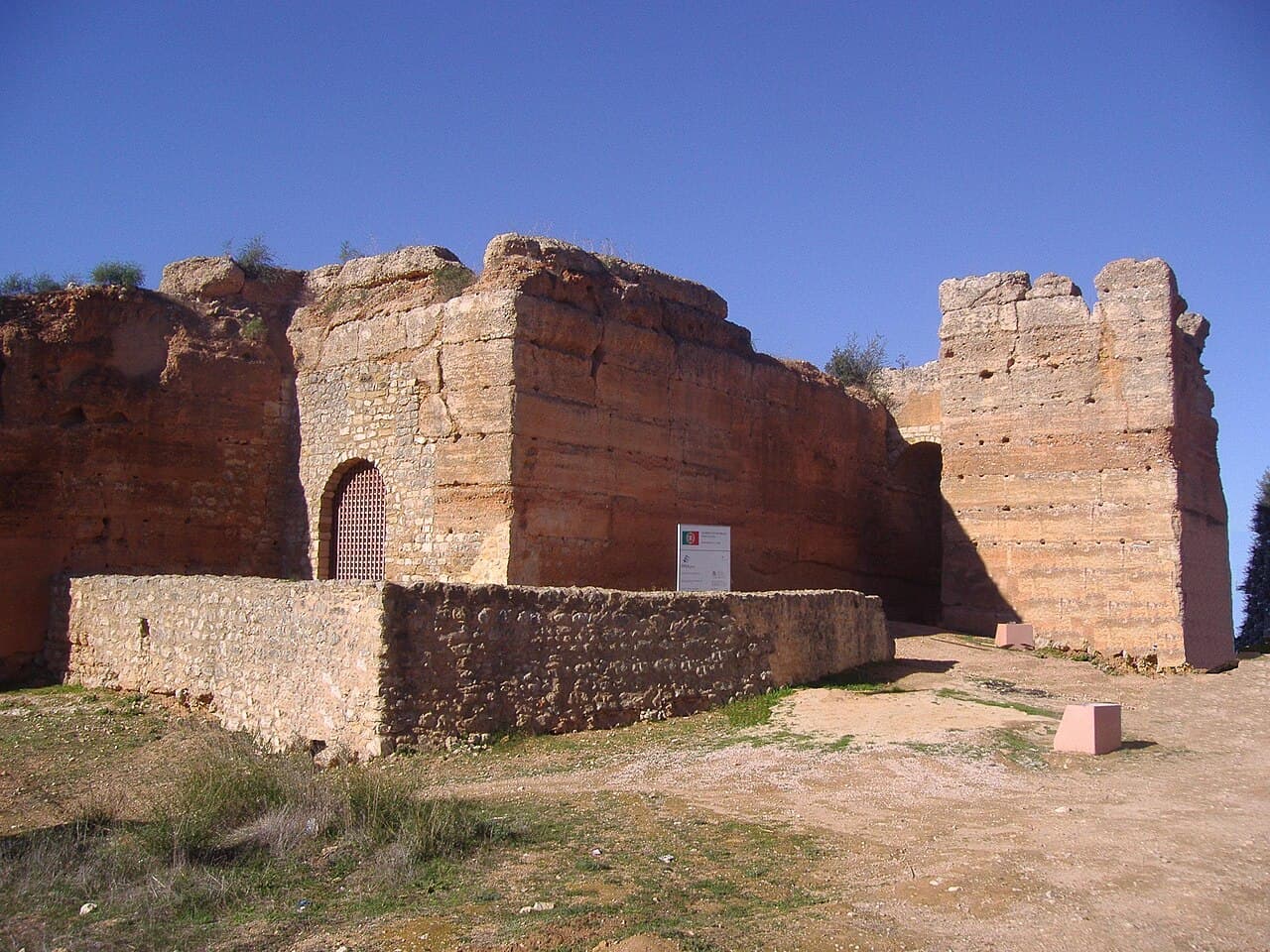
The castle’s fortifications are a prime example of taipa military architecture. The walls are constructed from layers of compacted earth mixed with lime, resting on stepped limestone bases over one meter high. These walls measure between 1.9 and 2.1 meters thick, providing formidable defense while blending with the natural terrain. The irregular trapezoidal plan with ten sides was carefully adapted to the hilltop’s contours, maximizing defensive coverage.
A key defensive element is the albarrana tower, situated outside the main enclosure on the northeast side near the fortress’s single entrance. This tower measures about 5.85 meters per side at its base and rises to nearly 9.3 meters in height. It is connected to the castle walls by a small walkway supported by a reconstructed stone arch. The tower’s walls consist of eleven taipa modules, with arrow slits visible for archers. Archaeological evidence indicates the terrace was used to store munitions on wooden platforms, highlighting its military function.
The main gate on the southeast side features a bent, or L-shaped, entrance passage designed to complicate direct assaults, a common defensive strategy in medieval fortifications. This entrance funnel would force attackers to slow down and expose themselves to defenders on the walls above.
Interior structures and water management
Within the castle walls lie the remains of a rectangular chapel dedicated to Nossa Senhora da Assunção (Our Lady of the Assumption). The chapel was oriented northeast and originally had a wooden roof over the nave with a vaulted chancel. It contained three altars and served as the local parish church until abandonment following population shifts. Archaeological findings reveal it was built over a 13th-century Christian church that itself replaced an earlier Islamic mosque, reflecting the site’s religious transformations.
The castle’s residential area included housing units arranged around small central courtyards, or sahns, typical of Islamic architectural planning. These adobe or taipa-built houses, some attached to the fortress walls, included one large dwelling measuring approximately 11.3 by 8.2 meters with eight rooms surrounding its courtyard, indicating a well-organized settlement inside the fortifications.
Water supply was critical for sustaining the castle’s inhabitants, especially during sieges. Two cisterns within the walls collected and stored rainwater. One cistern near the chapel features a vaulted roof and measures about 6.25 by 2.7 meters internally. These cisterns ensured a reliable water source in the castle’s elevated and exposed position.
Archaeological discoveries and preservation efforts
Excavations at Paderne Castle have uncovered a wealth of artifacts spanning several centuries. Notably, numerous Islamic ceramics and kitchenware from the 12th to 13th centuries have been found, including pieces attributed to Nasrid production. These finds highlight the castle’s role as a cultural and trade hub during the Islamic period in the Algarve.
Later artifacts dating from the 16th to 17th centuries attest to continued, albeit diminished, occupation after the Christian reconquest. Archaeological digs have revealed the foundations of multiple buildings inside the castle walls, confirming the presence of a vibrant community during its peak use.
Since the 1980s, conservation work has focused on stabilizing and partially restoring the castle ruins. The albarrana tower’s connecting arch was reconstructed, and the walls were consolidated to prevent further deterioration. These efforts are overseen by the Portuguese Institute of Architectural Heritage and supported by Natura 2000 environmental protections, emphasizing both cultural heritage and natural conservation.
Visiting paderne castle today
Today, Paderne Castle is a protected historic site accessible to visitors interested in medieval military architecture and Portuguese history. Although some areas may be temporarily closed for ongoing conservation, the castle’s ruins provide a fascinating glimpse into the layered history of the Algarve region.
The castle is easily visible from the nearby IP1/E01 highway between Loulé and Albufeira, making it a convenient stop for travelers exploring southern Portugal. Nearby, visitors can also see a well-preserved Roman bridge spanning the river valley, adding to the historical richness of the area.
The castle is situated within a Natura 2000 protected area and forms part of a nature trail managed by the national Institute for Nature Conservation, combining cultural heritage with natural beauty. Visitors are encouraged to respect the fragile ruins and the surrounding environment.
Frequently asked questions (FAQ)
- How do I get to Paderne Castle?
- Paderne Castle is located in the village of Paderne, just a short drive from Albufeira in the Algarve region of Portugal. You can reach it by car or public transport, with various bus services connecting Paderne to nearby towns. Parking is available near the castle for visitors arriving by car.
- What is the historical significance of Paderne Castle?
- Paderne Castle is a historical monument that dates back to the Moorish period, showcasing the region's rich history and medieval architecture. It played a crucial role in the Reconquista, serving as a strategic fortress for the Christian forces. The castle is a symbol of the cultural heritage of the Algarve and offers insight into the region's past.
- When was Paderne Castle built?
- Paderne Castle was constructed in the 12th century during the period of Muslim rule in the Iberian Peninsula. It was later modified and expanded by Christian forces after the Reconquista in the 13th century. The castle's architecture reflects its long and varied history, blending Moorish and medieval styles.
- Can I visit Paderne Castle year-round?
- Yes, Paderne Castle is open to visitors throughout the year, allowing you to explore its historical grounds and enjoy the stunning views of the surrounding landscape. However, it is advisable to check for any special events or maintenance closures before your visit. Guided tours may be available to enhance your experience.
- Why is Paderne Castle a popular tourist attraction?
- Paderne Castle is a popular destination due to its historical significance, stunning architecture, and picturesque location. Visitors are drawn to its well-preserved ruins and panoramic views of the Algarve countryside. The castle also offers a glimpse into the region's rich heritage, making it a must-visit for history enthusiasts.
- Is it possible to access Paderne Castle with limited mobility?
- While Paderne Castle is an outdoor site with some uneven terrain, there are pathways that allow for access to the main areas of the castle. Visitors with limited mobility may find it challenging to explore all areas, but staff can provide assistance and information on navigating the site. It is advisable to contact the castle prior to your visit to inquire about specific accessibility options.
- What are the opening hours for Paderne Castle?
- Paderne Castle is generally open from 9 AM to 7 PM during the summer months and from 9 AM to 5 PM in the winter months. Note that these hours may vary during holidays or special events, so it's best to verify before your visit. The castle is accessible throughout the day, allowing for ample time to explore its grounds.
- Are there any nearby attractions to visit after Paderne Castle?
- Yes, there are several nearby attractions that visitors can explore after touring Paderne Castle. The charming village of Paderne itself offers quaint streets and local shops, while the beautiful beaches of Albufeira are only a short drive away. Additionally, the scenic countryside provides opportunities for hiking and enjoying nature.
- What are the ticket prices for visiting Paderne Castle?
- Entry to Paderne Castle is typically free for all visitors, making it an accessible destination for everyone. However, if you wish to join a guided tour, there may be a small fee associated with that. It's recommended to check for any updates on ticketing policies before your visit.
Photo gallery

Photo by Beechgrove at English Wikipedia•Public domain
Information
Loading map...
Visitor reviews
No reviews yet. Been here? Write the first review and help other travelers!
Write the first reviewVisited this castle? Share your experience
Your review helps other travelers and adds first-hand knowledge to our encyclopedia.