Oświęcim — Poland castle

Oświęcim

Oświęcim castle: medieval bastioned fortress ruins in poland
Oświęcim, Poland
High Medieval (11th–13th c.)
Ruins

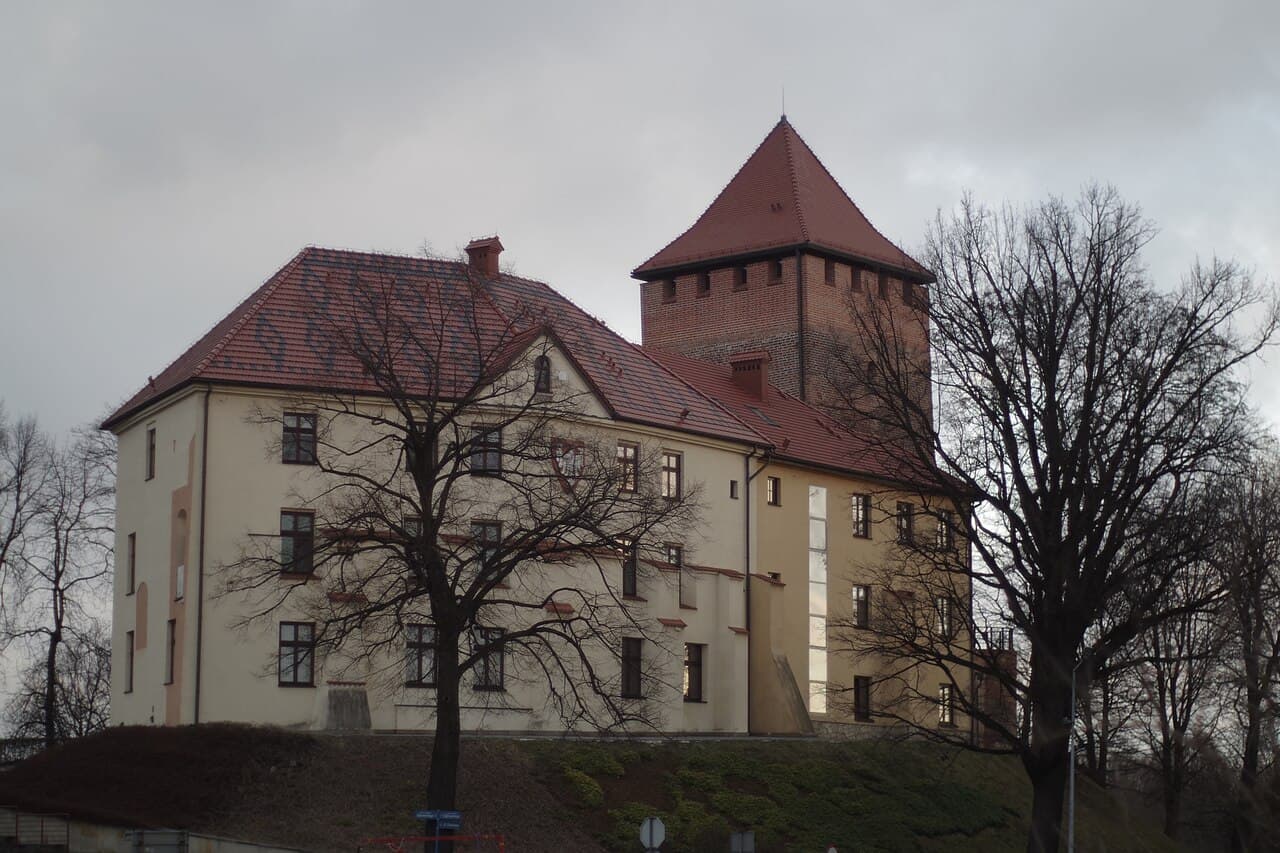
Oświęcim Castle stands prominently on a raised escarpment overlooking the Soła River in southern Poland. Its history dates back to the 12th century, making it a significant medieval stronghold in the region. The earliest records mentioning the castle appear in documents from 1177 and 1228, identifying it initially as a wooden and earth fortification typical of early medieval defensive architecture.

Early fortifications and archaeological findings

Archaeological excavations have uncovered remnants of earthworks and wooden defensive structures beneath the current ruins, confirming the castle's origins as a wooden-earth fort. Notably, beneath the existing tower, a stone foundation was found that does not align with the tower's current walls, suggesting it supported an earlier wooden construction. This discovery sheds light on the castle's evolution from a simple fortification to a more complex stone structure.

Medieval development and architectural features

In the mid-13th century, alongside the original fort, the town of Oświęcim was established under town law, marking the area's growing importance. During this period, a brick tower with a square plan was constructed, which remains the most prominent surviving feature today. The exact date of the main castle's stone construction is uncertain, but it likely connected to this tower on the southern side and formed a slightly curved quadrilateral layout.

The castle comprised two main sections: a southern part that was originally two stories tall with a basement, and a northern section. This division reflects typical medieval castle organization, separating residential and defensive functions.

Political significance and ownership history

From 1317, Oświęcim Castle served as the seat of the dukes of Oświęcim, a branch of the Silesian Piasts. Its strategic location made it a regional power center. In 1457, King Kazimierz Jagiellończyk purchased the castle and the Duchy of Oświęcim, incorporating it into the Polish Crown. Subsequently, it became the residence of royal starosts until the First Partition of Poland in 1772.

Fires, reconstructions, and decline

The castle endured multiple fires and floods throughout its history. After a devastating fire in 1503, royal starosta Jan Jordan oversaw reconstruction efforts to restore the castle. Another fire around 1535 prompted further rebuilding, and in the early 17th century, the castle underwent additional renovations following yet another fire. These later reconstructions diminished the castle's defensive character, reflecting changing military and residential needs.

By the late 17th and early 18th centuries, the castle fell into disrepair and began to deteriorate significantly. It ceased to function as a fortress and gradually became ruins.

Surviving structures and 20th-century restoration

Today, the most visible remnant of Oświęcim Castle is the 13th-century brick tower, which stands three stories high. Adjacent to the tower, fragments of castle walls survive at the northeast corner. The castle's present appearance largely results from restoration and reconstruction efforts undertaken in the early 20th century, aimed at preserving the deteriorating ruins.

Architectural and cultural significance

Oświęcim Castle exemplifies the transition from early medieval wooden fortifications to more durable stone and brick bastioned fortresses. Its layered history reflects the political shifts in Silesia and Poland from the High Middle Ages through the Early Modern period. The castle's ruins provide valuable insight into medieval defensive architecture and the evolution of regional power centers.

Visitors to the site can explore the imposing brick tower and the surviving walls, gaining a tangible connection to the region's medieval heritage. The castle's location on a high river escarpment offers scenic views and underscores its strategic military importance.

Visiting information and accessibility

The castle ruins are accessible to the public, allowing visitors to appreciate the historical and architectural significance of this medieval bastioned fortress. While no extensive facilities exist on site, the castle's evocative remains and surrounding landscape make it a compelling destination for history enthusiasts and those interested in medieval architecture.

Frequently asked questions (FAQ)

When was Oświęcim Castle originally built?
Oświęcim Castle was originally established in the 12th century as a wooden and earth fortification before evolving into a stone and brick fortress.
What remains of Oświęcim Castle can be seen today?
Today, visitors can see the 13th-century brick tower and remnants of the castle walls, especially at the northeast corner of the site.
How did the castle's role change over time?
Initially a ducal seat for the dukes of Oświęcim, the castle later became a royal starost residence after incorporation into the Polish Crown in 1457, before falling into ruin in the 17th and 18th centuries.
What architectural styles are represented in Oświęcim Castle?
The castle showcases early medieval wooden-earth fortifications transitioning to brick construction typical of the High Medieval period, though later reconstructions diminished its defensive features.
Is Oświęcim Castle accessible to visitors?
Yes, the castle ruins are open to the public and provide a historical site for exploring medieval architecture and regional history.

Photo gallery

Oświęcim
Click to view

Photo by Jacek Daczyński•CC BY-SA 4.0

1 photo • Click any image to view in full screen

Information

Bastioned Fortress

Loading map...

Visitor reviews

No reviews yet. Been here? Write the first review and help other travelers!

Write the first review

Visited this castle? Share your experience

Your review helps other travelers and adds first-hand knowledge to our encyclopedia.

Write a review

(5/5)

0/2000 characters

Your review will be visible after admin approval

Nearby castles

4.1 km

Bobrek

Bobrek, Poland

Bobrek Castle is a significant historical monument located in the village of Bobrek, Poland. Its history traces back to the late medieval period, with the first documented mention of the castle dating to 1408. The castle was likely constructed at the turn of the 14th and 15th centuries on an artificially raised mound amidst the floodplains of the Przemsza River. This strategic location along the trade route from Kraków to Moravia highlights its importance as a defensive stronghold with advanced fortifications. Historical context and ownership lineage The earliest records mention the village of Bobrek in 1390, referring to Mikołaj Strzała of Bobrek. The castle itself first appears in documents in 1408. It was probably owned by Jan Ligęza, the voivode of Łęczyca, who is recorded as the castle's heir in 1410. Jan Ligęza commanded a banner at the Battle of Grunwald and later adopted the surname Ligęza Bobrkowski after the castle. His son Piotr Ligęza was involved in the 1439 Hussite confederation under Spytko of Melsztyn. By the mid-15th century, the Ligęza family holdings in the Bobrek area were divided among several members, but around 1467 Stanisław Ligęza consolidated the estate. The last Ligęza owner, Adam Ligęza, died childless in 1624, after which the property became contested and eventually passed to Jan Wielopolski in 1640. Architectural features and fortifications The castle was built as a bastioned fortress, a style characterized by angular bastions designed to provide overlapping fields of fire and improved defense against artillery. Its position on an artificial hill surrounded by river floodplains enhanced its defensive capabilities. Although the precise layout of the original Gothic castle remains uncertain due to the current state of ruin, it is believed to have featured typical late medieval fortifications including curtain walls, battlements, and possibly a moat fed by the nearby river waters. The castle's strategic location on a major trade route suggests it served both military and economic functions, controlling movement and trade between Kraków and the Moravian region. The presence of bastions indicates adaptation to the evolving art of fortification in response to the introduction of gunpowder weaponry in the late medieval period. Significant historical events During the Swedish Deluge in 1655, the castle was occupied by the Swedish general Witz. Upon their retreat, the Swedes left the fortress looted and burned. Despite the extensive damage, the castle was rebuilt, although the restoration required substantial financial investment. In the late 18th century, the castle played a role in the Bar Confederation (1770-1771), a Polish noble uprising against Russian influence. Under the command of Kazimierz Pułaski, notable for his later role in the American Revolutionary War, the castle's fortifications were part of a defensive line along the upper Vistula River. However, after the defeat at the Battle of Lanckorona in 1771, the fortress surrendered. Transformation and decline Following the death of Jan Józef Wielopolski, his widow Teresa Wielopolska transformed the ruined castle remains into a classicist palace using parts of the original walls and vaulted cellars. The palace was surrounded by an extensive park, marking a shift from military to residential and aesthetic functions. The estate changed hands through marriage, passing to the Potulicki family around 1830 and later to the Ogiński family in 1877. At the beginning of the 20th century, the palace was remodeled under the initiative of Princess Maria Ogińska, adopting an eclectic style with strong neo- and pseudo-Baroque elements. Before World War I, the estate became property of the Sapieha princes. In 1939, the last owner, Prince Adam Zygmunt Sapieha, removed valuable furnishings before the German occupation. During World War II, the palace was used by German forces as a radar station and gendarmerie post. After the war, the palace was repurposed as a school until the 1970s, after which it was abandoned. The lack of maintenance led to rapid deterioration, leaving the site in a state of ruin. Current condition and preservation efforts Today, Bobrek Castle stands as ruins, reflecting centuries of turbulent history and architectural evolution. In 2002, the dilapidated palace was purchased by Ziyad Raoof with plans to convert it into a hotel. Although some clearing and debris removal have occurred, comprehensive restoration has yet to be realized. The site holds significant potential for archaeological research to uncover more about the original medieval fortress and its successive transformations. Preservation and restoration efforts would help revive this important cultural landmark, allowing visitors to appreciate the rich heritage of Bobrek Castle and its role in Polish history. Architectural legacy and cultural significance Bobrek Castle exemplifies the transition from medieval fortification to noble residence, illustrating broader historical trends in Polish architecture and society. Its bastioned design reflects adaptations to changing military technologies, while the later classical and eclectic palace phases demonstrate shifts in aesthetic and functional priorities. As a site intertwined with notable historical figures such as Jan Ligęza, Kazimierz Pułaski, and the Wielopolski family, the castle offers valuable insights into regional power dynamics and cultural developments from the late medieval period through the 19th century. Preserving and studying Bobrek Castle contributes to understanding Poland's architectural heritage and the historical narratives embedded in its landscape.

Late Medieval (14th–15th c.)
Details
10.8 km

Bieruń Stary

Bieruń Stary, Poland

Bieruń Stary castle stands as a significant historical monument in the town of Bieruń Stary, Poland. Its origins trace back to an early fortified settlement from the 10th to 11th century, located strategically in the valley of the Mleczna River. This early stronghold was built on an artificially raised mound and protected by a wooden palisade, serving primarily to control the river crossing and safeguard merchants traveling through the region. The early fortified settlement and strategic importance The initial fortification in Bieruń Stary was a defensive gord constructed during the Early Medieval period. Positioned on a man-made mound, it was surrounded by a wooden palisade, a typical feature of Slavic fortifications of that era. This site played a crucial role in monitoring and protecting the river crossing over the Mleczna River, which was an important route for trade and communication. The fortification ensured the safety of merchants and travelers, contributing to the economic and strategic development of the area. The transition to a medieval castle During the Late Medieval period, specifically between 1327 and 1387, the original wooden fortification was replaced or supplemented by a stone castle. Although detailed records of the castle's architectural design and history are scarce, it is known that the castle was established on the site of the earlier gord. This transformation reflects the broader trend in medieval Europe of replacing wooden fortifications with more durable stone structures to enhance defense capabilities. Granting of town rights and political context In 1387, Bieruń was granted town rights by Jan II the Iron, Duke of Opava-Racibórz, marking a significant milestone in its development. This event signified the growing importance of the settlement and its castle within the region controlled by the Piast dynasty of Silesia. The castle likely served as a local administrative and military center during this period, although specific details about its role remain limited due to the lack of surviving documentation. Architectural features and current state While no substantial remains of the original castle survive today, the site retains a prominent mound on the southwestern edge of the town, which is the last visible remnant of the medieval fortifications. On top of this mound stands a 19th-century chapel dedicated to St. John of Nepomuk, a notable landmark that adds cultural and historical value to the site. The absence of visible castle structures suggests that the stone castle was either dismantled or fell into ruin over the centuries. Preservation and archaeological significance The site of Bieruń Stary castle is considered well preserved in terms of its historical footprint, with the mound serving as a tangible connection to the town's medieval past. Archaeological investigations in the area have the potential to reveal more about the castle's layout and construction techniques, although such studies have been limited. The castle's location and remnants provide valuable insights into medieval fortification strategies in the Silesian region. Historical legacy and cultural importance Bieruń Stary castle represents an important chapter in the history of Silesia and Poland. Its evolution from an early medieval gord to a late medieval stone castle illustrates the region's shifting political and military landscape. The castle's association with the Piast dynasty and the granting of town rights highlight its role in regional governance and development. Today, the site is a symbol of local heritage, attracting interest from historians, archaeologists, and visitors intrigued by Poland's medieval past. Visiting the site Visitors to Bieruń Stary can explore the castle mound and the chapel of St. John of Nepomuk, enjoying panoramic views of the surrounding landscape. Although the castle itself no longer stands, the site offers a unique opportunity to connect with the area's early medieval history and appreciate the strategic importance of river crossings in medieval settlement patterns.

Late Medieval (14th–15th c.)
Details
13.1 km

Malec

Malec, Poland

Malec castle is a notable example of a late medieval hill castle located in the village of Malec, Poland. Established in the early 14th century, it originally belonged to local nobility before passing into the hands of the Oświęcim princes. The castle was strategically situated on an island amidst fish ponds, which provided natural defenses and reflected typical medieval defensive planning. The origins and strategic importance of Malec castle The castle was initiated by Prince Jan III of Oświęcim as a small defensive stronghold designed to secure the region and assert princely authority. Its location on an island surrounded by water made it a formidable obstacle for attackers, enhancing its defensive capabilities. The castle played a significant role during the turbulent period of feudal conflicts between the Oświęcim princes and the knights loyal to the Polish crown. Role in regional conflicts During the 15th century, Malec castle was embroiled in local power struggles and was seized by a band of robber knights led by Włodek of Skrzyczno. These knights, known for their raids on the Polish borderlands and merchant caravans heading to Kraków, used the castle as a base for their operations. This period highlighted the castle's strategic importance as a frontier fortress controlling access to important trade routes. Royal intervention and military campaigns King Casimir IV Jagiellon responded to the threat posed by the robber knights by pressuring Prince Janusz IV of Oświęcim to support a military campaign against them. When the prince failed to fulfill his obligations and was suspected of aiding the raiders, the king dispatched royal forces under the command of Jan Szafraniec in 1452. The royal army successfully stormed Malec castle, which was then garrisoned with 200 soldiers. Following the siege, the prince regained control of the castle after paying a substantial sum of 2,000 red złoty as military support and an additional 800 złoty in compensation. This episode underscores the castle's military and political significance during the mid-15th century. Incorporation into the Polish Crown and subsequent decline In 1457, the Oświęcim Duchy was formally annexed to the Kingdom of Poland. However, the ongoing Thirteen Years' War against the Teutonic Order limited Poland's ability to maintain control over its border fortresses. During this period, Malec castle was occupied by mercenaries demanding overdue pay. These soldiers formed a group called the "Brothers," who conducted raids in the surrounding region. In response, King Casimir IV ordered a military expedition to capture and destroy the castle to eliminate this threat. The royal forces complied, and the castle was razed, marking the end of its functional existence as a fortress. Architectural features and current state Today, Malec castle survives only as a 7-meter-high earthen mound located on the island in the fish pond. This mound represents the remnants of the castle's defensive earthworks and possibly the foundation of its main structures. In the latter half of the 20th century, a causeway that once connected the island to the mainland was removed, further isolating the site. The castle's original architectural details are largely lost, but its layout as an island fortress with water defenses is typical of late medieval hill castles in the region. The use of natural water features for defense reflects common strategic considerations of the time. Historical significance and cultural heritage Malec castle serves as an important historical site that illustrates the complex feudal and military dynamics of southern Poland during the late medieval period. Its history encapsulates themes of princely power, royal authority, and the challenges of border security in a contested frontier zone. Despite its ruinous state, the site remains a point of interest for historians and enthusiasts of medieval architecture, offering insights into the defensive strategies and political conflicts of 15th-century Poland. Preservation and archaeological potential While only earthworks remain, the site holds archaeological value that could shed light on the construction techniques and daily life within a small medieval hill castle. Preservation efforts focus on maintaining the integrity of the mound and the surrounding landscape to protect this cultural heritage.

Late Medieval (14th–15th c.)
Details

