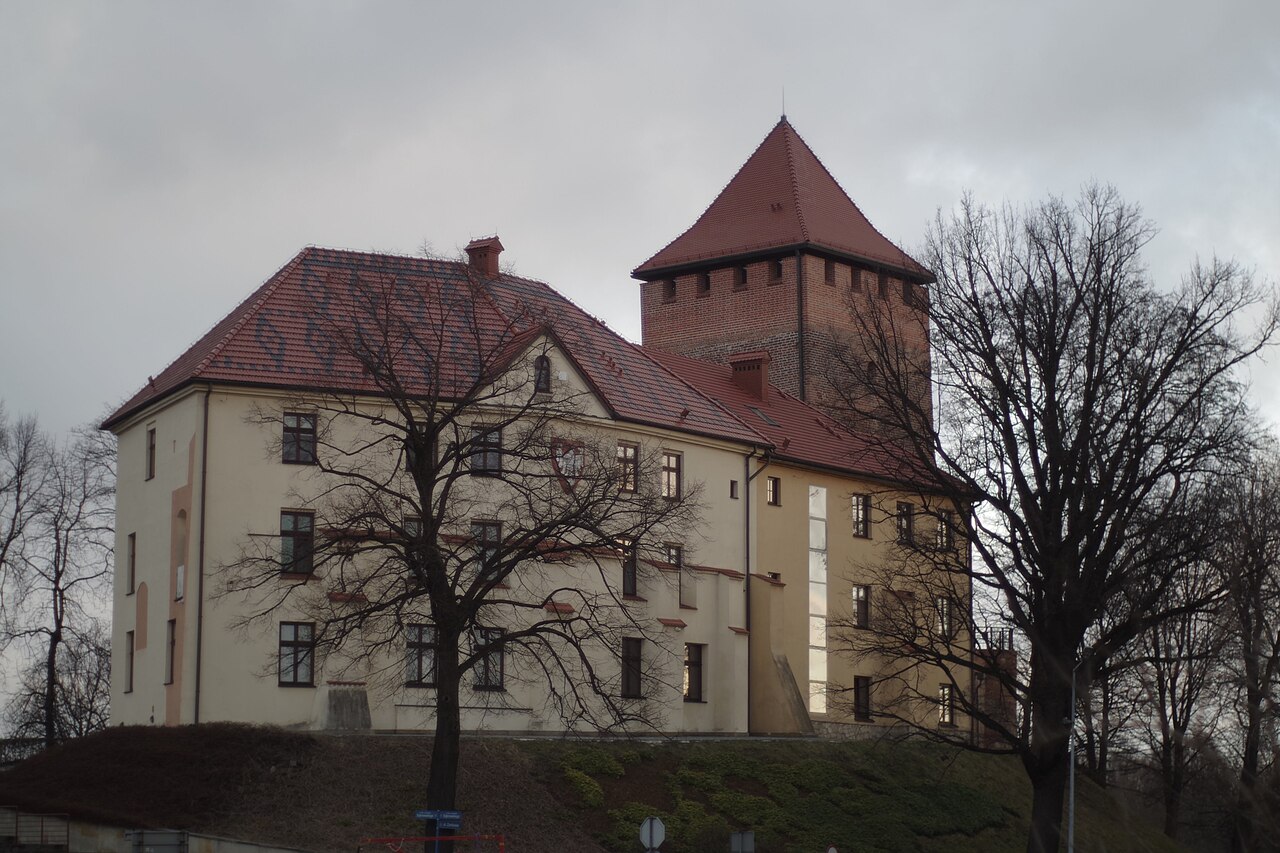
Bobrek
Bobrek Castle is a significant historical monument located in the village of Bobrek, Poland. Its history traces back to the late medieval period, with the first documented mention of the castle dating to 1408. The castle was likely constructed at the turn of the 14th and 15th centuries on an artificially raised mound amidst the floodplains of the Przemsza River. This strategic location along the trade route from Kraków to Moravia highlights its importance as a defensive stronghold with advanced fortifications.
Historical context and ownership lineage
The earliest records mention the village of Bobrek in 1390, referring to Mikołaj Strzała of Bobrek. The castle itself first appears in documents in 1408. It was probably owned by Jan Ligęza, the voivode of Łęczyca, who is recorded as the castle's heir in 1410. Jan Ligęza commanded a banner at the Battle of Grunwald and later adopted the surname Ligęza Bobrkowski after the castle. His son Piotr Ligęza was involved in the 1439 Hussite confederation under Spytko of Melsztyn.
By the mid-15th century, the Ligęza family holdings in the Bobrek area were divided among several members, but around 1467 Stanisław Ligęza consolidated the estate. The last Ligęza owner, Adam Ligęza, died childless in 1624, after which the property became contested and eventually passed to Jan Wielopolski in 1640.
Architectural features and fortifications
The castle was built as a bastioned fortress, a style characterized by angular bastions designed to provide overlapping fields of fire and improved defense against artillery. Its position on an artificial hill surrounded by river floodplains enhanced its defensive capabilities. Although the precise layout of the original Gothic castle remains uncertain due to the current state of ruin, it is believed to have featured typical late medieval fortifications including curtain walls, battlements, and possibly a moat fed by the nearby river waters.
The castle's strategic location on a major trade route suggests it served both military and economic functions, controlling movement and trade between Kraków and the Moravian region. The presence of bastions indicates adaptation to the evolving art of fortification in response to the introduction of gunpowder weaponry in the late medieval period.
Significant historical events
During the Swedish Deluge in 1655, the castle was occupied by the Swedish general Witz. Upon their retreat, the Swedes left the fortress looted and burned. Despite the extensive damage, the castle was rebuilt, although the restoration required substantial financial investment.
In the late 18th century, the castle played a role in the Bar Confederation (1770-1771), a Polish noble uprising against Russian influence. Under the command of Kazimierz Pułaski, notable for his later role in the American Revolutionary War, the castle's fortifications were part of a defensive line along the upper Vistula River. However, after the defeat at the Battle of Lanckorona in 1771, the fortress surrendered.
Transformation and decline
Following the death of Jan Józef Wielopolski, his widow Teresa Wielopolska transformed the ruined castle remains into a classicist palace using parts of the original walls and vaulted cellars. The palace was surrounded by an extensive park, marking a shift from military to residential and aesthetic functions.
The estate changed hands through marriage, passing to the Potulicki family around 1830 and later to the Ogiński family in 1877. At the beginning of the 20th century, the palace was remodeled under the initiative of Princess Maria Ogińska, adopting an eclectic style with strong neo- and pseudo-Baroque elements.
Before World War I, the estate became property of the Sapieha princes. In 1939, the last owner, Prince Adam Zygmunt Sapieha, removed valuable furnishings before the German occupation. During World War II, the palace was used by German forces as a radar station and gendarmerie post.
After the war, the palace was repurposed as a school until the 1970s, after which it was abandoned. The lack of maintenance led to rapid deterioration, leaving the site in a state of ruin.
Current condition and preservation efforts
Today, Bobrek Castle stands as ruins, reflecting centuries of turbulent history and architectural evolution. In 2002, the dilapidated palace was purchased by Ziyad Raoof with plans to convert it into a hotel. Although some clearing and debris removal have occurred, comprehensive restoration has yet to be realized.
The site holds significant potential for archaeological research to uncover more about the original medieval fortress and its successive transformations. Preservation and restoration efforts would help revive this important cultural landmark, allowing visitors to appreciate the rich heritage of Bobrek Castle and its role in Polish history.
Architectural legacy and cultural significance
Bobrek Castle exemplifies the transition from medieval fortification to noble residence, illustrating broader historical trends in Polish architecture and society. Its bastioned design reflects adaptations to changing military technologies, while the later classical and eclectic palace phases demonstrate shifts in aesthetic and functional priorities.
As a site intertwined with notable historical figures such as Jan Ligęza, Kazimierz Pułaski, and the Wielopolski family, the castle offers valuable insights into regional power dynamics and cultural developments from the late medieval period through the 19th century.
Preserving and studying Bobrek Castle contributes to understanding Poland's architectural heritage and the historical narratives embedded in its landscape.
Frequently asked questions (FAQ)
- When was Bobrek Castle first mentioned in historical records?
- Bobrek Castle was first mentioned in historical documents in the year 1408, with the village of Bobrek noted earlier in 1390.
- What architectural style characterizes Bobrek Castle?
- Bobrek Castle was originally constructed as a bastioned fortress in the late medieval period, featuring Gothic defensive elements adapted for artillery warfare.
- What significant historical events took place at Bobrek Castle?
- The castle was involved in the Battle of Grunwald in 1410, occupied and burned during the Swedish Deluge in 1655, and served as a defensive point during the Bar Confederation in 1770-1771.
- Is Bobrek Castle accessible to visitors today?
- Currently, Bobrek Castle remains in ruins and is not fully restored. Visitors can view the site, but facilities and guided tours may be limited.
- What efforts have been made to preserve or restore Bobrek Castle?
- In 2002, the castle was purchased with plans for hotel conversion, and some clearing has been done, but full restoration has yet to be achieved.
Information
Loading map...
Visitor reviews
No reviews yet. Been here? Write the first review and help other travelers!
Write the first reviewVisited this castle? Share your experience
Your review helps other travelers and adds first-hand knowledge to our encyclopedia.