Ostrawa
Silesian Ostrava Castle, located in the city of Ostrava in the Czech Republic, stands as a significant historical monument reflecting centuries of military, political, and cultural evolution. Originally constructed in the mid-13th century by the Piast dukes of Opole, the castle was strategically positioned near the confluence of the Lu0dina and Ostravice rivers to guard the border between the historic regions of Silesia and Moravia. Its location also protected a vital trade route connecting Opava, Hlucin, Cieszyn, and Krakow, underscoring its importance in regional defense and commerce.
The castle's earliest documented mention dates to 1297, in a dispute over the shifting course of the Ostravice River, which marked the border between the Duchies of Cieszyn and Olomouc. Initially a Gothic fortress built on a trapezoidal plan, the castle featured thick stone walls approximately 2.5 meters thick and over 4 meters high, a multi-story residential building in the southeast corner, a tall tower in the northwest, and a wooden economic complex surrounded by a moat. This medieval fortification was primarily a military stronghold, serving as a border castle until 1327 when the Duchy of Cieszyn became a fief of the Bohemian crown, diminishing the castle's defensive role.
Medieval origins and early history
During the late 13th and early 14th centuries, Silesian Ostrava Castle was a key defensive site and administrative center. Ownership shifted multiple times, including a notable exchange in 1380 when Duke Przemys2aw I Noszak traded the castle for a hereditary mayoralty in Cieszyn. The castle subsequently passed into the hands of noble families such as the Milotovi of Tvorkov and later Jan 0capek of Se1n, a leader of the Hussite "Orphans" during the Hussite Wars (1419-1439). These conflicts left their mark on the castle's history and control, reflecting the turbulent political landscape of the region.
Transition from fortress to noble residence
By the late 15th and early 16th centuries, the castle underwent significant transformation. The owners expanded and remodeled the complex, including the addition of a three-winged structure with a curtain wall on the north side and a gate tower strengthening the entrance. This period marked the beginning of the castle's transition from a purely defensive fortress to a more representative noble residence.
Renaissance reconstruction and architectural evolution
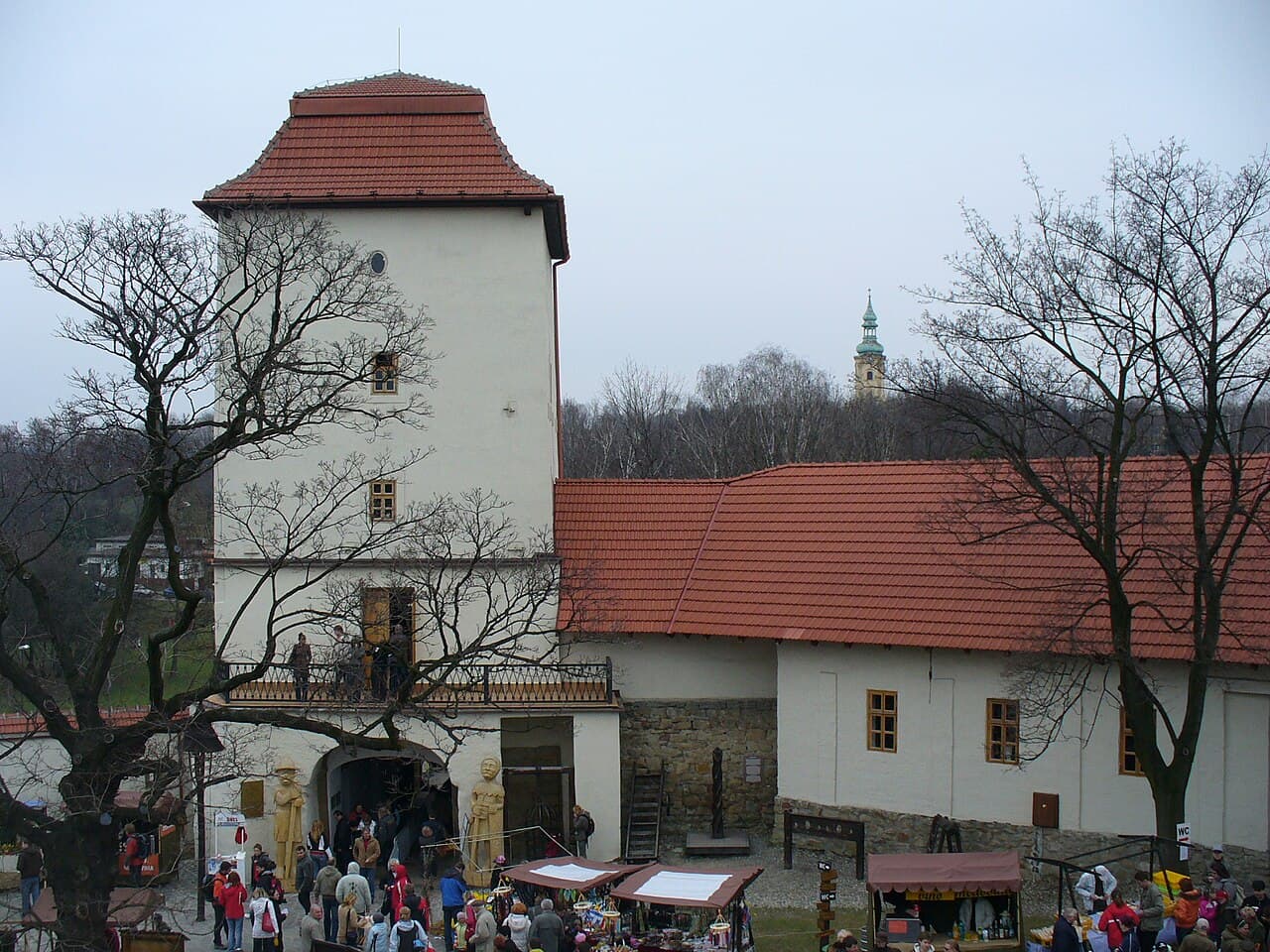
Between 1534 and 1548, under the ownership of Jan Sedlnicky of Choltice, the castle was extensively rebuilt in the Renaissance style. The renovation introduced new buildings arranged in an "L" shape, connected to the original castle at the southeast corner. Defensive features were not only preserved but enhanced, with the construction of large artillery bastions on the western side. A new four-story gate tower with a distinctive tented roof became the castle's most prominent feature, serving as both an entrance and a symbol of status.
The Renaissance remodeling included the addition of a chapel and a knights' hall, which elevated the castle's cultural and residential significance. The newly created courtyard became a central space for social and administrative activities. This period represents the castle's golden age, coinciding with the owner's influential role at the court of the Duke of Cieszyn.
Notable visitors and events
The castle hosted several important historical figures, including Archduchess Anna Habsburg in 1592 during her journey to Krakow to marry King Sigismund III Vasa of Poland. In 1637, Archduchess Cecilia Renata, sister of Emperor Ferdinand III, stayed at the castle en route to her wedding with King Władysław IV Vasa. These visits highlight the castle's prominence in Central European noble and royal networks.
Decline during the thirty years' war and later centuries
The Thirty Years' War (1618-1648) brought devastation to Silesian Ostrava Castle. It was plundered multiple times by various armies, including Neapolitan troops in 1621, Danish forces in 1626, and the army of Albrecht von Wallenstein in 1628. The Swedish occupation from 1642 to 1649 inflicted severe damage, reducing the once splendid Renaissance residence to ruins. Although plans were considered around 1660 to convert the castle into a fortress to defend against Ottoman incursions, these were never realized.
Ownership passed to the wealthy Wilczek family in 1714, who held the property until 1945. During the 18th century, the castle served primarily as an administrative center rather than a residence. The Prussian occupation during the Silesian Wars further impacted the site. In the 19th century, a fire in 1872 caused significant destruction, but some restoration followed. However, the discovery and intensive exploitation of coal deposits beneath the castle led to subsidence of up to 11 meters, causing structural damage and accelerating its decline into ruin.
20th century challenges and restoration efforts
The 20th century saw continued deterioration of the castle. Bombing during World War II in 1944 further damaged the structure. Despite its designation as a cultural monument in 1963, parts of the castle, including the last Gothic bastion, were demolished in 1965 due to safety concerns. For decades, the ruins were neglected and even used as a source of building materials.
In 2001, the city of Ostrava acquired the castle ruins and initiated comprehensive conservation and restoration projects. By 2004, the castle reopened to the public, housing a museum and serving as a venue for cultural events. The Renaissance gate tower remains the best-preserved element, featuring exhibitions that detail the castle's history, the Hussite movement, and the Thirty Years' War. Visitors can also enjoy panoramic views from the tower's upper levels.
Architectural remains and visitor experience
Today, the castle's layout reveals its layered history. The surviving Renaissance gate tower dominates the site, while fragments of the original Gothic walls hint at the medieval fortress beneath. The courtyard contains a well and historically significant structures, including a citadel with a cellar known locally as the "haunted cellar," now hosting freshwater aquariums. Walking paths and interpretive signage guide visitors through the ruins, illustrating the castle's evolution from a border fortress to a Renaissance noble residence.
Access to the castle is facilitated by the Union footbridge from the Černá louka area, making it easily reachable from the city center. Plans for further development aim to enhance visitor facilities while preserving the castle's historical integrity.
Cultural significance and legacy
Silesian Ostrava Castle is a vital cultural landmark reflecting the complex history of Silesia and Moravia. Its architectural evolution from a Gothic fortress to a Renaissance bastioned residence encapsulates broader shifts in military technology, noble lifestyle, and regional politics. The castle's role in significant historical events, including the Hussite Wars, the Thirty Years' War, and royal visits, underscores its importance in Central European history.
Today, the castle serves as a museum and cultural venue, connecting visitors with the rich heritage of Ostrava and the surrounding region. Its preservation exemplifies successful efforts to protect and revitalize historic sites impacted by industrialization and conflict.
Frequently asked questions (FAQ)
- How do I get to Silesian Ostrava Castle?
- Silesian Ostrava Castle is accessible on foot via the Union footbridge from the Černá louka area, located near Ostrava city center. The castle is well-signposted and easy to reach for visitors exploring the city.
- What are the opening hours of the castle museum?
- The castle museum is generally open to visitors daily from 10:00 to 18:00, though hours may vary seasonally. It is advisable to check the official website or local tourist information for the most current visiting times.
- Is there an entrance fee to visit the castle?
- Entrance to the castle grounds and exhibitions typically requires a modest ticket fee, with discounts available for children, students, and seniors. Some cultural events may offer free admission or special pricing.
- What architectural styles are visible at Silesian Ostrava Castle?
- The castle showcases a blend of Gothic and Renaissance architectural styles. The original medieval fortress features thick stone walls and defensive towers, while the Renaissance reconstruction introduced elegant bastions, a grand gate tower, and residential buildings.
- Can I learn about the castle's history during my visit?
- Yes, the castle museum offers detailed exhibitions covering its medieval origins, Renaissance transformation, involvement in historical conflicts like the Hussite Wars and Thirty Years' War, and its restoration journey in the 21st century.
- Is the castle suitable for visitors with limited mobility?
- While some areas of the castle ruins may be challenging due to uneven terrain and stairs, the main gate tower and museum spaces are designed to be as accessible as possible. Visitors with mobility concerns should inquire in advance about specific accommodations.
Photo gallery

Information
Sources & official resources
Verify the information above using these authoritative references.
Loading map...
Visitor reviews
No reviews yet. Been here? Write the first review and help other travelers!
Write the first reviewVisited this castle? Share your experience
Your review helps other travelers and adds first-hand knowledge to our encyclopedia.


