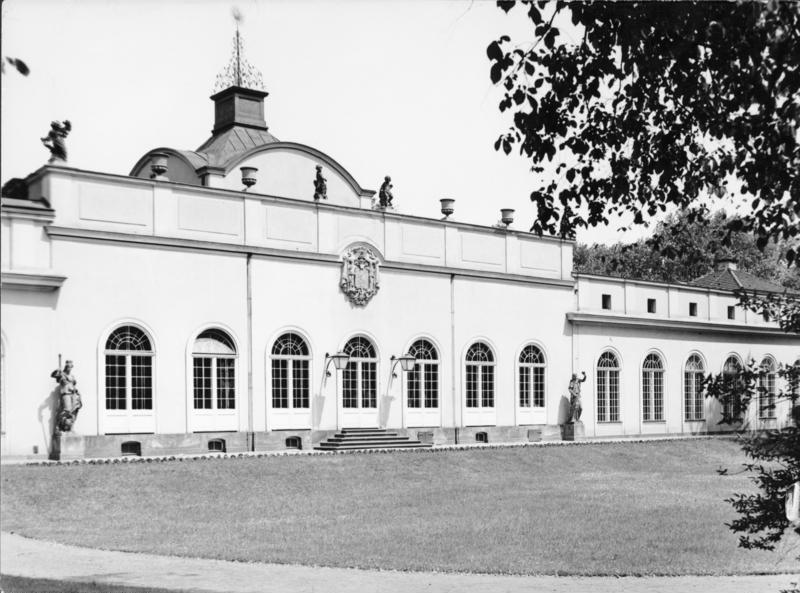
Oranienburg Palace
Oranienburg Palace stands as the oldest Baroque schloss in the Margraviate of Brandenburg, constructed between 1651 and 1655 under the direction of Louise Henriette of Orange-Nassau, the first wife of Frederick William, Elector of Brandenburg. Erected on the site of a former hunting lodge, the palace was designed by the architect Johann Gregor Memhardt. Its external appearance reflects the influence of Dutch classicism, evident in its vertical orientation and the distinctive turrets on the side wings. The palace's extensive gardens were initially intended for the cultivation of trees, ornamental shrubs, flowers, and vegetables, notably introducing crops such as potatoes and cauliflower to the Mark Brandenburg region.
Architectural design and early construction
The original design of Oranienburg Palace showcases the principles of Dutch classicism, a style characterized by restrained ornamentation and balanced proportions. The corps de logis forms the central body of the building, flanked by side wings capped with turrets, creating a vertical emphasis uncommon in the region at the time. The palace's layout was complemented by extensive gardens that served both aesthetic and practical purposes, reflecting the Electress's interest in horticulture and agricultural innovation.
Baroque expansion under frederick i
From 1689, the palace underwent significant enlargement under the patronage of Frederick I, son of Louise Henriette, who favored grandiose architectural styles. Influenced by Italian and French Baroque architecture, the expansion was overseen by the architect Johann Arnold Nering until 1699. Nering transformed the facade of the corps de logis and added two northern rear wings, each culminating in pavilions. These wings were connected by a walk-in arcade, creating a second courtyard and enhancing the palace's spatial complexity. The interior was later enriched by Johann Friedrich Eosander von Göthe, who contributed to the elaborate Baroque decoration and design.
Historical use and ownership through the 18th century
Following the death of Frederick I in 1713, Oranienburg Palace saw a decline in regular use. His son, Frederick William I, visited only occasionally and allocated minimal funds for maintenance. In 1742, Frederick II gifted the estate to his younger brother, Prince Augustus William of Prussia, who resided there until his untimely death in 1758. Augustus William's widow, Luise of Brunswick, continued to use the palace until her death in 1780. Later, in 1794, the palace was presented as a gift to the future Prussian Queen Louise of Mecklenburg-Strelitz, further cementing its royal connections.
19th and 20th century transformations
From 1858 to 1925, Oranienburg Palace was repurposed as a teacher's seminary, marking a shift from royal residence to educational use. In the period 1933 to 1937, the palace served as SS barracks and subsequently as a police academy. The palace suffered damage from bombing during World War II, but its exterior was restored between 1948 and 1954. After a brief occupation by the Red Army, the palace functioned as an officer school for the barracked People's Police from 1952 and later housed the Border Troops of the German Democratic Republic until 1990.
Current status and museum function
Today, Oranienburg Palace is managed by the Prussian Palaces and Gardens Foundation Berlin-Brandenburg and operates as a museum. Visitors can explore numerous valuable objects of Baroque handicrafts and paintings, including artworks directly connected to the castle's history and its former inhabitants. Some exhibits include individual pieces of the original interior, offering insight into the palace's historical grandeur and architectural evolution.
Frequently asked questions (FAQ)
- What is the historical significance of Oranienburg Palace?
- Oranienburg Palace is significant as it was originally built as a summer residence for the House of Orange-Nassau in the 17th century. The palace showcases the transition from Renaissance to Baroque architecture and reflects the rich history of the region.
- When was Oranienburg Palace built?
- Construction of Oranienburg Palace began in 1650 and was completed in 1673. It was commissioned by Sophie von der Leyen, a member of the House of Orange, and has since been a symbol of the area's noble heritage.
- What are the opening hours for Oranienburg Palace?
- Oranienburg Palace is typically open to visitors from Tuesday to Sunday, from 10 AM to 6 PM. However, it is advisable to check the official website for any changes in hours or special holiday openings.
- Can I visit Oranienburg Palace year-round?
- Yes, Oranienburg Palace is open to visitors throughout the year, but certain areas may be closed during winter months for maintenance. It's best to plan your visit during the spring or summer for a more enjoyable experience with the gardens in full bloom.
- Is it possible to take guided tours of Oranienburg Palace?
- Yes, guided tours of Oranienburg Palace are available and provide an in-depth look at its history and architecture. These tours are typically conducted in German, but audio guides in other languages may also be offered.
- What are the ticket prices for entry to Oranienburg Palace?
- The ticket prices for Oranienburg Palace are generally around €8 for adults, with discounts available for students and seniors. Children under 18 years of age can often enter for free, making it a great family destination.
- How do I get to Oranienburg Palace from Berlin?
- Oranienburg Palace is easily accessible from Berlin by train, with direct connections from Berlin Hauptbahnhof to Oranienburg station. The journey takes around 30 minutes, and from the station, it's a short walk to the palace.
- What is the best time to visit Oranienburg Palace?
- The best time to visit Oranienburg Palace is during the spring and summer months when the gardens are in full bloom and various outdoor events take place. Additionally, visiting during weekdays can help you avoid larger crowds.
- Are there any nearby attractions to Oranienburg Palace?
- Yes, nearby attractions include the Sachsenhausen Concentration Camp Memorial and the beautiful gardens of the palace itself. Visitors can also explore the charming town of Oranienburg, which features quaint shops and cafes.
Information
Loading map...
Visitor reviews
No reviews yet. Been here? Write the first review and help other travelers!
Write the first reviewVisited this castle? Share your experience
Your review helps other travelers and adds first-hand knowledge to our encyclopedia.