Charlottenburg Palace
Charlottenburg Palace stands as the largest palace in Berlin and is the only surviving royal residence from the era of the Hohenzollern dynasty in the city. Originally commissioned by Sophie Charlotte, wife of Friedrich III, Elector of Brandenburg, the palace was constructed in what was then the village of Lietzow. Initially named Lietzenburg, the palace was designed by Johann Arnold Nering in the Baroque architectural style. The inauguration of the palace took place on 11 July 1699, coinciding with Friedrich's 42nd birthday.
In 1701, Friedrich crowned himself as King Friedrich I in Prussia. Two years earlier, he had appointed Johann Friedrich von Eosander as the royal architect, sending him to study architectural developments in Italy and France, particularly the Palace of Versailles. Upon his return in 1702, Eosander began extensive extensions to the palace, adding two side wings to enclose a large courtyard and expanding the main palace building on both sides. Following Sophie Charlotte's death in 1705, Friedrich renamed the palace and its estate Charlottenburg in her memory.
Architectural development and expansions
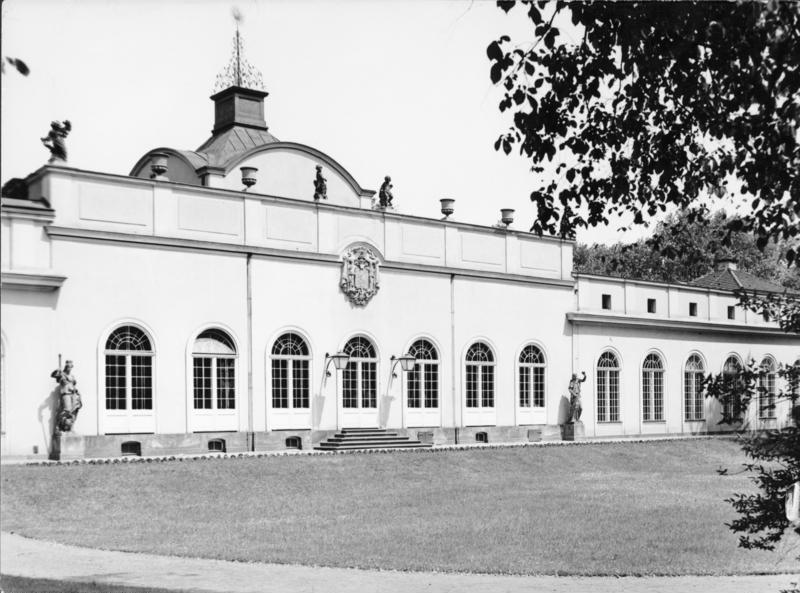
The palace complex underwent significant additions over the following years. The Orangery was constructed to the west of the main building and served originally to overwinter rare plants. During summer, over 500 orange, citrus, and sour orange trees decorated the Baroque garden, and the Orangery became a venue for lavish court festivities.
A notable architectural feature added was the large domed tower with an expansive vestibule. Atop the dome stands a gilded statue representing Fortune, designed by Andreas Heidt. The palace interiors included the famed Amber Room, described as "the eighth wonder of the world," with walls surfaced in decorative amber. Designed by Andreas Schlüter and crafted by Danish amber artisan Gottfried Wolfram starting in 1701, the Amber Room was gifted to Tsar Peter the Great by Friedrich Wilhelm I in 1716.
18th-century enhancements and royal usage
After Friedrich I's death in 1713, his son Friedrich Wilhelm I maintained the palace but had less ambitious building plans. Construction resumed under Friedrich II (Frederick the Great) after he ascended the throne in 1740. That year, stables for his personal guard regiment were completed south of the Orangery wing, and work began on the east wing under the supervision of Georg Wenzeslaus von Knobelsdorff, Superintendent of all Royal Palaces. Knobelsdorff largely followed Eosander's design, creating a relatively simple exterior contrasted by lavish interior furnishings.
The ground floor of the east wing was intended for Frederick's wife, Elisabeth Christine, who preferred Schönhausen Palace and was only an occasional visitor. The upper floor featured richly decorated rooms such as the White Hall, Banqueting Hall, Throne Room, and Golden Gallery, mainly designed by Johann August Nahl. In 1747, a second apartment for the king was prepared in the eastern part of the wing. During this period, Frederick was primarily resident at Sanssouci Palace in Potsdam, visiting Charlottenburg occasionally.
Later royal residents and modifications
Friedrich Wilhelm II, who succeeded in 1786, transformed several rooms on the ground floor of the east wing into his summer quarters and part of the upper floor into Winter Chambers, though he did not live to use them extensively. His son, Friedrich Wilhelm III, reigned from 1797 alongside his wife, Queen Luise, spending much time in the east wing. Their eldest son, Friedrich Wilhelm IV, lived in the upper storey of the central palace building during his reign from 1840 to 1861. The last royal resident was Friedrich III, who reigned briefly in 1888.
Damage, restoration, and modern status
The palace suffered severe damage during World War II, particularly in 1943. After the war, there were concerns it might be demolished, as happened with the nearby Stadtschloss in East Berlin in 1951. Thanks to the efforts of Margarete Kühn, Director of the State Palaces and Gardens, Charlottenburg Palace was restored to its former glory. The restoration included modern ceiling paintings by Hann Trier that blend with the historic interiors.
Gardens and landscape design
The Baroque garden was designed in 1697 by Simeon Godeau, influenced by André Le Nôtre, the famed designer of Versailles gardens. The original layout featured geometric patterns with avenues and moats that separated the formal gardens from the surrounding landscape. Beyond the formal gardens lies the Carp Pond.
In the late 18th century, the garden was redesigned in the English landscape style by Georg Steiner under the direction of Peter Joseph Lenné for Friedrich Wilhelm II, reflecting changing tastes towards more naturalistic garden designs. After World War II, the central garden area was restored to its original Baroque style, preserving the palace's historic character.
Architectural significance and cultural heritage
Charlottenburg Palace is a prime example of Baroque palace architecture in Germany, showcasing the transition from a modest summer residence to a grand royal palace. Its architectural evolution reflects the tastes and ambitions of the Hohenzollern rulers over more than a century. The palace's interiors, including the now-lost Amber Room, and its extensive gardens, demonstrate the blending of artistic, cultural, and political aspirations during the 17th and 18th centuries.
Today, Charlottenburg Palace serves as a museum and cultural venue, attracting visitors interested in Prussian history, royal architecture, and historic gardens. Its survival through war and restoration efforts underscores its importance as a heritage landmark in Berlin.
Frequently asked questions (FAQ)
- What is Charlottenburg Palace known for?
- Charlottenburg Palace is renowned for its stunning baroque architecture and beautiful gardens. It serves as a significant historical site in Berlin, showcasing the opulence of Prussian royalty and housing an impressive collection of art and artifacts.
- When was Charlottenburg Palace built?
- Construction of Charlottenburg Palace began in 1695 and continued over several decades, with significant expansions in the 18th century. It was originally designed as a summer residence for Sophie Charlotte, the wife of Frederick I of Prussia.
- How do I get to Charlottenburg Palace?
- Charlottenburg Palace is easily accessible via public transport, with several nearby U-Bahn and S-Bahn stations. Visitors can also reach the palace by bus or enjoy a leisurely walk from nearby attractions.
- What are the opening hours for Charlottenburg Palace?
- Charlottenburg Palace typically opens daily from 10 AM to 5 PM, with extended hours during the summer months. It's advisable to check the official website for any seasonal changes or special events that may affect visiting hours.
- Can I take photographs inside Charlottenburg Palace?
- Photography is generally permitted in the gardens and some public areas of Charlottenburg Palace. However, in certain exhibition rooms and galleries, flash photography and tripods may be restricted to preserve the artworks.
- Is it possible to visit the gardens of Charlottenburg Palace?
- Yes, the gardens of Charlottenburg Palace are open to the public and are a beautiful area to explore. The gardens feature baroque design elements, fountains, and sculptures, making them a perfect spot for leisurely strolls.
- What are the ticket prices for Charlottenburg Palace?
- Ticket prices for Charlottenburg Palace vary depending on the type of access you choose, with reduced rates available for students and seniors. It's best to purchase tickets online in advance to avoid long queues at the entrance.
- When is the best time to visit Charlottenburg Palace?
- The best time to visit Charlottenburg Palace is during the spring and summer months when the gardens are in full bloom. However, visiting during weekdays can help you avoid larger crowds typically seen on weekends.
- Are there any nearby attractions to Charlottenburg Palace?
- Yes, there are several nearby attractions including the Berlin Zoo, the Kaiser Wilhelm Memorial Church, and the Museum of Prehistory and Early History. These sites can enhance your visit to the area and provide a deeper insight into Berlin's rich history.
Information
Loading map...
Visitor reviews
No reviews yet. Been here? Write the first review and help other travelers!
Write the first reviewVisited this castle? Share your experience
Your review helps other travelers and adds first-hand knowledge to our encyclopedia.