
Olhain Castle
Olhain Castle, also known as Château d'Olhain, is a remarkable example of a medieval water castle located in the village of Olhain, within the Pas-de-Calais department in the historic province of Artois, northern France. Surrounded by a lake and moats, this castle's picturesque setting and well-preserved structures make it a significant heritage site in the Hauts-de-France region.
The castle's origins trace back to the early 13th century, when Hugues d'Olhain, a nobleman and captain in the Fourth Crusade, established the initial fortress. Hugues notably participated in the fall of Constantinople in 1204, linking the castle's early history to major medieval events. The original structure was primarily a defensive stronghold designed to control the surrounding territory.
In 1387, the lordship passed to Jean de Nielles by marriage to Marie d'Olhain. Around 1400, following damage sustained during the Hundred Years' War, Jean and Marie undertook a significant rebuilding project that shaped the castle's current form. Jean de Nielles served as treasurer to John the Fearless, Duke of Burgundy, reflecting the castle's importance within Burgundian domains.
Medieval architecture and defensive features
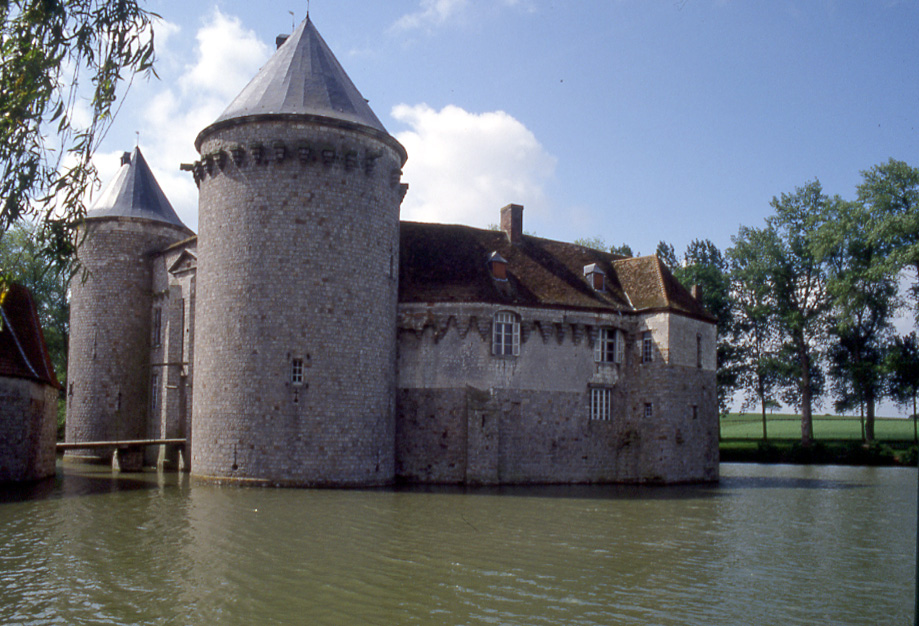
Olhain Castle is characterized by its circular plan and its unique location on an artificial island within a lake, classifying it as a water castle. The castle is connected to a partially moated circular outer bailey by a drawbridge, emphasizing its defensive design.
The main citadel is protected by two imposing round towers with conical tiled roofs. The tallest tower, reaching approximately 30 meters, served as a stair tower and lookout, providing panoramic views of the surrounding landscape. The castle's curtain walls and battlements were constructed to withstand sieges and artillery attacks, common in its turbulent history.
The outer bailey contains essential service buildings such as storerooms, a smithy, a bakery, and stables, enclosed by fortified stone walls. Originally, access to both the citadel and bailey was controlled by drawbridges, which enhanced the castle's security. Some of the moats have been partially filled over time, but the water features remain a defining element.
Historical significance and ownership
The castle's ownership history reflects the complex political and religious shifts in the region. After the marriage of Alix de Nielles to Jean I de Berghes in the early 15th century, the castle passed to the Berghes-Saint-Winock family, who retained it for over 450 years until its sale in 1900.
During the 17th century, the Berghes family converted to Protestantism while the region was under the Spanish Netherlands. This religious change led to tensions, as Protestantism was not tolerated by the Spanish Crown. Consequently, the family was forced to leave the castle.
The castle endured multiple sieges and military actions. In 1641, Spanish troops occupied the castle but were massacred after a surprise attack by French forces from nearby Arras. In 1654, during the Battle of Arras, Spanish forces besieged the castle and destroyed one of its towers, which once stood on the terrace overlooking the lake to the west.
In 1710, during the War of the Spanish Succession, troops of the Grand Alliance, led by the Dutch, besieged nearby Béthune and inflicted artillery damage on Olhain Castle.
Later history and restoration
In the 19th century, the Berghes-Saint-Winock family returned to the castle and carried out restoration work, including the construction of a chapel in the southeast tower. However, after 1870, the family relocated to Rânes Castle in Normandy, and Olhain was eventually sold in 1900.
During both World Wars, the castle was requisitioned by military forces—first by French troops, then by Canadian and British soldiers—highlighting its ongoing strategic importance. Despite these occupations, the castle survived with only minor damage.
Since the 20th century, the castle has been privately owned by the Dutoit family, who have undertaken extensive restoration to preserve its historical integrity. The Château d'Olhain was officially designated as a French historical monument on 12 April 1989, ensuring its protection and recognition.
Archaeological discoveries and cultural heritage
In 2021, archaeologists uncovered a Neolithic fortified site near Olhain Castle, dating back approximately 6,000 years. This ancient enclosure features three earthen ramparts and ditches spanning roughly 500 meters, underscoring the area's long-standing strategic significance well before the medieval period.
Architectural details and notable features
The castle complex consists of two main sections on separate artificial islands surrounded by moats. The smaller island hosts the main citadel with noble residences, while the larger island accommodates the outer bailey with service buildings.
The citadel's entrance on the east side is guarded by two robust round towers with conical roofs. The tallest tower, about 30 meters high, served as a lookout and stair tower. Although the residential building enclosing the inner courtyard on the west side no longer exists, the remaining structures vividly illustrate the castle's layout.
The outer bailey is enclosed by fortified stone walls and contains storerooms, a smithy, bakery, stables, and other outbuildings. Historically, drawbridges provided access to both islands, enhancing defense. Some moats have been partially filled, but water remains a key defensive feature.
Defensive elements include curtain walls, round towers, and battlements. Several artillery pieces called couleuvrines, dating from the Spanish attacks, are preserved on site. The castle kitchens are located in vaulted cellars built atop earlier Merovingian walls, indicating layers of historical construction beneath the medieval fabric.
Additional features include a 19th-century chapel in the southeast tower, a historic bakery, and a guardroom with a large sandstone fireplace bearing the Berghes-Saint-Winock family coat of arms depicting a lion. The prominent watchtower remains an iconic element of the castle's silhouette.
The moat surrounding the castle is partially filled with water and silted in places. Two bridges cross the moat: one leading to the outer bailey and another connecting the bailey to the main castle, preceded by a gatehouse. One wing of the castle facing the widest part of the moat, approximately 80 meters across, was demolished at an unknown date.
Thanks to ongoing maintenance and restoration, Olhain Castle remains well preserved, offering visitors a clear understanding of its historical layout, architectural features, and defensive mechanisms. Its picturesque setting and rich history make it a notable destination for those interested in medieval architecture and French heritage.
Visiting olhain castle
Today, Olhain Castle is privately owned but open to visitors for guided tours on Sunday afternoons from April to November. The castle's unique water setting, well-preserved structures, and historical significance make it a popular attraction in the Hauts-de-France region.
Visitors can explore the castle's towers, curtain walls, chapel, and other historic buildings while learning about its role in regional history, including its connections to the Hundred Years' War, religious conflicts, and European wars of succession.
The castle's location near Arras and Béthune also allows visitors to combine their visit with other historic sites in the area, enhancing their cultural experience of northern France.
Frequently asked questions (FAQ)
- When was Olhain Castle originally built and by whom?
- Olhain Castle was originally built in the early 13th century by Hugues d'Olhain, a captain in the Fourth Crusade who participated in the fall of Constantinople in 1204.
- What architectural style characterizes Olhain Castle?
- Olhain Castle is a medieval water castle with a circular plan, featuring round towers with conical roofs, curtain walls, and defensive moats typical of high medieval fortifications.
- Can visitors tour Olhain Castle?
- Yes, Olhain Castle is privately owned but open to visitors for guided tours on Sunday afternoons from April to November.
- What significant historical events affected Olhain Castle?
- The castle was damaged during the Hundred Years' War, besieged in 1641 and 1654 during conflicts involving French and Spanish forces, and damaged again in 1710 during the War of the Spanish Succession.
- What are some notable features of the castle's defenses?
- Notable defensive features include its location on an artificial island surrounded by moats, drawbridges, curtain walls, round towers, battlements, and preserved artillery pieces called couleuvrines from the 17th century.

Information
Opening hours
Sunday afternoons, April to November
Current owner
Private owner
Website
Visit websiteAddress
19 Rue Léo Lagrange, France
Sources & official resources
Verify the information above using these authoritative references.
Loading map...
Visitor reviews
No reviews yet. Been here? Write the first review and help other travelers!
Write the first reviewVisited this castle? Share your experience
Your review helps other travelers and adds first-hand knowledge to our encyclopedia.