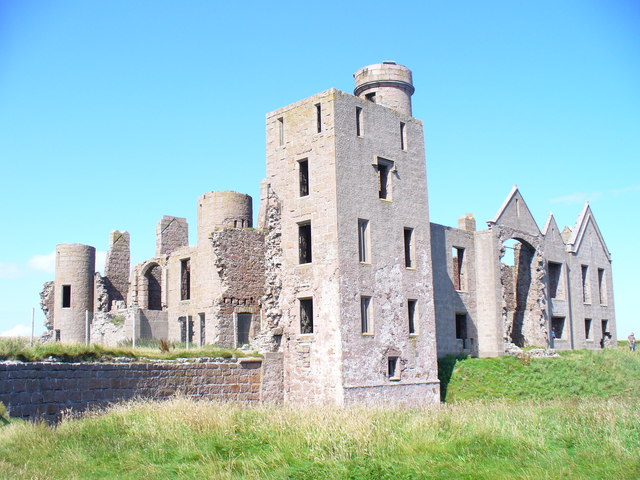
Old Slains Castle
Old Slains Castle is a striking example of a medieval hill castle located near Collieston in Aberdeenshire, Scotland. Dating back to the 13th century, it was originally established as a stronghold for the powerful Comyn family, who were the Earls of Buchan. The castle's strategic position on a narrow rocky peninsula overlooking the North Sea provided both defense and control over the surrounding lands. Its rich history reflects the turbulent medieval period in Scotland, marked by shifting allegiances, royal conflicts, and religious upheaval.
The castle was granted to Sir Gilbert Hay by Robert the Bruce in the 14th century after the forfeiture of the Comyns, cementing the Hay family's long association with the site. The Hays were elevated to the peerage as the Earls of Erroll in the 15th century, with Old Slains Castle serving as their principal seat. The castle witnessed significant historical events, including its occupation by a royal garrison under James VI in 1589 and its destruction in 1594 following the rebellion led by Francis Hay, 9th Earl of Erroll.
Historical background and ownership
Constructed in the 13th century, Old Slains Castle began as a stronghold for the Comyn family, one of Scotland's most influential noble families during the High Medieval period. The Comyns' power waned following their defeat and forfeiture in the early 14th century during the Wars of Scottish Independence. In recognition of his support against the English, Robert the Bruce granted the castle to Sir Gilbert Hay, marking a significant transfer of power and property.
By 1453, the Hay family had been ennobled as the Earls of Erroll, with Old Slains Castle becoming their main residence. The castle's history in the late 16th century is closely tied to the religious and political conflicts of the era. Francis Hay, 9th Earl of Erroll, converted to Catholicism and became involved in conspiracies against the Protestant Scottish crown, including the Spanish Blanks plot and the Battle of Glenlivet in 1594.
In response to these threats, James VI stationed a royal garrison at the castle in 1589 to maintain control. After the rebellion was crushed, the king ordered the castle's destruction on November 1, 1594. The demolition was carried out with gunpowder and cannon, overseen by the stonemason John Fraser and supported by the Aberdeen town council.
Despite restoration efforts led by Elizabeth Douglas, Countess of Erroll in 1595, the damage was too extensive to repair. The family eventually abandoned Old Slains Castle, building New Slains Castle near Cruden Bay on the site of the former Bowness Castle.
Architectural features and layout
Old Slains Castle was originally a formidable fortress, characterized by a five-storey oblong keep constructed on a narrow rocky peninsula. Its location provided natural defense, with steep cliffs on the seaward side and a dry moat separating the castle from the mainland to protect against landward attacks. The dry moat was a significant defensive feature, acting as a barrier to invading forces.
In the early 16th century, a defensive curtain wall was added to further strengthen the castle's landward defenses. This wall enclosed the keep and created a fortified courtyard, enhancing the castle's resilience against siege warfare. The castle's design reflects typical medieval military architecture, balancing residential needs with defensive capabilities.
Today, only two sections of the castle's walls remain standing, reaching heights of approximately 25 meters (82 feet). These surviving walls offer valuable insight into the castle's original scale and construction techniques. The partial collapse of the south-facing wall in 1979 dramatically altered the ruins, with around 100 tons of rubble falling onto the road below.
In the 1950s, a three-storey house was constructed within the castle ruins, adjoining an 18th-century fishing cottage. This later development illustrates the site's continued use and adaptation beyond its medieval origins.
Archaeological investigations and preservation
Since 1991, Old Slains Castle has been the focus of several archaeological excavations aimed at documenting and understanding its historical and architectural significance. These investigations have shed light on the castle's layout, construction phases, and the lifestyle of its inhabitants. Further digs in 2007 continued to enhance knowledge of the site.
The ruins are protected as a scheduled monument, ensuring their preservation for future generations. The site remains an important cultural heritage landmark in Aberdeenshire, attracting historians, archaeologists, and visitors interested in Scotland's medieval past.
Legacy and cultural significance
Old Slains Castle stands as a testament to the complex history of medieval Scotland, reflecting the era's political struggles, religious conflicts, and architectural advancements. Its association with prominent families such as the Comyns and the Earls of Erroll highlights its importance in Scottish noble history.
The castle's dramatic destruction and subsequent abandonment illustrate the consequences of political rebellion during the reign of James VI. Its ruins continue to inspire interest and research, contributing to a broader understanding of Scotland's feudal heritage and medieval fortifications.
Visitors to the site can explore the remains of the imposing walls and moat, gaining a tangible connection to Scotland's past. The castle's coastal setting also offers scenic views of the North Sea, enhancing its appeal as a historic and natural landmark.
Frequently asked questions (FAQ)
- What is the historical significance of Old Slains Castle?
- Old Slains Castle was a key stronghold for the Comyn family and later the Earls of Erroll, reflecting Scotland's medieval noble history and political conflicts.
- When was Old Slains Castle destroyed and why?
- The castle was destroyed in 1594 by order of King James VI after a rebellion led by Francis Hay, 9th Earl of Erroll, who opposed the Protestant crown.
- Can visitors access the ruins of Old Slains Castle today?
- Yes, the ruins are accessible to the public as a scheduled monument, offering views of the surviving walls and the surrounding coastal landscape.
- What architectural features remain at Old Slains Castle?
- Surviving features include two tall sections of the original walls, remnants of the dry moat, and evidence of the five-storey oblong keep and defensive curtain wall.
- Are there any archaeological excavations at Old Slains Castle?
- Archaeological digs have been conducted since 1991, uncovering details about the castle's layout, construction, and history.
Information
Website
Visit websiteSources & official resources
Verify the information above using these authoritative references.
Loading map...
Visitor reviews
No reviews yet. Been here? Write the first review and help other travelers!
Write the first reviewVisited this castle? Share your experience
Your review helps other travelers and adds first-hand knowledge to our encyclopedia.