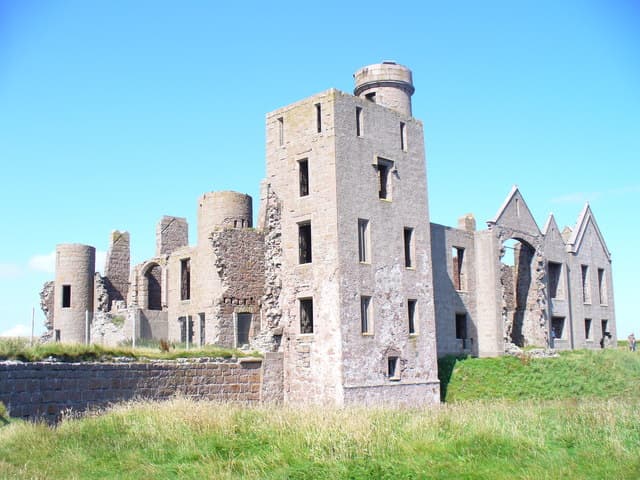
New Slains Castle
New Slains Castle, also known simply as Slains Castle, is a striking ruined fortress perched dramatically on the cliffs overlooking the North Sea near Cruden Bay in Aberdeenshire, Scotland. This imposing structure, visible from miles around, embodies centuries of Scottish history, architectural evolution, and cultural significance. Originally constructed in the late 16th century as a tower house by Francis Hay, 9th Earl of Erroll, the castle was extensively expanded and remodeled over the following centuries, culminating in a grand Scots Baronial mansion in the 1830s. Despite its current ruined and roofless state, New Slains Castle remains an evocative symbol of Scottish nobility and heritage, as well as a source of literary inspiration.
The site of New Slains Castle is intimately connected to the powerful Clan Hay, who held the lands and title of the Earls of Erroll since the 14th century. The original family seat was Old Slains Castle, located some 8 kilometres to the southwest near Collieston. However, after the destruction of Old Slains by royal order in 1594 due to the rebellious actions of the 9th Earl, Francis Hay, a new residence was commissioned on the cliff edge east of Cruden Bay. This new fortress, initially called Bowness, was built around 1597 and later became known as New Slains Castle to distinguish it from its predecessor.
Early history and political significance
The castle's foundation is deeply rooted in the turbulent religious and political conflicts of late 16th-century Scotland. Francis Hay's conversion to Roman Catholicism and involvement in conspiracies such as the Spanish Blanks rebellion led to his outlawry and the destruction of Old Slains Castle by order of King James VI. After renouncing Catholicism and regaining royal favor in 1597, Hay established New Slains Castle as his new seat of power.
During the 17th and early 18th centuries, the castle underwent significant modifications reflecting both defensive needs and residential comfort. The wings around the central courtyard were extended in 1664, including the addition of a gallery or corridor, and the main entrance front was renewed in 1707. The castle also played a role in the Jacobite uprisings, with several Countesses of Erroll actively supporting the cause, making New Slains a hub of Jacobite sympathies. Notably, Lady Catherine Carnegie participated in the 1689 rising, and Lady Anne Drummond hosted the French agent Nathaniel Hooke. The castle was even considered as a landing site during the planned 1708 French-Jacobite invasion of Scotland.
19th-century remodeling and gardens
The 19th century brought a dramatic transformation to New Slains Castle under the direction of William Hay, 18th Earl of Erroll, who married Lady Elizabeth FitzClarence, an illegitimate daughter of King William IV. Seeking to modernize and enhance the family seat, the Earl commissioned the prominent Aberdeen architect John Smith to remodel the castle in the Scots Baronial style during 1836–1837. This renovation involved a near-complete rebuilding, including the application of smooth granite facings that contrasted with the older rougher masonry, and the addition of characteristic turrets and ornamental details emblematic of the style.
Later in the century, the castle's extensive gardens were laid out by the renowned landscape architect T. H. Mawson in the late 1890s. These gardens, once comprising three large sections, complemented the grandeur of the castle and reflected Victorian tastes for formal landscaping and picturesque natural settings.
Architectural features and defensive elements
New Slains Castle is architecturally complex, reflecting its long history of construction phases and styles. The core is a late 16th-century square tower house, surrounded by wings added in the 17th century that form a courtyard. The addition of a gallery corridor in 1664 connected various parts of the castle, blending residential and defensive functions.
The castle's masonry is varied, including rough mortared granite, medieval red brick, sandstone, and later granite facings from the 19th-century renovations. This mixture creates a visually rich fabric that tells the story of its architectural evolution. Defensive features include the use of the natural North Sea cliffs as a formidable barrier on the western side, a deep chasm functioning as an impassable moat, and a ruined rampart protecting the southern main entrance.
The ruins today preserve three- and four-story sections of the castle, with partial basements particularly intact on the eastern side. The basement kitchens contain multiple firepits and brick-lined storage spaces, offering insight into the castle's domestic operations during its peak occupancy. Inside, well-preserved wooden lintels and sandstone and brick archways mark doorways, while the ground floor comprises a maze of small rooms and passageways indicative of dense habitation and complex functional use in the 17th century.
Literary connections and cultural significance
New Slains Castle is famously linked with the Irish author Bram Stoker, who frequently visited nearby Cruden Bay between 1893 and 1910. The castle appears in his novels The Watter's Mou' and The Mystery of the Sea, and it is widely believed to have inspired elements of his most famous work, Dracula. The castle's distinctive octagonal hall is thought to have influenced the depiction of the octagonal room in Castle Dracula, lending the ruin a unique place in literary history.
In addition to its literary associations, New Slains Castle served as a summer retreat for notable figures such as Robert Baden-Powell, Prime Minister H. H. Asquith, and Winston Churchill, underscoring its status as a prominent aristocratic residence in the late 19th and early 20th centuries.
Decline and preservation efforts
After over 300 years of continuous ownership by the Hay family, the castle was sold in 1916 by the 20th Earl of Erroll. It changed hands several times before being acquired by a demolition company in 1925. That year, the roof was removed, likely to avoid property taxes or to salvage materials, which accelerated the castle's deterioration into the roofless ruin seen today.
Despite its ruinous condition, most of the castle's outer and inner walls remain standing to near full height, allowing visitors to appreciate the scale and complexity of the original structure. Many architectural elements, including battens, flooring, roof slates, doors, window fittings, and granite window sills, were removed and sold off during the early 20th century, contributing to its current state.
In the early 2000s, plans emerged to restore New Slains Castle and convert it into holiday apartments. Outline planning permission was granted in 2007, but these efforts were halted in 2009 due to economic challenges. The castle was designated a Category B listed building by Historic Environment Scotland in 2018, recognizing its historical and architectural significance and ensuring its protection.
Today, New Slains Castle stands as a fascinating ruin that offers a tangible connection to Scotland's noble past, architectural heritage, and cultural legacy. Its cliff-top location provides spectacular views of the North Sea, while its layered construction offers a rich narrative of changing styles, political intrigue, and social history spanning over four centuries.
Frequently asked questions (FAQ)
- How do I get to New Slains Castle?
- New Slains Castle is located in Aberdeenshire, Scotland, near the village of Cruden Bay. It is accessible by car, with parking available nearby, and is also reachable by public transport via local buses. The castle is situated approximately 20 miles from Aberdeen, making it an easy day trip for visitors.
- What is the historical significance of New Slains Castle?
- New Slains Castle has a rich history dating back to the 16th century and is associated with the Gordon family. It is famously linked to Bram Stoker, the author of "Dracula," who found inspiration for his novel while visiting the castle. The ruins tell the story of Scotland's turbulent past and showcase its architectural evolution over the centuries.
- When was New Slains Castle built?
- Construction of New Slains Castle began in the late 1500s, with major renovations occurring in the 19th century. The castle was originally designed as a fortress but later transformed into a grand residence. Although it has been in ruins since the early 20th century, its historical architecture remains a significant attraction.
- Can I explore the ruins of New Slains Castle?
- Yes, visitors are welcome to explore the ruins of New Slains Castle. While there are no formal guided tours, the site is open to the public, allowing guests to wander through the remnants and enjoy stunning views of the North Sea. However, it is important to exercise caution as some areas may be unstable.
- Why is New Slains Castle a popular tourist destination?
- New Slains Castle attracts visitors due to its dramatic coastal location and rich literary connections. The picturesque ruins set against the backdrop of the sea provide excellent photographic opportunities. Additionally, the castle's intriguing history and association with "Dracula" add to its allure for history and literature enthusiasts.
- Is it possible to hold events at New Slains Castle?
- While New Slains Castle itself is primarily a historical ruin, nearby venues may host events and gatherings inspired by the castle's romantic setting. It's advisable to contact local event planners for options that incorporate the castle's backdrop into your celebrations. Many visitors come to the area for weddings and photoshoots due to the castle's enchanting atmosphere.
- What are the opening hours for New Slains Castle?
- New Slains Castle is generally open year-round, but access may vary depending on weather conditions and local regulations. There are no official opening hours as it is a ruin, allowing visitors to explore at their convenience. However, it’s best to check local resources or visitor centers for any updates before your trip.
- What is the best time to visit New Slains Castle?
- The best time to visit New Slains Castle is during the late spring and summer months when the weather is typically mild and the surrounding scenery is lush. This allows for comfortable exploration and stunning coastal views. Fall can also be a beautiful time to visit, with vibrant autumn colors enhancing the landscape.
- Are there any nearby attractions to visit?
- Yes, there are several attractions near New Slains Castle, including the picturesque village of Cruden Bay and the nearby Slains Castle Golf Club. Visitors can also explore the stunning coastal paths and the local beaches. Additionally, the historic town of Peterhead and the Bullers of Buchan are within a short drive, offering more opportunities for adventure.
- What are the ticket prices for visiting New Slains Castle?
- There are no ticket prices for visiting New Slains Castle, as it is a public ruin without formal entry fees. Visitors can explore the site freely, but donations to local preservation efforts are always appreciated. It's a wonderful opportunity to enjoy Scotland's history without the cost of admission.
Photo gallery

Information
Website
Visit websiteSources & official resources
Verify the information above using these authoritative references.
Loading map...
Visitor reviews
No reviews yet. Been here? Write the first review and help other travelers!
Write the first reviewVisited this castle? Share your experience
Your review helps other travelers and adds first-hand knowledge to our encyclopedia.


