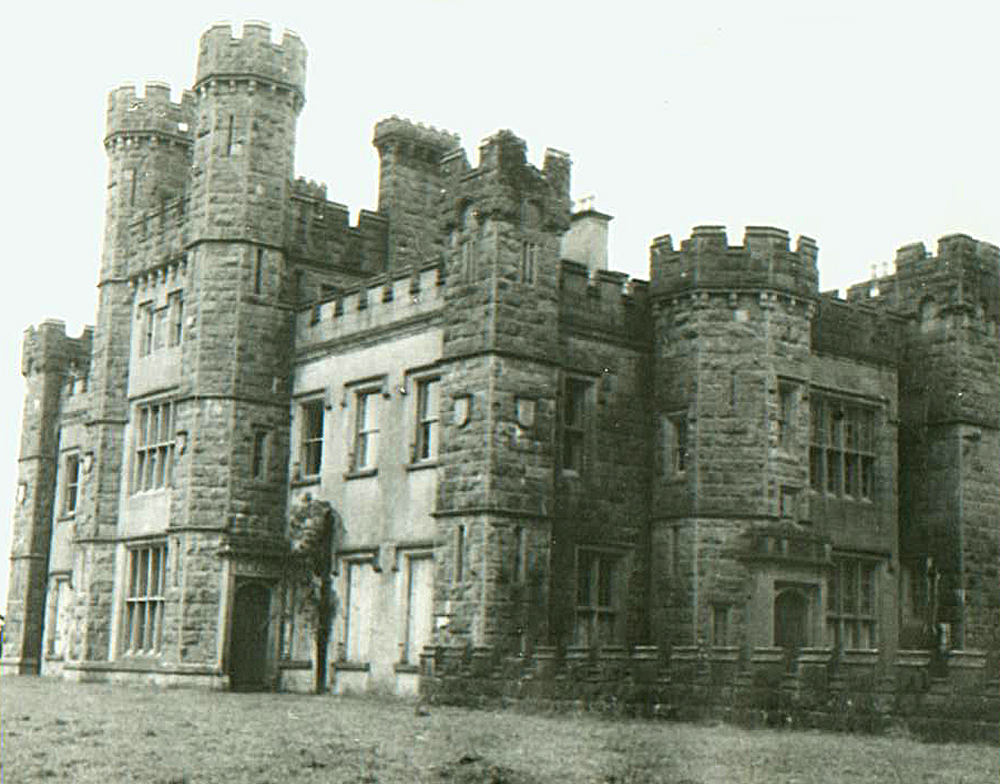
Old Crom Castle
Old Crom Castle, located on the east bank of Upper Lough Erne near Newtownbutler in County Fermanagh, Northern Ireland, is a significant example of an early 17th-century Renaissance tower house with a bawn and defensive round flankers. Built in 1611 by the Scottish planter Michael Balfour, it reflects the plantation-era architecture introduced during the colonization of Ulster. This castle is distinct from the later 19th-century Victorian Crom Castle, which stands some distance to the north.
Construction and early history
The castle was originally constructed as a fortified residence typical of the plantation period. Its design as a tower house with an enclosing bawn and round flankers provided both domestic accommodation and defensive capabilities. In 1619, ownership passed to Sir Stephen Butler, a notable figure in the region. By 1655, the estate had transferred to Abraham Crichton of Aghalane through marriage to the daughter of the previous tenant, the Bishop of Clogher, marking the start of the Crichton family's long association with the property.
Sieges and survival during the 17th century
Old Crom Castle endured two attacks during the turbulent period of the Jacobite wars in 1689. Its robust defensive features allowed it to withstand these sieges, underscoring the strategic importance of the castle in the region during this era of conflict.
Destruction by fire and subsequent changes
In 1764, the castle suffered a devastating fire that gutted the tower house. According to local tradition, the fire was discovered by Abraham Crichton as he returned by boat, alerted by a glow on the horizon. The Crichtons were away at a housewarming party at Florence Court when the accident occurred. Following this event, the castle was left in ruins.
Romantic restoration and the new Crom Castle
In 1820, the Crichton family constructed a new Victorian-style Crom Castle further north, reflecting the architectural tastes of the 19th century. The ruins of the Old Crom Castle were retained as a picturesque garden feature. Later in the 19th century, additional walls and towers were added to the ruins to enhance their romantic, gothic appeal, a common landscaping trend of the period that celebrated medieval ruins as ornamental elements.
Unique features and estate landmarks
Opposite the ruins on Gad Island in the lough stands a distinctive round tower. Although it appears medieval, this structure is a stone folly built around 1847 as a famine relief project and served as an observatory, illustrating the estate's layered history beyond the castle itself.
Current status and visitor information
Today, Old Crom Castle remains private property of the Crichton family, while the surrounding estate and the castle ruins are managed by the National Trust. Visitors can freely explore the estate and the tranquil ruins during daytime hours. The site offers a peaceful setting to appreciate the remains of a Renaissance tower house and the estate's historical landscape.
Architectural significance
The castle exemplifies the plantation-era architecture of early 17th-century Ulster, combining defensive features like the bawn and round flankers with the residential function of a tower house. Its later transformation into a romantic ruin reflects changing attitudes towards medieval architecture during the Victorian period, when ruins were often enhanced for aesthetic purposes.
Historical context
Built during the early phase of the Ulster Plantation, Old Crom Castle represents the Scottish and English efforts to establish control over Ulster through fortified settlements. Its survival through the Jacobite conflicts highlights its military and strategic value. The castle's destruction by fire and subsequent replacement with a Victorian mansion illustrate the evolution of aristocratic residences in Ireland from fortified homes to country houses.
Frequently asked questions (FAQ)
- How do I visit Old Crom Castle and its estate?
- Old Crom Castle and the surrounding Crom Estate are managed by the National Trust and open to the public during daytime hours daily. Visitors can explore the castle ruins and estate grounds free of charge.
- What is the historical significance of Old Crom Castle?
- Old Crom Castle is a notable example of a 17th-century Renaissance tower house built during the Ulster Plantation. It withstood attacks during the Jacobite wars and reflects the region's colonial and military history.
- When was Old Crom Castle built and by whom?
- Old Crom Castle was built in 1611 by Scottish planter Michael Balfour as a fortified tower house with a bawn and round flankers.
- Can I see the round tower on Gad Island?
- Yes, the round tower on Gad Island opposite the Old Crom Castle ruins is visible from the estate. It is a 19th-century stone folly built as a famine relief project and observatory, not a medieval structure.
- Is there a newer Crom Castle nearby?
- Yes, a new Victorian-style Crom Castle was built in 1820 by the Crichton family north of the Old Castle ruins. The new castle remains a private residence.
Information
Opening hours
Daytime, daily
Ticket prices
Free
Current owner
Private owner
Loading map...
Visitor reviews
No reviews yet. Been here? Write the first review and help other travelers!
Write the first reviewVisited this castle? Share your experience
Your review helps other travelers and adds first-hand knowledge to our encyclopedia.