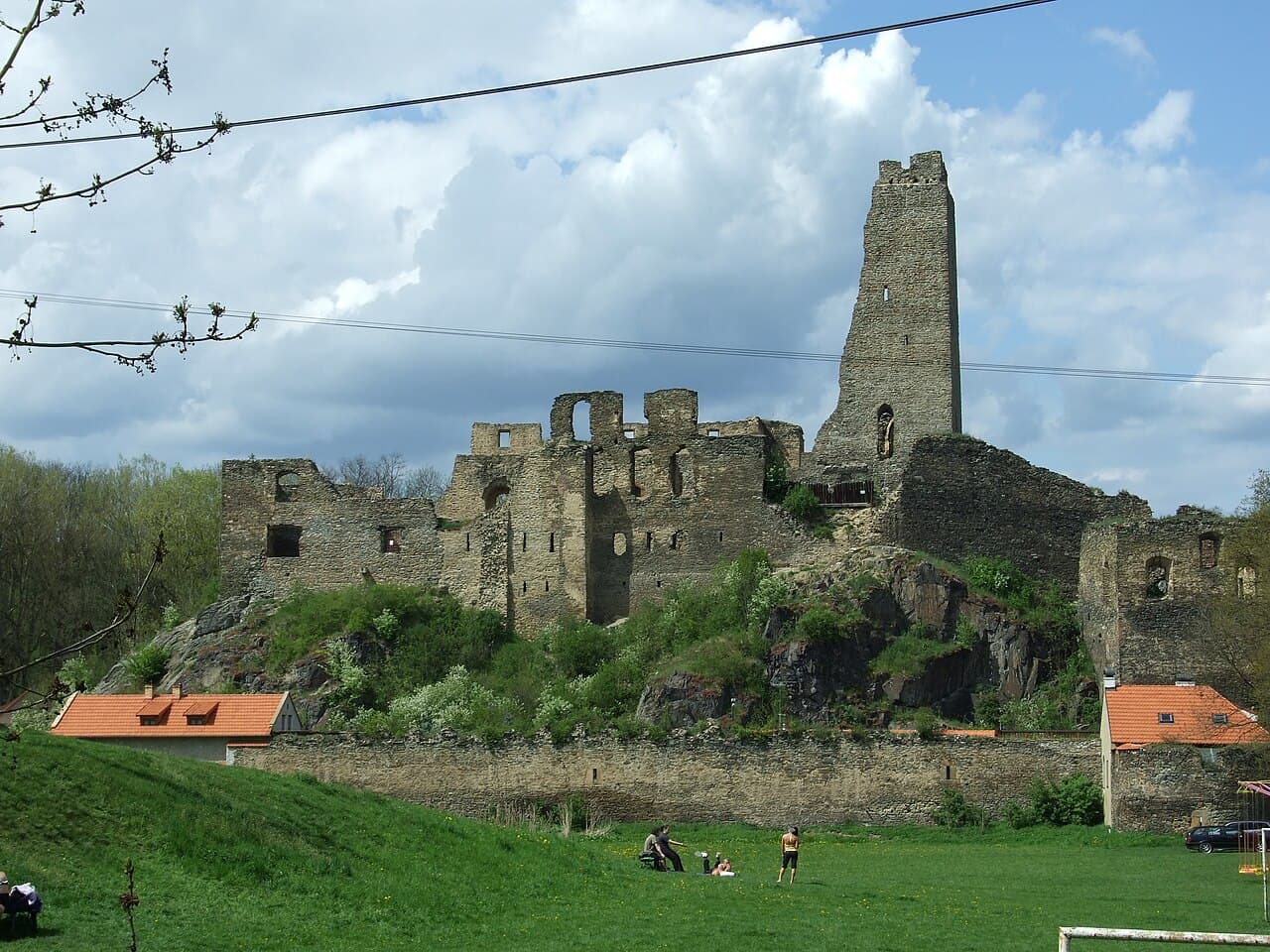
Okor Castle
Okor Castle, located on a low rocky promontory near the village of Okoř, about 15 kilometres northwest of Prague, is a remarkable example of a high medieval hill castle with a complex architectural and historical evolution spanning several centuries. Founded originally in 1228 as a fortified stronghold, the castle’s strategic position overlooking the valley of the Zákolanský potok stream offered natural defensive advantages. Its early structure was centered around a polygonal stone tower, which contained a rare and elaborately designed octagonal chapel, indicative of the castle’s initial importance and the status of its founders.
The castle underwent significant transformation in the 14th century, particularly after 1359 when František Rokyčanský, a wealthy burgher from Prague’s Old Town, acquired and rebuilt it in the Gothic architectural style. This period saw the castle develop into a residence favored by affluent citizens and lesser nobility, including the Rokyčanský family, the Lords of Donín, and later the Bořitové family of Martinice. The castle’s layout expanded to include a large rectangular residential tower, a palace with a courtyard tower featuring a hypocaust system, and a fortified gatehouse with a projecting donjon to protect the entrance.
Medieval origins and gothic transformation
The original castle, constructed in the early 13th century, was primarily a defensive stronghold with a polygonal tower that incorporated a unique octagonal chapel with thick Gothic walls and intricately patterned trefoil and quatrefoil windows. The tower’s walls were later thickened to enhance protection, and the upper floors featured flat ceilings supported by stone corbels. Dendrochronological dating places some of the windows around 1311–1312, providing precise insight into the construction phases.
During the 14th century, the castle expanded into a larger complex with two main parts: the eastern outer bailey and the central stronghold atop the rock. The large residential tower, measuring approximately 16 by 8.5 meters, became a dominant feature of the front area, partly incorporating the original chapel space. The palace wing enclosed the courtyard and included advanced features such as a hypocaust heating system, demonstrating the blend of residential comfort with defensive needs.
Late gothic enhancements and renaissance remodeling
Following the Hussite Wars in the early 15th century, during which the castle was seized by Hussite forces in 1421, the castle’s defenses were strengthened to accommodate emerging military technologies like firearms. The late 15th century saw the addition of extensive outer fortifications, including a defensive pond on three sides and two semi-circular bastions designed for artillery defense. One bastion incorporated a timber structure near the original gate, reinforcing the castle’s front line of defense.
In 1518, under the ownership of Hynek Bořita of Martinice, the castle was remodeled in the Renaissance style. This remodeling introduced grouped Renaissance windows, barrel vault ceilings, and sgraffito decorations on the palace’s western wing. These artistic and architectural updates reflected the changing tastes and residential functions of the castle, transitioning from a purely military fortress to a noble residence.
Baroque modifications and decline
During the Thirty Years' War in the early 17th century, Okor Castle suffered heavy damage. After the war, in 1649, the castle was donated to the Jesuit order by Jaroslav Bořita of Martinice. The Jesuits adapted the castle with Baroque style modifications and used it as a summer retreat. However, these Baroque changes were more focused on maintenance and minor alterations rather than extensive redesign, and most of these have not survived to the present day.
Following the suppression of the Jesuit order in 1773, the castle was abandoned and gradually fell into ruin. Roofs were dismantled, and building materials were removed, accelerating its deterioration. In the 19th century, parts of the ruins were repurposed as housing for the poor. Recognizing its cultural and historical value, the castle was legally protected in the early 20th century, and conservation efforts began in 1921. Today, the ruins are managed by the Central Bohemian Museum and are preserved as an important cultural monument.
Architectural features and castle layout
Okor Castle’s layout reflects its evolution from a medieval fortress to a noble residence. The central polygonal tower with its Gothic chapel remains a highlight, showcasing intricate stonework and Gothic window tracery. The castle’s fortified entrance evolved from a simple gateway to a complex gatehouse protected by a projecting donjon, compensating for the lack of a moat.
The late medieval fortifications included outer walls with artillery bastions and a defensive pond, illustrating adaptations to the development of gunpowder weaponry. The castle’s outer bailey housed economic facilities such as a brewery, while the eastern bailey contained residential spaces including a well tower and a refectory.
Nearby, on a hilltop east of the main castle, lie the remains of an oval fortification with earthworks and a ditch, likely serving as a forward bastion to protect the main site. This detached fortification’s defenses are oriented outward, emphasizing its role in the castle’s overall defensive system.
Cultural significance and preservation
Okor Castle stands today as a testament to the rich medieval history of the Czech lands and the architectural evolution from the high medieval period through the Renaissance and Baroque eras. Its ruins provide valuable insights into castle construction techniques, defensive adaptations, and noble residential life over several centuries.
The site is a protected cultural monument and a popular destination for visitors interested in medieval architecture, history, and the picturesque landscape surrounding Prague. Ongoing conservation efforts ensure the preservation of its unique features, making Okor Castle an important heritage site in the Central Bohemian Region.
Frequently asked questions (FAQ)
- What is the historical significance of Okor Castle?
- Okor Castle, dating back to the late 14th century, is a significant example of Gothic architecture in the Czech Republic. It served as a royal residence and later fell into disrepair, but its ruins still reflect the castle's medieval grandeur and historical importance in the region.
- When was Okor Castle built?
- Okor Castle was constructed in the late 1300s, specifically around 1380. It was established during the reign of Charles IV, showcasing the architectural style and fortification techniques of that era.
- What are the opening hours for Okor Castle?
- Okor Castle is open to visitors from April to October, typically from 10 AM to 6 PM on weekends and holidays. During the off-season, the castle is closed, but special tours may be arranged by appointment.
- How do I get to Okor Castle from Prague?
- To reach Okor Castle from Prague, you can take a train or bus to Roztoky and then enjoy a short walk to the castle. The journey takes approximately 30-40 minutes, making it an accessible day trip for visitors staying in the capital.
- Can I take a guided tour of Okor Castle?
- Yes, guided tours of Okor Castle are available, providing visitors with in-depth knowledge of its history and architecture. Tours are typically offered during the peak visiting season and can be booked in advance for larger groups.
- Is it possible to explore the castle grounds freely?
- While guided tours are encouraged to fully appreciate the history, visitors can also explore the castle grounds on their own during open hours. However, access to certain areas may be restricted for safety and preservation reasons.
- What is the best time to visit Okor Castle?
- The best time to visit Okor Castle is during the spring and early autumn months when the weather is pleasant and the surrounding landscape is beautiful. Visiting during these times also allows you to enjoy the castle's lush gardens and scenic views.
- What are the ticket prices for Okor Castle?
- Ticket prices for Okor Castle are generally affordable, with discounts available for students and seniors. Children under a certain age may enter for free, making it a great family-friendly destination.
- Are there any nearby attractions to visit along with Okor Castle?
- Yes, nearby attractions include the picturesque town of Roztoky and the charming Kralupy nad Vltavou. Additionally, the surrounding nature offers lovely hiking trails, making it easy to combine a visit to Okor Castle with outdoor activities.
Photo gallery

Photo by I would appreciate being notified if you use my work outside Wikimedia. More of my work can be found in my personal gallery.•CC BY-SA 3.0
Information
Website
Visit websiteSources & official resources
Verify the information above using these authoritative references.
Loading map...
Visitor reviews
No reviews yet. Been here? Write the first review and help other travelers!
Write the first reviewVisited this castle? Share your experience
Your review helps other travelers and adds first-hand knowledge to our encyclopedia.



