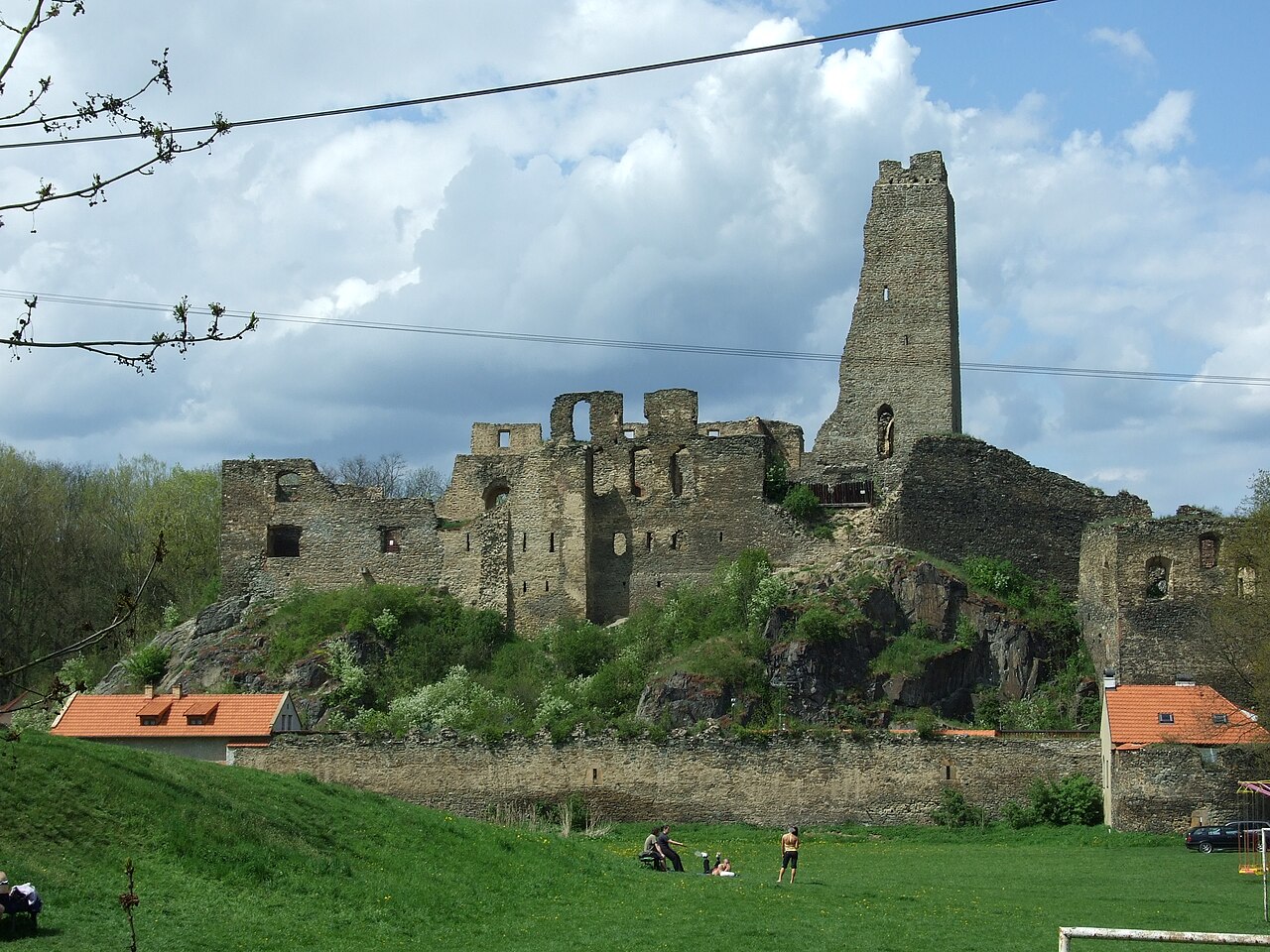
Liběhrad
Liběhrad castle is a medieval fortress ruin located on a prominent rock formation above the Vltava River near Libčice nad Vltavou in the Czech Republic. The castle's origins most likely date back to the 13th or 14th century, placing it within the High to Late Medieval period. This hill castle was strategically positioned to oversee the river valley and control the surrounding territory, utilizing both natural and man-made defenses.
Historical background and origins
The earliest documented mention of Liběhrad appears in records from 1532, although by then the castle was already abandoned and described as a ruin. The castle’s foundation is traditionally linked to the Zbraslav Monastery, which likely established the fortress to protect its estates and monitor the nearby parish church of Libčice. Alternative theories propose connections to the Břevnov Monastery or to a noble landlord leasing the lands, but the absence of an economic courtyard reduces the likelihood of a noble residential origin.
Liběhrad’s strategic importance diminished by the late 14th century, possibly as a consequence of the Hussite Wars upheavals, which affected many fortifications in Bohemia. By 1541, the castle was recorded as a ruin, indicating it had fallen out of use for over a century.
A 19th-century flood in the Vltava River and subsequent construction of the Prague–Děčín railway further damaged the site. Rock blasting during railway line elevation in 1845 particularly affected the eastern parts of the castle remains, accelerating its decay.
In addition to historical records, local legend attributes the founding of Liběhrad to the mythical Czech princess Libuše, who supposedly established a wooden stronghold here in 711. This tale, chronicled by Václav Hájek of Libočany, remains part of the cultural memory surrounding the site, although it lacks archaeological confirmation.
Architectural features and layout
Liběhrad was constructed as a relatively small castle with a roughly quadrangular layout adapted to the uneven rocky terrain atop a steep slope overlooking the river. The natural elevation provided formidable defense on the riverside, while on the opposite side, the castle was protected by man-made earthworks including a defensive ditch and the remains of an embankment wall.
Surviving fortifications include a small section of the rectangular defensive wall at the southeastern corner of the site. Within the castle's interior, archaeological traces are primarily visible as topographical changes on the southern side, indicating the former presence of at least one two-room building.
The northeastern section of the castle has been largely removed due to excavation and railway construction, leaving only a modest fragment of masonry at the edge of the riverside slope. The castle's footprint remains discernible despite centuries of erosion and modern disturbances.
Cultural significance and preservation
Situated at approximately 200 meters above sea level, the Liběhrad ruins are protected as a cultural monument in the Czech Republic. The site preserves the medieval layout and defensive design typical of small hill castles in the region.
Liběhrad's combination of natural rock defenses and constructed fortifications illustrates its historical role as a fortified point of control overseeing the Vltava river valley. Although it never developed into a large or heavily fortified stronghold, its remains contribute valuable insight into the network of smaller castles that dotted Bohemia during the Middle Ages.
Today, the site attracts visitors interested in medieval history, archaeology, and the natural landscape of the Vltava valley. The ruins serve as a tangible link to the region's feudal past and the monastic influences that shaped the area's settlement patterns.
Archaeological investigations and challenges
Archaeological work at Liběhrad has been limited but has helped clarify the castle's layout and construction phases. The lack of extensive building remains complicates detailed reconstruction, but the surviving earthworks and masonry fragments provide key evidence of its defensive structures.
Modern infrastructure projects, especially the 19th-century railway construction, significantly disturbed the site, causing loss of archaeological layers and structural remains. Flood events in the Vltava River have also contributed to erosion and damage over time.
Preservation efforts focus on protecting the remaining ruins and maintaining the site as a cultural heritage landmark, balancing conservation with public accessibility.
Frequently asked questions (FAQ)
- When was Liběhrad castle built?
- Liběhrad castle was most likely constructed during the 13th or 14th century, placing it in the High to Late Medieval period.
- Is Liběhrad castle accessible to visitors?
- Yes, the site is accessible to the public as a protected cultural monument, although it consists mainly of ruins and earthworks.
- What caused the ruin of Liběhrad castle?
- The castle fell into disuse by the 16th century, with damage exacerbated by the Hussite Wars, natural erosion, and 19th-century railway construction.
- What architectural features remain at Liběhrad?
- Visitors can see fragments of the rectangular defensive walls, earthworks including a ditch and embankment, and traces of a two-room building within the castle interior.
- Are there any legends associated with Liběhrad castle?
- Local legend credits the mythical Czech princess Libuše with founding a wooden stronghold on the site in 711, although this is not supported by archaeological evidence.
Information
Sources & official resources
Verify the information above using these authoritative references.
Loading map...
Visitor reviews
No reviews yet. Been here? Write the first review and help other travelers!
Write the first reviewVisited this castle? Share your experience
Your review helps other travelers and adds first-hand knowledge to our encyclopedia.