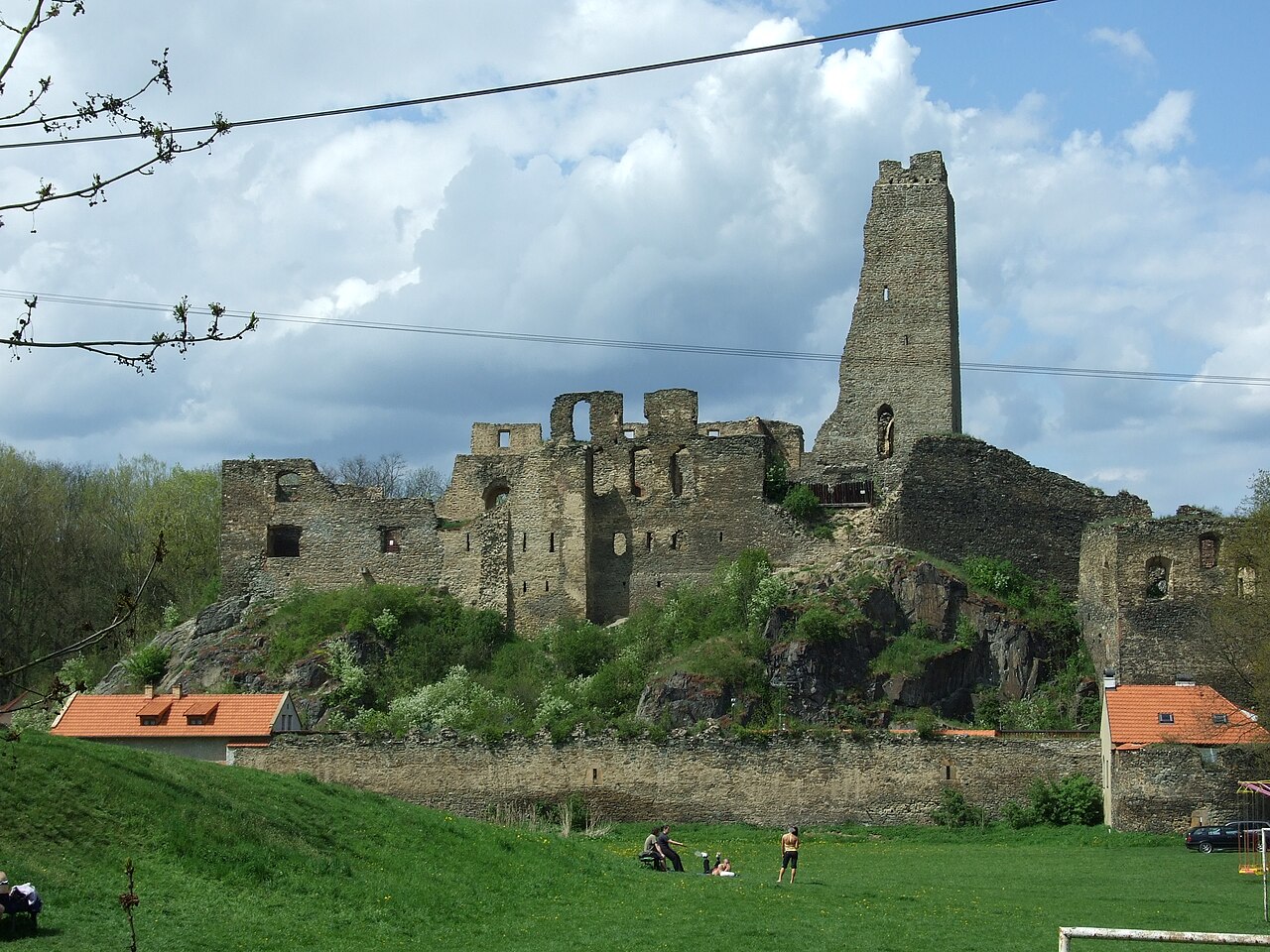
Buštěhrad Castle
Buštěhrad Castle stands as a significant historical monument located in the municipality of Buštěhrad in the modern Czech Republic. Established originally in the 14th century, this castle began as a medieval fortress strategically positioned at the eastern edge of the village then known as Buštěves. Its location on a hill provided natural defensive advantages, particularly with a steep northern slope that served as a natural barrier against invaders.
The earliest documented mention of the fortress dates back to 1352, when the village was under the ownership of the Rokycanský family from Prague. This initial fortress was constructed primarily for defensive purposes, utilizing the natural terrain and early medieval stonework. Around 1440, the castle underwent a significant transformation under the ownership of Jindřich Libštejnský of Kolovrat. He initiated a comprehensive reconstruction in the late Gothic style, expanding the fortress into a more formidable castle while preserving much of the original medieval stonework. The primary residential wing, known as the main palace, retained many of these early features.
Historical significance and turbulent times
During the Hussite Wars in the first half of the 15th century, Buštěhrad Castle played an active political and military role. In 1450, it endured a siege by forces loyal to Jiří z Poděbrady, who opposed the castle’s owner due to his steadfast Catholic allegiance and resistance to the Hussite movement. This siege was a pivotal event reflecting the religious and political conflicts of the time. After a truce and Jiří’s ascension as king in 1458, ownership of the castle shifted, aligning with the changing power dynamics as the Hussites established dominance in the region.
By 1462, the castle's construction and fortifications were likely completed, as evidenced by a dated sandstone block embedded in the surviving western gate. This period saw the adaptation of the castle’s defenses to the evolving nature of warfare, incorporating features designed to withstand artillery and early firearms, which were becoming increasingly prevalent.
Architectural evolution and fortifications
The castle’s design took full advantage of the natural topography, with additional defenses including a moat surrounding the castle on its western and southern sides, parts of which are still visible today. On the eastern side, a fortified forecourt was protected by a large bastion (known in German as a bollwerk), a protruding defensive structure that allowed defenders to deliver flanking fire against approaching enemies.
The core of the castle was approximately rectangular, with thick walls reinforced by artillery towers and bastions designed to resist the impact of firearms introduced in the 15th century. A notable surviving feature is one of these bastions along with the western gate, distinguished by a five-block sandstone arch bearing a mason’s mark composed of a ruler and compass—symbols of the builders’ craft. This gate was restored in 1556 and served as the main entrance for several centuries thereafter.
Old palace and Renaissance additions
The earliest core of the castle, referred to as the Old Palace, was located on the land where modern houses numbered 24 and 25 on Hradní street now stand. Subsequent expansions extended the castle’s footprint with additional wings constructed on nearby lots, corresponding today to houses 15 and 130.
In the late 1500s, the castle underwent Renaissance-era modifications, including the addition of a new palace building. Although much of this structure has been absorbed into later residential construction, fragments remain visible in the masonry of several houses along Hradní street, including numbers 23, 26, 151, and possibly 379.
Remnants of the castle’s robust walls survive in some buildings, with masonry walls notably thick, suggesting the former presence of a noble chapel within the fortress grounds.
Decline and modern legacy
The Kolovrat family maintained control of Buštěhrad Castle until 1630, when ownership passed through marriage to František Julius, Duke of Saxon-Lauenburg. During the Thirty Years’ War in 1632, retreating Saxon troops ransacked the castle, setting it ablaze and looting its contents. This devastation marked the beginning of the castle’s decline, as it was never fully restored to its former condition.
A plague epidemic in 1680 led to depopulation around Buštěhrad. As new settlements expanded, the ruined castle became a convenient source of building materials for local inhabitants. By the mid-18th century, residential development had overtaken the castle precinct, incorporating surviving remains from both the Gothic and Renaissance periods into new structures.
Today, the ruins of Buštěhrad Castle are largely absorbed into the urban fabric of the historic town. Medieval fortification elements remain discernible in the street patterns and surviving stonework. Together with remnants of moats and bastions, these features provide valuable testimony to the castle’s architectural evolution from a medieval fortress to a Renaissance residence.
Preservation and cultural significance
Recognizing its historical and cultural importance, the ruins of Buštěhrad Castle and the adjoining park were designated a protected national cultural monument of the Czech Republic in 1967. This status helps preserve the remaining structures and promotes awareness of the castle’s role in Czech history.
Visitors to Buštěhrad can observe surviving elements such as the western gate with its distinctive sandstone arch, sections of the moat, and the bastion, which collectively illustrate the castle’s defensive adaptations over centuries. The integration of the castle ruins into the town’s residential areas offers a unique glimpse into how medieval and Renaissance architecture can coexist with modern urban development.
Frequently asked questions (FAQ)
- What is the historical significance of Buštěhrad Castle?
- Buštěhrad Castle dates back to the 14th century and played an important role in the defense of the region during various conflicts. It is a significant example of Czech Gothic architecture and has been restored to preserve its historical integrity. The castle's rich history reflects the evolution of the area and its architectural styles over the centuries.
- When is the best time to visit Buštěhrad Castle?
- The best time to visit Buštěhrad Castle is during the spring and summer months when the weather is pleasant and the surrounding gardens are in full bloom. Guided tours are more frequent during this time, offering visitors a comprehensive look at the castle's history and architecture. Fall also provides a beautiful backdrop with changing leaves, making it a picturesque time to explore.
- Can I take guided tours of Buštěhrad Castle?
- Yes, guided tours are available for visitors and are an excellent way to learn about the castle's history and architectural features. Tours typically cover both the main castle grounds and significant historical artifacts. It is advisable to check the schedule in advance, especially during peak tourist seasons.
- What are the opening hours for Buštěhrad Castle?
- Buštěhrad Castle is generally open to visitors from April to October, with specific hours varying by day and season. Typically, the castle opens at 10 AM and closes at 6 PM, but it's best to verify the exact hours before your visit. During the winter months, the castle may have limited access or be closed altogether.
- Is Buštěhrad Castle accessible for visitors with disabilities?
- Buštěhrad Castle strives to be accessible to all visitors; however, the historical architecture may present some challenges. Certain areas may not be fully wheelchair accessible due to stairs and uneven paths. It’s recommended to contact the castle administration ahead of your visit for specific accessibility arrangements.
- What are the ticket prices for visiting Buštěhrad Castle?
- Ticket prices for Buštěhrad Castle vary depending on the type of tour you choose. Generally, adult tickets range from 100 to 200 CZK, while discounted rates are often available for students and seniors. Family tickets or group discounts may also be offered, making it an affordable destination for all.
- Are there any nearby attractions to Buštěhrad Castle?
- Yes, there are several attractions near Buštěhrad Castle, including the charming town of Kladno, which features local shops and dining options. The surrounding countryside also offers beautiful walking and cycling paths, perfect for those looking to explore the natural beauty of the region. Additionally, other historical sites and castles are within a short drive, enriching your visit.
Information
Website
Visit websiteSources & official resources
Verify the information above using these authoritative references.
Loading map...
Visitor reviews
No reviews yet. Been here? Write the first review and help other travelers!
Write the first reviewVisited this castle? Share your experience
Your review helps other travelers and adds first-hand knowledge to our encyclopedia.