
Okayama Castle
Okayama Castle, often referred to as the "Black Crow Castle" due to its striking black exterior, stands as a significant historical fortress in Okayama, Japan. Constructed initially under the direction of Ukita Naoie in 1573 and completed by his son Ukita Hideie in 1597, this castle exemplifies the architectural and strategic advancements of the late Sengoku period transitioning into the early Edo period. Its location as a hill castle provided natural defensive advantages, complemented by its imposing stone walls and complex layout.
Historical background and significance
The castle's initial construction was motivated by the Ukita clan's rising power during the turbulent Sengoku era. After the pivotal Battle of Sekigahara in 1600, control of Okayama Castle passed to Kobayakawa Hideaki, a key figure in the battle who was rewarded for his allegiance to Tokugawa Ieyasu. However, Hideaki's tenure was short-lived due to his death in 1602. Subsequently, the castle was entrusted to Ikeda Tadatsugu, the second son of Ikeda Terumasa and a grandson of Tokugawa Ieyasu, marking the beginning of the Ikeda family's long stewardship over the castle throughout the Edo period.
Under the Ikeda clan, Okayama Castle flourished as a regional power center and administrative hub. The castle's design and fortifications were enhanced to reflect the stability and prosperity of the era. The Ikeda family's rule extended until the Meiji Restoration, when the feudal system was dismantled, and many castles across Japan were decommissioned or repurposed.
Architectural features and layout
Okayama Castle is renowned for its distinctive black lacquered wooden exterior, which earned it the nickname "Crow Castle." This aesthetic choice was unusual compared to the more common white plaster walls of Japanese castles, giving it a unique and intimidating appearance. The castle's main keep, or tenshu, is a multi-storied structure featuring curved gables and decorative roof tiles, embodying the elegance and defensive needs of its time.
The castle complex originally included multiple yagura towers (turrets), moats, and stone walls arranged in a concentric pattern to maximize defense. One notable surviving yagura, designated as an Important Cultural Property, is located on the grounds of a nearby school, although public access is restricted. The castle grounds also feature extensive courtyards and gates that controlled access and provided layers of security.
Defensive innovations
The castle's design incorporated advanced defensive features typical of the late Sengoku period, including steep stone bases to prevent scaling, angled walls to deflect projectiles, and strategically placed loopholes for archers and gunners. The moats surrounding the castle added a critical barrier against attackers, while the complex layout of baileys and gates created choke points to slow enemy advances.
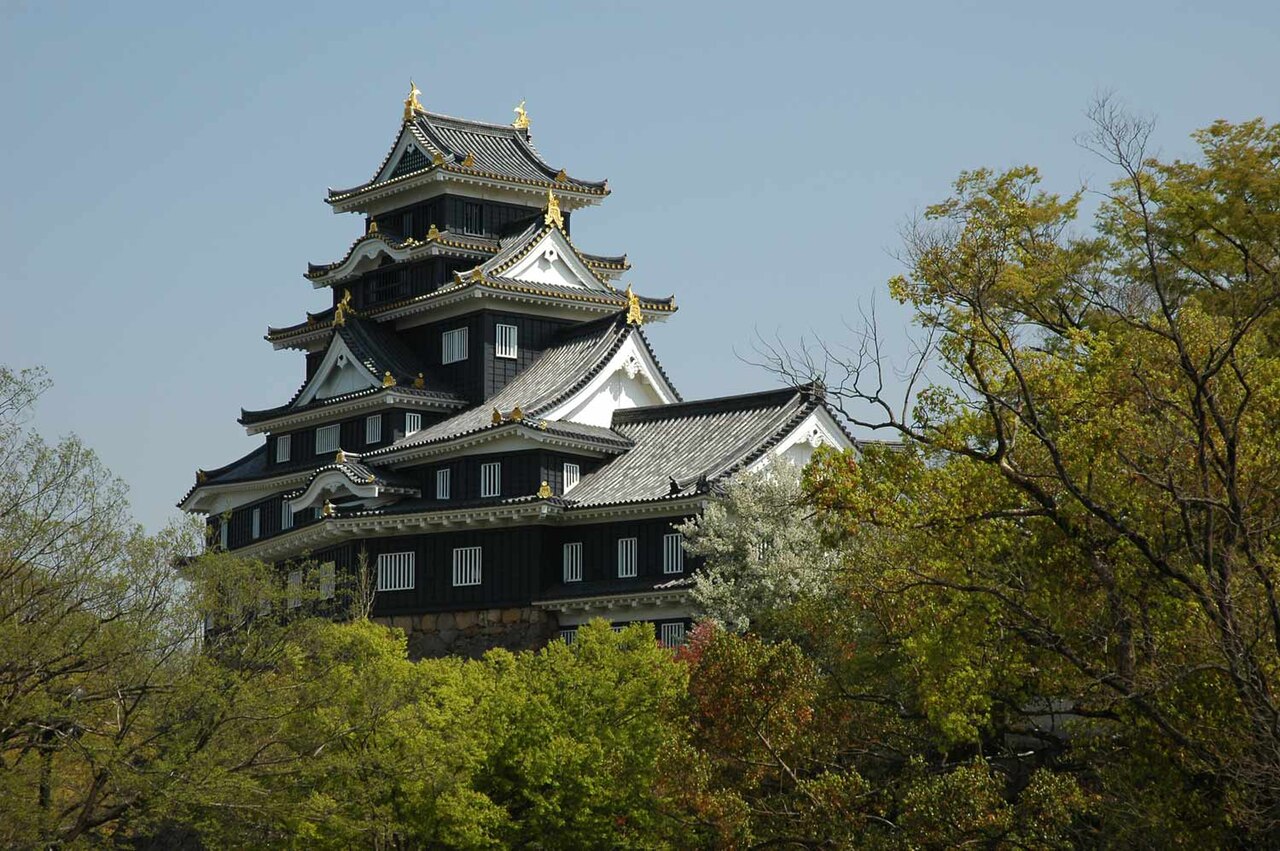
Photo by by Reggaeman • CC BY-SA 3.0
Destruction and restoration
Despite its historical importance, Okayama Castle suffered extensive damage during the air raids of 1945 in World War II, which destroyed much of the main keep and other structures. Post-war restoration efforts began decades later, focusing on rebuilding the main keep using traditional methods combined with modern materials to ensure longevity and safety.
The castle today is classified as partially restored, with the main keep reconstructed and several other structures repaired or preserved. The restoration has aimed to maintain the castle's authentic appearance, preserving its iconic black exterior and historical architectural elements. It now serves as a museum and cultural landmark, attracting visitors interested in Japan's feudal history and castle architecture.
Cultural importance and tourism
Okayama Castle holds a prominent place in Japan's cultural heritage as a symbol of the region's feudal past and architectural ingenuity. Its unique black facade and historical associations with prominent samurai clans make it a popular destination for tourists and historians alike.
The castle grounds are open to the public and offer panoramic views of the surrounding city and the nearby Korakuen Garden, one of Japan's most celebrated traditional gardens. Visitors can explore the reconstructed main keep, which houses exhibits on the castle's history, samurai culture, and local artifacts.
Photography enthusiasts often praise the castle for its photogenic qualities, as its design offers varied perspectives from every angle. While some areas, such as the yagura on school grounds, remain inaccessible, the castle's main precincts provide ample opportunities for exploration and appreciation of Japanese castle architecture.
Visitor information and accessibility
Okayama Castle is accessible year-round, with seasonal events and guided tours enhancing the visitor experience. The site is equipped with informational signage in multiple languages, and efforts have been made to accommodate visitors with mobility challenges.
The castle's proximity to Okayama Station and local transportation hubs makes it a convenient stop for travelers exploring the Chugoku region. Nearby attractions, including Korakuen Garden and the Okayama Prefectural Museum, complement a visit to the castle, offering a comprehensive cultural itinerary.
Frequently asked questions (FAQ)
- When was Okayama Castle originally built and by whom?
- Okayama Castle was originally constructed starting in 1573 by Ukita Naoie and was completed in 1597 by his son Ukita Hideie.
- Why is Okayama Castle called the "Black Crow Castle"?
- Okayama Castle is nicknamed the "Black Crow Castle" due to its distinctive black lacquered exterior, which is unusual among Japanese castles and gives it a striking appearance.
- What happened to Okayama Castle during World War II?
- The castle suffered significant destruction during the air raids of 1945, which destroyed much of the main keep and other structures, leading to later restoration efforts.
- Is Okayama Castle open to visitors today?
- Yes, Okayama Castle is open to the public and functions as a museum showcasing the castle's history and samurai culture, with reconstructed buildings and exhibits.
- What architectural features make Okayama Castle unique?
- Its unique black exterior, multi-storied main keep with curved gables, and the presence of multiple yagura towers and moats contribute to its distinctive architectural character.
Photo gallery

Information
Website
Visit websiteSources & official resources
Verify the information above using these authoritative references.
Loading map...
Visitor reviews
No reviews yet. Been here? Write the first review and help other travelers!
Write the first reviewVisited this castle? Share your experience
Your review helps other travelers and adds first-hand knowledge to our encyclopedia.