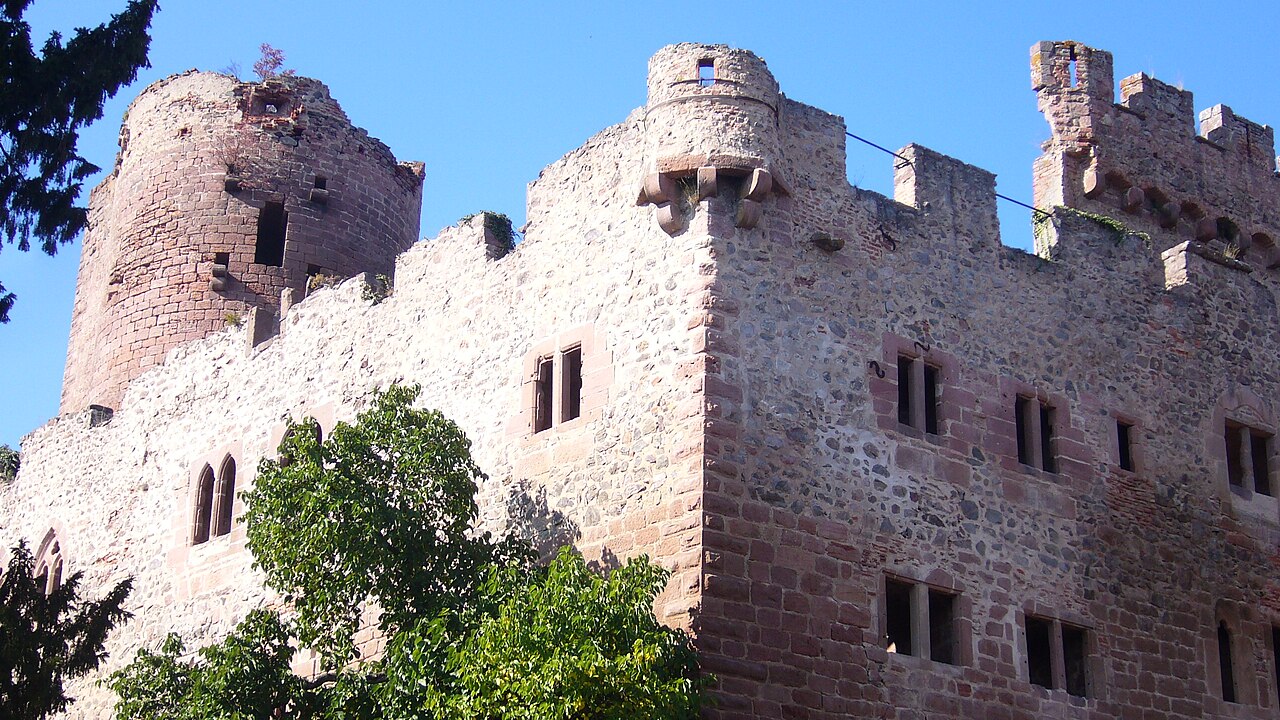
Œdenbourg Castle

Œdenbourg castle: medieval hill fortress near Haut-Kœnigsbourg in France
Oedenbourg, Hauts-de-France, France
High Medieval (11th–13th c.)
Partially Preserved

Œdenbourg Castle, locally known as Château de l'Œdenbourg or Oedenburg, stands as a significant medieval ruin west of the village of Orschwiller in the Bas-Rhin department of France. Nestled within the region often referred to as Southern Alsace or the Southern Vosges, this hill castle occupies a strategic rocky outcrop on the western end of the Staufen mountain. Its proximity—only about 200 meters—to the renowned Haut-Kœnigsbourg Castle suggests a closely intertwined history and defensive role between the two fortifications.

The origins of Œdenbourg Castle are somewhat obscure, but architectural and archaeological evidence firmly places its construction in the 13th century, during the high medieval period. The castle's initial builders were likely affiliated with the Hohenstaufen dynasty, a powerful ruling family of the Holy Roman Empire known for their extensive castle-building activities across Alsace and the surrounding regions.

Historical background and ownership

The earliest recorded mention of the site dates back to 1147, under the name Estuphin, a term reflecting Roman influences in the region. By 1187, the area was known as Kunigesberg or Königsburg, names that originally applied to a broader fortified complex encompassing both present-day Œdenbourg and Haut-Kœnigsbourg. This indicates that the two castles were once considered a unified defensive estate.

Ownership records from 1267 suggest the estate belonged to the Rathsamhausen family, a noble lineage documented in regional archives. The castle remained inhabited through the early 15th century, as evidenced by archaeological finds such as heating stove tiles dated to the early 1400s. However, by 1417, documents refer to the fortress as Œdenbourg, derived from an older term meaning "the abandoned castle," confirming its decline and desertion shortly thereafter. No artifacts dating beyond 1420 have been found, solidifying the conclusion that the castle was abandoned in the early 15th century.

Despite its abandonment, the site regained military importance in 1504 when it was identified by Albrecht von Berwangen as a valuable artillery position. Soldiers stationed at Haut-Kœnigsbourg utilized Œdenbourg's elevated vantage point to secure the surrounding territory, demonstrating the continued strategic relevance of the ruins.

Architectural features and layout

Œdenbourg Castle exemplifies the architectural characteristics of a high medieval hill castle built during the late Staufer period. The construction predominantly features large stone blocks with a roughened surface technique known as bossage or Buckelquadern, providing both structural strength and a distinctive textured appearance.

The keep and shield wall

One of the castle's most prominent elements is a thick shield wall on the eastern side, angled slightly towards Haut-Kœnigsbourg. This wall is noticeably higher and more massive than other sections, serving as the primary defensive barrier protecting the castle's inner precincts. Adjacent to this wall are the remains of a rectangular palas, a residential building identifiable by its characteristic Gothic-style window openings. The palas's elongated form indicates it was a significant domestic space within the fortress.

At the highest point on the western side of the rocky hill stands the stump of an older bergfried, a square-shaped keep typical of Germanic medieval castles. This robust tower served as a last refuge during sieges and offered commanding views of the surrounding landscape.

Courtyard and defensive structures

The castle's layout includes a courtyard separating the keep from the living quarters, featuring a cistern essential for water storage during sieges. The living quarters are protected by a curtain wall facing west, designed to defend against attacks from that direction.

Surrounding the core castle are extensive defensive ditches and ramparts, particularly on the eastern and western approaches. These earthworks emphasize the strategic efforts to safeguard access routes and reinforce the castle's defensive capabilities. The overall fortified complex rivals Haut-Kœnigsbourg in scale and complexity.

Strategic location and views

Situated atop a rocky promontory, Œdenbourg Castle commands sweeping views over the Villé and Argent valleys to the northwest and southwest. Partial vistas extend over the Rhine plain to the east, although these are partly obscured by the rock formation supporting Haut-Kœnigsbourg. This positioning highlights the complementary defensive roles of the two castles, enabling surveillance and control of important regional routes and territories.

Current condition and preservation

Today, Œdenbourg Castle exists as a partially preserved ruin, fenced off to protect the site and prevent public access to its interior. The remaining structures, including the shield wall, bergfried stump, and palas ruins, provide valuable insights into medieval castle construction and defensive strategies.

Protection efforts began in the 20th century, with the castle officially recognized as a historic monument and preserved as part of France's cultural heritage. While it is often overshadowed by the nearby Haut-Kœnigsbourg, Œdenbourg offers a fascinating glimpse into the region's medieval past and the complex network of fortifications that once dominated the landscape.

Visiting information and accessibility

Currently, visitors cannot enter the interior of Œdenbourg Castle due to fencing and preservation measures. However, the site can be viewed from surrounding paths and vantage points near Orschwiller. The castle is a worthwhile destination for enthusiasts of medieval architecture and history, especially those exploring the cluster of castles in Alsace.

Visitors interested in the broader historical context can combine a visit to Œdenbourg with the nearby Haut-Kœnigsbourg Castle, which offers extensive tours and well-preserved medieval architecture.

Frequently asked questions (FAQ)

When was Œdenbourg Castle built?
Œdenbourg Castle was constructed in the 13th century during the high medieval period, likely by the Hohenstaufen family.
Can visitors enter the interior of Œdenbourg Castle?
Currently, the interior of Œdenbourg Castle is fenced off and not accessible to visitors to protect the ruins.
What is the relationship between Œdenbourg and Haut-Kœnigsbourg castles?
Œdenbourg Castle is located only about 200 meters from Haut-Kœnigsbourg and was historically part of a larger fortified complex, serving complementary defensive roles.
What remains can be seen at Œdenbourg Castle?
Visitors can observe the thick eastern shield wall, the stump of the bergfried, the palas ruins with Gothic windows, and surrounding defensive earthworks.
Why was Œdenbourg Castle abandoned?
The castle was abandoned in the early 15th century, as indicated by historical records and archaeological finds, likely due to changes in regional power and military strategy.

Information

Hill Castle

Sources & official resources

Verify the information above using these authoritative references.

Loading map...

Visitor reviews

No reviews yet. Been here? Write the first review and help other travelers!

Write the first review

Visited this castle? Share your experience

Your review helps other travelers and adds first-hand knowledge to our encyclopedia.
Write a review

(5/5)

0/2000 characters

Your review will be visible after admin approval

Nearby castles

0.4 km
Haut-Kœnigsbourg Castle — France castle

Haut-Kœnigsbourg Castle

Orschwiller, France

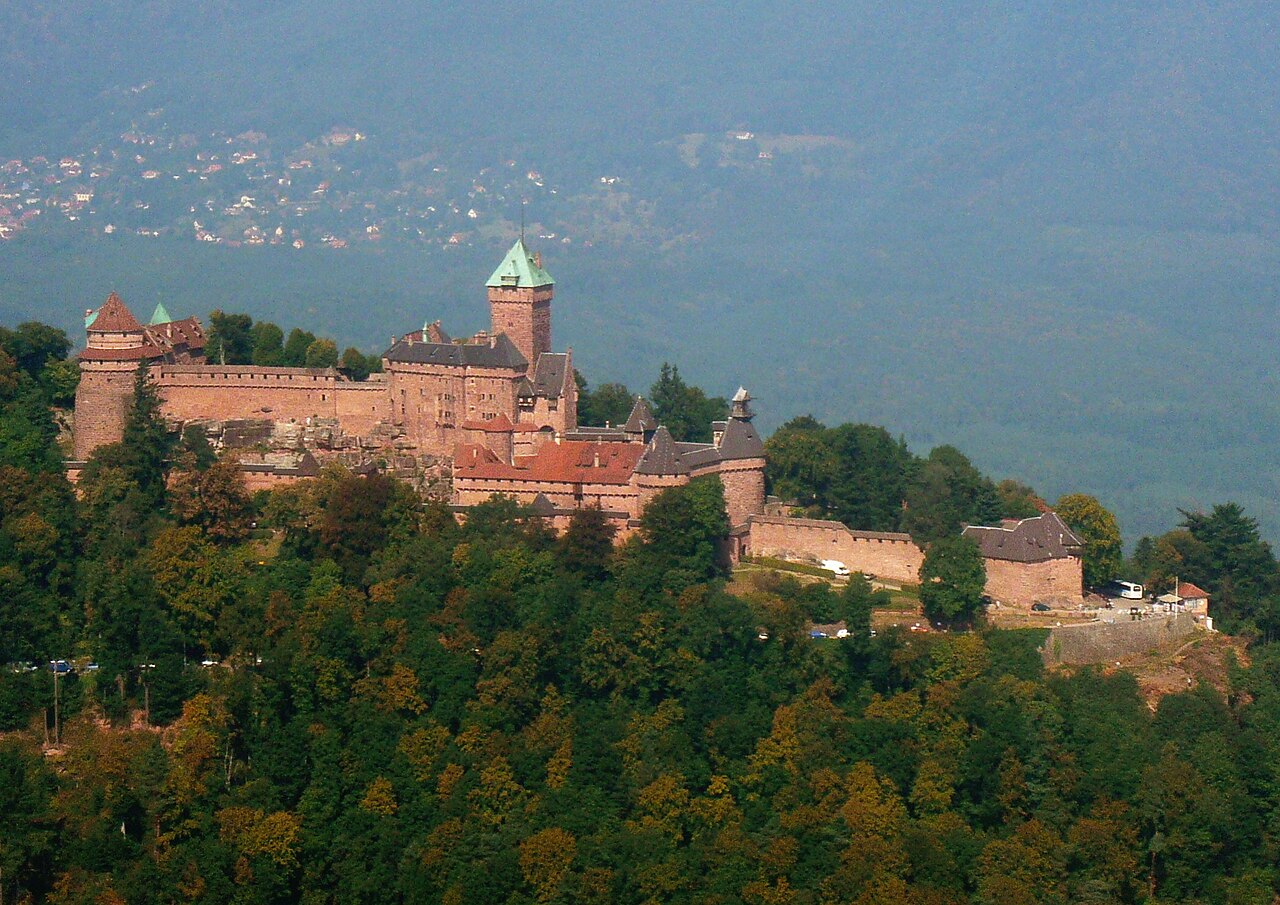
Haut-Kœnigsbourg Castle, also known locally as Château du Haut-Koenigsbourg, is a striking medieval fortress perched on a rocky spur at an altitude of 757 meters in the Vosges mountains near the village of Orschwiller, in the Grand-Est region of northeastern France. Overlooking the Upper Rhine Plain, this castle has played a significant strategic role throughout its history, commanding sweeping views of the Alsace plain below. Its location and formidable fortifications made it a key defensive stronghold from the High Medieval period through to the Thirty Years' War. The castle's origins trace back to the 12th century, with the earliest documented mention in 1147 when monks lodged a complaint to King Louis VII of France about its unauthorized construction by the Hohenstaufen Duke Frederick II of Swabia. By the late 12th century, it was known as Königsburg or "King's Castle," reflecting its imperial connections. Throughout the centuries, Haut-Kœnigsbourg changed hands among powerful families and rulers, including the Dukes of Lorraine, the local Rathsamhausen and Hohenstein families, the Bishop of Strasbourg, and the Habsburg emperors. Medieval origins and strategic importance The castle was originally built on a rocky promontory that provided natural defenses and excellent visibility over the surrounding landscape. Its initial construction was likely motivated by the Hohenstaufen dynasty's desire to consolidate control over the Alsace region. The fortress was part of a network of castles that secured trade routes and borders in this contested area of the Holy Roman Empire. In the early 13th century, control passed from the Hohenstaufen family to the Dukes of Lorraine, who entrusted the castle to the Rathsamhausen and later the Hohenstein families. During this period, the castle was expanded and fortified to meet evolving military needs. However, by the 15th century, the castle had become a refuge for robber barons, leading to sieges and destruction by a coalition of regional powers in 1462. Rebuilt for artillery and decline After its destruction, the castle was granted in fief by Emperor Frederick III to the Counts of Thierstein in 1479. They undertook significant reconstruction and enlargement, adapting the fortress to withstand artillery attacks. This included the addition of bastions and thick walls designed to absorb cannon fire, marking Haut-Kœnigsbourg as a bastioned fortress—a transitional form of military architecture between medieval castles and early modern fortifications. Despite these improvements, the castle's military value diminished over time. By the 16th century, it was primarily used as a garrison rather than a noble residence, leading to gradual neglect. During the Thirty Years' War, the fortress endured a 52-day siege by Swedish forces in 1633 but ultimately fell. The attackers burned and looted the castle, after which it was abandoned and left to ruin for over two centuries. Romantic restoration under kaiser wilhelm ii The ruins of Haut-Kœnigsbourg attracted romantic interest in the 19th century, reflecting a broader European fascination with medieval heritage. After Alsace was annexed by Germany following the Franco-Prussian War (1870–71), the ruined castle was gifted to German Emperor Wilhelm II in 1899. Wilhelm sought to restore the fortress as a symbol of German nationalism and imperial continuity, linking the Hohenzollern dynasty to the medieval Holy Roman Empire. Architect Bodo Ebhardt led the restoration from 1900 to 1908, aiming to recreate the castle's appearance around the year 1500. Ebhardt relied on archaeological evidence, surviving walls, historical documents, and comparisons with contemporary castles. However, some reconstruction elements were imaginative, as original plans and details were missing. The restored castle features a blend of authentic medieval structures and romanticized architectural elements, including an oversized keep and elaborately decorated interiors. Architectural features of the restored castle The restored Haut-Kœnigsbourg Castle showcases multiple layers of fortifications, including western bastions designed to resist artillery fire and an eastern star-shaped bastion guarding the lower approaches. The entrance gate is protected by a portcullis and adorned with coats of arms from the Thierstein family, the Hohenzollerns, and Emperor Charles V, reflecting the castle's layered history. The castle's interior includes the Kaiser's Hall, a grand ceremonial space with a vaulted ceiling painted with the imperial eagle and the motto "Gott mit uns" (God with us). Frescoes depict jousting scenes and heraldic symbols that emphasize the castle's medieval heritage and imperial associations. The Emperor's Cabinet contains stained glass reproductions of works by Albrecht Dürer and houses various ritual objects and weapons. The defensive structures include a deep well, 62.5 meters in depth, ensuring a reliable water supply during sieges. The upper courtyard is surrounded by wooden galleries and features a cistern topped with a mermaid sculpture. The grand bastion contains replicas of 16th- and 17th-century artillery pieces, illustrating the castle's adaptation to gunpowder warfare. Cultural significance and tourism today Today, Haut-Kœnigsbourg Castle is one of the most visited historic sites in the Grand-Est region, attracting over 500,000 visitors annually. It serves as a vivid example of medieval military architecture and the complexities of historic restoration. The castle's reconstruction under Wilhelm II remains a subject of scholarly interest for its reflection of early 20th-century romantic nationalism and architectural revivalism. Visitors can explore the extensive fortifications, richly decorated interiors, and panoramic views from the castle's ramparts. The site also includes the nearby ruins of Château de l'Œdenbourg, a smaller 13th-century castle located just below Haut-Kœnigsbourg, accessible by a short forest walk. Despite some criticism of its restoration as overly romanticized, Haut-Kœnigsbourg remains a powerful symbol of Alsace's layered history at the crossroads of French and German cultures. Its preservation and presentation offer valuable insights into medieval fortification techniques, early modern military adaptations, and the cultural politics of heritage in Europe.

High Medieval (11th–13th c.)
Details
3.4 km

Castle of Haut-Koenigsbourg

Orschwiller, France

The castle of Haut-Koenigsbourg stands prominently on a rocky promontory at an altitude exceeding 700 meters, overlooking the Upper Rhine valley. This strategic position provided commanding views over vital trade and military routes, making it a formidable defensive stronghold in the region. Its location atop a steep rock formation exemplifies the classic hill castle design, optimized for surveillance and defense. Early history and medieval significance The origins of the castle trace back to approximately 1147 when the first fortification, known as Castrum Estuphin, was established. Within a decade, the fortress was renamed Koenigsburg, meaning "royal castle" in German, reflecting its elevated status and strategic importance. Throughout the high medieval period, the castle was a coveted asset, passing through various hands and serving as a military and administrative center. Its robust construction and commanding location allowed it to control key routes and exert influence over the surrounding territories. The castle's medieval fortifications included thick stone walls, towers, and a complex gate system designed to withstand sieges and assaults common in the period. Destruction and reconstruction in the late medieval period In 1462, the castle endured a significant siege led by a coalition of forces from the cities of Colmar, Strasbourg, and Basel. This siege resulted in the castle's destruction, reflecting the turbulent political and military conflicts of the late medieval era. Following this, the Habsburg emperor Frederick III granted the ruined fortress to the Counts of Tierstein. The Counts undertook a substantial reconstruction and enlargement of the castle, adapting its defenses to the evolving demands of warfare, particularly the increasing use of artillery. The defensive system was modernized with thicker walls and new bastions capable of withstanding cannon fire, marking a transition from purely medieval fortifications to early modern military architecture. The castle during the thirty years' war and abandonment During the Thirty Years' War, a devastating conflict that ravaged much of Central Europe from 1618 to 1648, the castle was once again a target. It was burnt to the ground by Swedish forces, leaving it in ruins. This destruction led to the castle being abandoned for nearly two centuries, a common fate for many medieval fortresses rendered obsolete by advances in military technology and changing political landscapes. 19th-century recognition and restoration efforts In 1862, the ruins of Haut-Koenigsbourg were officially classified as a historical monument, recognizing their cultural and historical significance. Three years later, the nearby town of Selestat purchased the ruins with the intent to preserve them. However, the restoration plans were interrupted by the geopolitical shifts following the Franco-Prussian War in 1871, when the Alsace region was annexed by Germany. In 1899, the citizens of Selestat transferred ownership of the castle to the German emperor Wilhelm II. The emperor, eager to emphasize German sovereignty over Alsace, commissioned a comprehensive restoration of the castle. This ambitious project began in 1900 and spanned eight years, culminating in the castle's grand reopening on May 13, 1908, attended by Wilhelm II himself. The restoration, led by architect Bergmann, aimed to faithfully reconstruct the castle as it would have appeared in the late medieval period, incorporating both historical accuracy and the romanticized vision of medieval fortresses popular at the time. The project included rebuilding the towers, curtain walls, gatehouses, and interior chambers, as well as restoring the castle's defensive features such as battlements and artillery bastions. Architectural features and defensive systems The castle of Haut-Koenigsbourg is an exemplary model of a hill castle with adaptations reflecting changes in military technology from the high medieval through the late medieval periods. Its layout includes a series of fortified enclosures, each protected by thick stone walls and towers positioned to maximize defensive coverage. Key architectural elements include the imposing donjon (keep), which served as the last line of defense and the residence of the lord. The castle also features multiple gatehouses with portcullises and murder holes, designed to repel attackers. The extensive use of machicolations and battlements along the walls allowed defenders to launch projectiles and boiling substances on besiegers. Following the 15th-century reconstruction, the castle incorporated artillery bastions and angled walls to better resist cannon fire, a significant advancement over earlier medieval designs. The castle's water supply was secured through a deep well within the courtyard, essential for surviving prolonged sieges. The castle in the 20th century and today After World War I, the Treaty of Versailles in 1919 returned the castle to French control. Since then, the castle has been maintained as a cultural monument and tourist attraction. It is now one of the most visited castles in France, attracting over 500,000 visitors annually. Today, the castle of Haut-Koenigsbourg stands as a remarkably well-preserved example of medieval military architecture, offering visitors a vivid glimpse into the past. Its restored interiors include period furnishings, armory displays, and detailed recreations of medieval life. The castle's location continues to provide breathtaking views over the surrounding Alsace region and the Rhine valley. The site hosts various cultural events, medieval reenactments, and educational programs, enhancing its role as a living museum and heritage site. Visitor information and cultural significance Visitors to the castle can explore its extensive ramparts, towers, and chambers, gaining insight into the defensive strategies and daily life of medieval nobility. The castle's museum exhibits include weapons, armor, and artifacts from different periods of its history. The castle of Haut-Koenigsbourg is not only a symbol of regional history but also a testament to the evolving nature of fortress design from the high medieval period through the early modern era. Its preservation and restoration reflect the broader European interest in medieval heritage and architectural conservation.

High Medieval (11th–13th c.)
Details
3.6 km
Kintzheim Castle — France castle

Kintzheim Castle

Kintzheim, France

Kintzheim Castle, also known as Château de Kintzheim, is a striking medieval fortress perched on the sandstone spur called Schlossberg overlooking the village of Kintzheim in the Bas-Rhin department of northeastern France. Nestled in the historic region of Southern Alsace near the Southern Vosges, this hill castle embodies centuries of European history, architecture, and cultural heritage. Its origins trace back to the 6th century when the site was known as Regis Villa, a royal domain under the Merovingian dynasty, serving as a center of a vast domain including the Liepvre valley and the Haut-Koenigsbourg forests. The castle as it stands today began to take shape in the mid-13th century, around 1250, under the order of Emperor Frederick II of Hohenstaufen. The initial phase of construction focused on the imposing circular keep (bergfried) and robust defensive ramparts, completed by the end of the 13th century. This keep, approximately 27 meters tall, is a dominant feature of the fortress, adjoining a massive shield wall on the west side that rises over 15 meters and creates a unique keyhole-shaped floor plan in the upper levels. The castle evolved over the following centuries with the addition of residential wings during the 14th and 15th centuries, reflecting a transition from purely military use to include domestic and administrative functions. Early history and medieval development The site’s significance predates the castle itself, with evidence of a temporary royal residence used by Merovingian and Carolingian rulers. In 774, Charlemagne granted part of the local forests to the Abbey of Liepvre, and it is believed he celebrated Christmas of 775 at a palace likely situated here. Later, in 843, ownership passed to Erchangar, Count of Nordgau, under Emperor Lothair I, highlighting the site's continued strategic and political importance. The castle’s construction under Frederick II marked a new era of fortification and imperial presence in the region. The late 13th-century completion of the keep and ramparts provided formidable defense, while the subsequent centuries saw the addition of chapels, courtyards, and living quarters. The castle was integrated into the Holy Roman Empire’s network of fortresses, serving both military and administrative roles. Ownership changes and conflicts In 1341, the village of Kintzheim was handed over to the town of Sélestat by Emperor Louis IV, and in 1492 the castle itself was sold to the town after acquisition by Gaspard de Morimont under Emperor Frederick III. This marked a shift from imperial to municipal control, reflecting changing political landscapes in late medieval Europe. The castle endured significant damage during the Thirty Years’ War when Swedish troops partially destroyed it in 1633. Following the war, between 1650 and 1670, J. G. de Gollen, a former mayor of Sélestat, restored the residential buildings and the chapel dedicated to Saint James, though he never took residence. The castle’s religious function was underscored by this chapel, a late Gothic structure on the north wall. Between 1760 and 1780, the last inhabitant was a hermit monk who maintained the chapel, after which the castle was abandoned following the upheavals of the French Revolution. By 1830, the roofs had disappeared, leaving the castle exposed to the elements. 19th-century romanticism and restoration In 1802, the castle was acquired by Gaetan Mathieu de Fabvier, who built a manor house below the ruins in the Directory style and landscaped the area with an English-style park, creating a romantic tableau inspired by the paintings of Nicolas Poussin, Claude Lorraine, and Hubert Robert. This garden linked the castle ruins and the new manor, emphasizing the picturesque qualities of the medieval remains. The romantic movement of the 19th century revived interest in medieval castles, leading to the consolidation of the ruins in 1876 by German architects. These efforts preserved the castle’s structural integrity and prevented further decay, allowing the ruins to become a cultural and historical landmark. Architecture and defensive features The castle’s layout occupies a roughly rectangular area approximately 35 by 20 meters atop the Schlossberg at an altitude between 260 and 280 meters. The most distinctive feature is the circular keep (bergfried) connected to a massive shield wall on the west side. This shield wall, about four meters thick in its southern extension, includes a casemate — a fortified gun emplacement — reflecting adaptations to evolving military technology. The western approach is guarded by a deep neck ditch, enhancing the castle’s defensive capabilities. A late 15th-century square corner tower protects the main gate, adding another layer of security. The residential wings on the south and east sides provided living quarters and administrative spaces, while the north wall chapel dedicated to Saint James served spiritual needs. A notable artistic detail is a carved apotropaic head on a bossage stone near the artillery tower entrance, designed to ward off evil spirits and protect the inhabitants. Over the centuries, the castle has seen multiple restorations, including repairs to window mullions, vaulted cellars, and the chapel’s roof and stained glass. Modern history and current use During World War II in 1945, the castle was used as an observation post and sustained artillery damage, particularly to the keep. Recognized for its historical value, the ruins were officially classified as a historic monument in 1965, ensuring ongoing protection and conservation. Since 1968, the outer bailey has been adapted to house La Volerie des Aigles, a bird park specializing in predatory birds such as eagles, falcons, and vultures. This falconry center offers daily flight demonstrations, attracting tourists and nature enthusiasts. The castle ruins provide a dramatic and atmospheric backdrop for these shows, combining cultural heritage with wildlife conservation. Visitors to Kintzheim Castle today can explore the grounds, enjoy the bird shows, and appreciate the blend of medieval architecture and natural beauty. Although the keep itself remains inaccessible, the site is well maintained and offers insight into the region’s rich history and architectural evolution. Heritage and cultural significance Kintzheim Castle stands as a testament to the layered history of Alsace, reflecting influences from the Merovingian and Carolingian eras through the medieval and early modern periods. Its architectural features illustrate the evolution of military design, from high medieval fortifications to adaptations for artillery defense. The castle’s integration into the landscape and its association with the romantic movement highlight its cultural importance beyond military function. The preservation efforts and modern use as a bird park demonstrate a successful fusion of heritage conservation and contemporary tourism, contributing to regional identity and education.

High Medieval (11th–13th c.)
Details