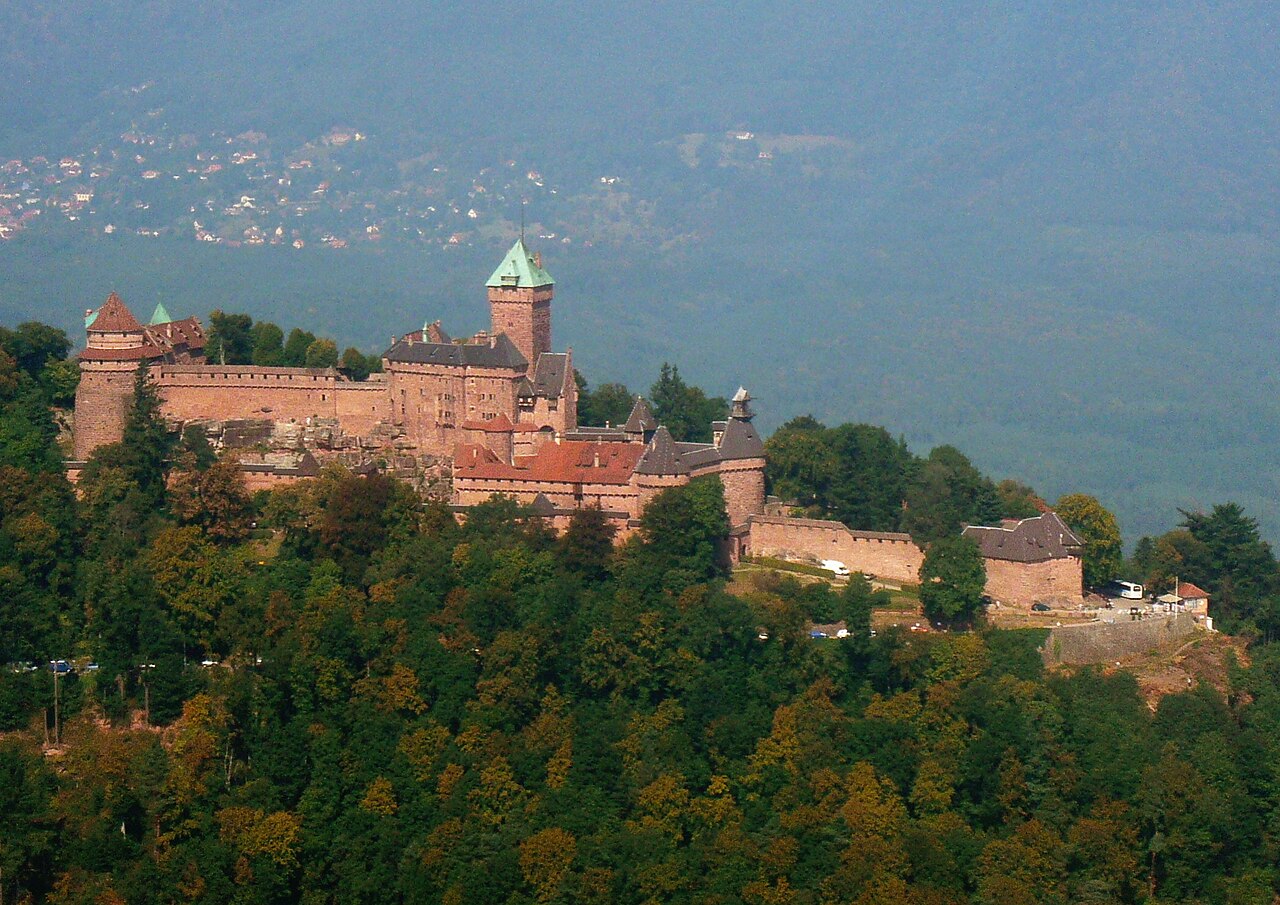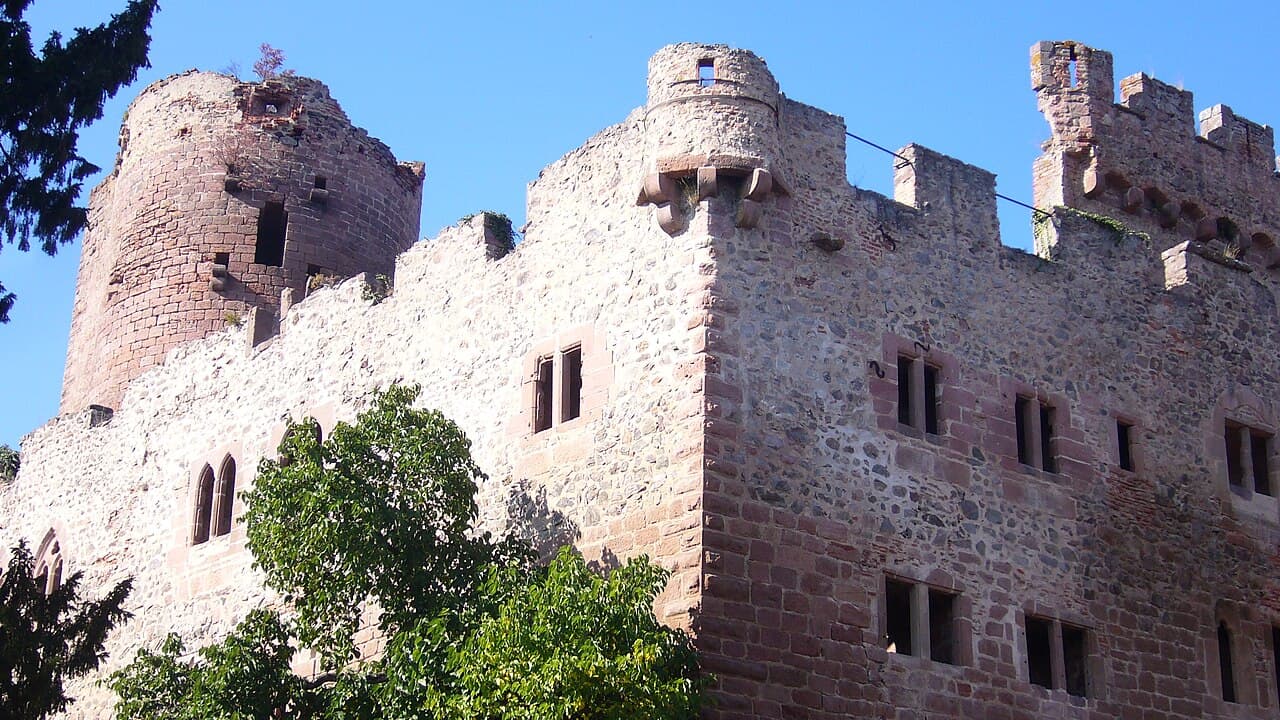
Kintzheim Castle
Kintzheim Castle, also known as Château de Kintzheim, is a striking medieval fortress perched on the sandstone spur called Schlossberg overlooking the village of Kintzheim in the Bas-Rhin department of northeastern France. Nestled in the historic region of Southern Alsace near the Southern Vosges, this hill castle embodies centuries of European history, architecture, and cultural heritage. Its origins trace back to the 6th century when the site was known as Regis Villa, a royal domain under the Merovingian dynasty, serving as a center of a vast domain including the Liepvre valley and the Haut-Koenigsbourg forests.
The castle as it stands today began to take shape in the mid-13th century, around 1250, under the order of Emperor Frederick II of Hohenstaufen. The initial phase of construction focused on the imposing circular keep (bergfried) and robust defensive ramparts, completed by the end of the 13th century. This keep, approximately 27 meters tall, is a dominant feature of the fortress, adjoining a massive shield wall on the west side that rises over 15 meters and creates a unique keyhole-shaped floor plan in the upper levels. The castle evolved over the following centuries with the addition of residential wings during the 14th and 15th centuries, reflecting a transition from purely military use to include domestic and administrative functions.
Early history and medieval development
The site’s significance predates the castle itself, with evidence of a temporary royal residence used by Merovingian and Carolingian rulers. In 774, Charlemagne granted part of the local forests to the Abbey of Liepvre, and it is believed he celebrated Christmas of 775 at a palace likely situated here. Later, in 843, ownership passed to Erchangar, Count of Nordgau, under Emperor Lothair I, highlighting the site's continued strategic and political importance.
The castle’s construction under Frederick II marked a new era of fortification and imperial presence in the region. The late 13th-century completion of the keep and ramparts provided formidable defense, while the subsequent centuries saw the addition of chapels, courtyards, and living quarters. The castle was integrated into the Holy Roman Empire’s network of fortresses, serving both military and administrative roles.
Ownership changes and conflicts
In 1341, the village of Kintzheim was handed over to the town of Sélestat by Emperor Louis IV, and in 1492 the castle itself was sold to the town after acquisition by Gaspard de Morimont under Emperor Frederick III. This marked a shift from imperial to municipal control, reflecting changing political landscapes in late medieval Europe.
The castle endured significant damage during the Thirty Years’ War when Swedish troops partially destroyed it in 1633. Following the war, between 1650 and 1670, J. G. de Gollen, a former mayor of Sélestat, restored the residential buildings and the chapel dedicated to Saint James, though he never took residence. The castle’s religious function was underscored by this chapel, a late Gothic structure on the north wall.
Between 1760 and 1780, the last inhabitant was a hermit monk who maintained the chapel, after which the castle was abandoned following the upheavals of the French Revolution. By 1830, the roofs had disappeared, leaving the castle exposed to the elements.
19th-century romanticism and restoration
In 1802, the castle was acquired by Gaetan Mathieu de Fabvier, who built a manor house below the ruins in the Directory style and landscaped the area with an English-style park, creating a romantic tableau inspired by the paintings of Nicolas Poussin, Claude Lorraine, and Hubert Robert. This garden linked the castle ruins and the new manor, emphasizing the picturesque qualities of the medieval remains.
The romantic movement of the 19th century revived interest in medieval castles, leading to the consolidation of the ruins in 1876 by German architects. These efforts preserved the castle’s structural integrity and prevented further decay, allowing the ruins to become a cultural and historical landmark.
Architecture and defensive features
The castle’s layout occupies a roughly rectangular area approximately 35 by 20 meters atop the Schlossberg at an altitude between 260 and 280 meters. The most distinctive feature is the circular keep (bergfried) connected to a massive shield wall on the west side. This shield wall, about four meters thick in its southern extension, includes a casemate — a fortified gun emplacement — reflecting adaptations to evolving military technology.
The western approach is guarded by a deep neck ditch, enhancing the castle’s defensive capabilities. A late 15th-century square corner tower protects the main gate, adding another layer of security. The residential wings on the south and east sides provided living quarters and administrative spaces, while the north wall chapel dedicated to Saint James served spiritual needs.
A notable artistic detail is a carved apotropaic head on a bossage stone near the artillery tower entrance, designed to ward off evil spirits and protect the inhabitants. Over the centuries, the castle has seen multiple restorations, including repairs to window mullions, vaulted cellars, and the chapel’s roof and stained glass.
Modern history and current use
During World War II in 1945, the castle was used as an observation post and sustained artillery damage, particularly to the keep. Recognized for its historical value, the ruins were officially classified as a historic monument in 1965, ensuring ongoing protection and conservation.
Since 1968, the outer bailey has been adapted to house La Volerie des Aigles, a bird park specializing in predatory birds such as eagles, falcons, and vultures. This falconry center offers daily flight demonstrations, attracting tourists and nature enthusiasts. The castle ruins provide a dramatic and atmospheric backdrop for these shows, combining cultural heritage with wildlife conservation.
Visitors to Kintzheim Castle today can explore the grounds, enjoy the bird shows, and appreciate the blend of medieval architecture and natural beauty. Although the keep itself remains inaccessible, the site is well maintained and offers insight into the region’s rich history and architectural evolution.
Heritage and cultural significance
Kintzheim Castle stands as a testament to the layered history of Alsace, reflecting influences from the Merovingian and Carolingian eras through the medieval and early modern periods. Its architectural features illustrate the evolution of military design, from high medieval fortifications to adaptations for artillery defense.
The castle’s integration into the landscape and its association with the romantic movement highlight its cultural importance beyond military function. The preservation efforts and modern use as a bird park demonstrate a successful fusion of heritage conservation and contemporary tourism, contributing to regional identity and education.
Frequently asked questions (FAQ)
- What is the best time to visit Kintzheim Castle and its bird park?
- The best time to visit Kintzheim Castle and La Volerie des Aigles is during the spring and summer months when the bird flight demonstrations are held daily and the weather is pleasant for exploring the castle grounds.
- Is the keep of Kintzheim Castle open to visitors?
- The keep of Kintzheim Castle is currently inaccessible to visitors due to safety concerns and preservation efforts, but visitors can enjoy the castle ruins and bird shows in the surrounding areas.
- How can I reach Kintzheim Castle from nearby cities?
- Kintzheim Castle is accessible by car from nearby towns such as Sélestat and Colmar. Public transportation options include regional buses, but a car is recommended for convenience when visiting the castle and bird park.
- Are there guided tours available at Kintzheim Castle?
- Guided tours may be available seasonally or by arrangement at Kintzheim Castle, often combined with visits to the bird park. It is advisable to check with the local tourist office for current offerings.
- What species of birds can I see at La Volerie des Aigles?
- La Volerie des Aigles features a variety of predatory birds including eagles, falcons, vultures, and other birds of prey, many of which are endangered species showcased in daily flight demonstrations.
Photo gallery

Information
Website
Visit websiteSources & official resources
Verify the information above using these authoritative references.
Loading map...
Visitor reviews
No reviews yet. Been here? Write the first review and help other travelers!
Write the first reviewVisited this castle? Share your experience
Your review helps other travelers and adds first-hand knowledge to our encyclopedia.