Oberburg Castle
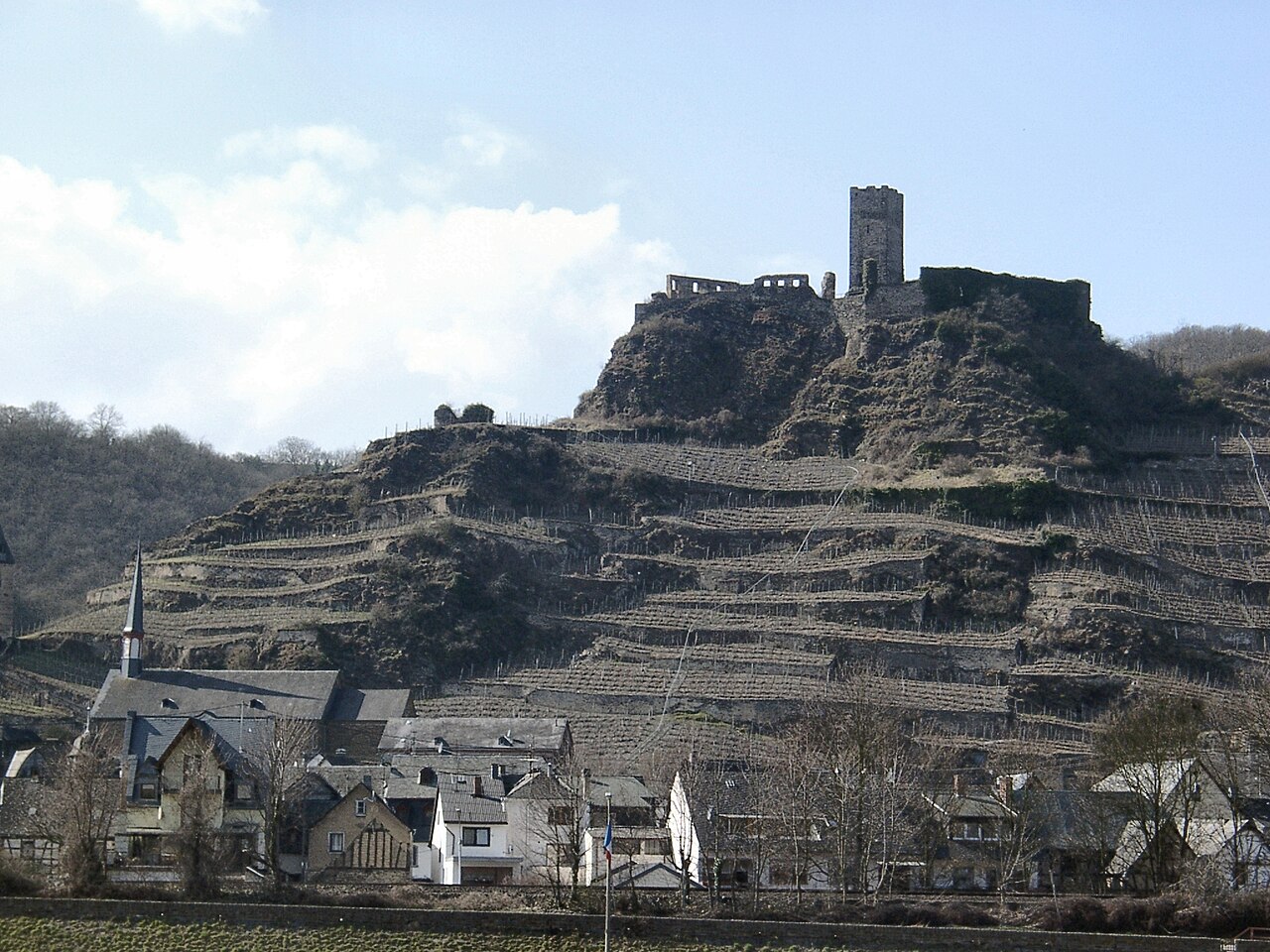
The Oberburg Castle, also known as the 'Upper Castle,' stands as a striking example of medieval fortification perched approximately 200 metres above the village of Kobern in the municipality of Kobern-Gondorf, Germany. This hill castle occupies a commanding ridge overlooking the Moselle River, a location that has been strategically significant since ancient times. The castle's origins trace back to the early 12th century, when it was constructed atop a former Celtic hillfort, demonstrating the continuity of defensive use on this site.
The castle's rectangular footprint measures roughly 110 by 40 metres, encompassing a range of structures that once formed a formidable defensive complex. Among the surviving features, the most prominent is the bergfried, a square tower approximately 9 by 9 metres in base dimensions. The bergfried's vaulted ground and upper storeys showcase medieval masonry techniques designed for durability and defense. Access to the upper floor is ingeniously provided via a staircase embedded within the thick walls, a typical feature aimed at conserving interior space and enhancing security.
Adjacent to the bergfried lies the Late Romanesque St. Matthias Chapel, constructed between 1220 and 1240 by Lord Henry II of Isenburg. This chapel was built to serve as a reliquary for the head of Saint Matthias, underscoring the castle's dual military and spiritual significance. The chapel incorporates the choir of an earlier, likely unfinished structure, indicating a continuity of sacred architecture on the site. Its presence expanded the castle's footprint and added a religious dimension to the fortress.
Historical background and ownership
The earliest documentary mention of Oberburg dates from 1195, when the castle's lord placed it under the authority of the Electorate of Trier as a fief. This affiliation reflects the castle's integration into the ecclesiastical territories governed by the Archbishopric of Trier, a powerful regional authority during the High Medieval period. The lords of Isenburg-Kobern maintained control over the castle until the mid-14th century, after which it was sold to the Archbishop of Trier.
Following this transfer, the Oberburg gradually fell into decline and ruin, as it lost its strategic and residential importance. Without a permanent lord to maintain its defenses and upkeep, the castle was abandoned and left to deteriorate over the centuries.
Architectural features and castle layout
Bergfried and defensive structures
The bergfried remains the most intact element of the Oberburg ruins. Its square plan and vaulted interiors are characteristic of High Medieval military architecture in the region. The tower's height was increased during restoration efforts in the late 20th century, and it was fitted with a new roof to protect the masonry. Historically, the bergfried would have served as a last refuge during sieges and as a lookout point commanding views over the Moselle valley.
Castle enceinte and walls
The castle originally featured a defensive enceinte or curtain walls enclosing the courtyard and key buildings. Today, only fragments of these walls survive, offering a glimpse into the castle's former defensive perimeter. The rectangular layout of the castle and the positioning of the bergfried within the enceinte reflect typical High Medieval fortification principles.
St. matthias chapel
The St. Matthias Chapel is a notable example of Late Romanesque ecclesiastical architecture. Its construction between 1220 and 1240 by Lord Henry II of Isenburg was motivated by the desire to house the relic of Saint Matthias' head, elevating the castle's religious status. The chapel's choir, reused from an earlier unfinished building, indicates a layering of architectural phases and the adaptation of pre-existing structures within the castle complex.
Restoration and modern use
In 1936, efforts to preserve the castle's remains began with the installation of a temporary roof over the bergfried to prevent further decay. More extensive restoration commenced in 1989, which involved raising the height of the bergfried and adding a new roof. A restaurant was also constructed adjacent to the tower on a site previously built upon within the castle grounds, blending modern use with historical preservation.
Today, the Oberburg is open to the public year-round and can be visited free of charge. The castle grounds include a restaurant housed within the bergfried and adjoining buildings, providing visitors with a unique experience combining historical ambiance and contemporary hospitality. The St. Matthias Chapel is accessible to visitors on summer weekends, offering insight into the castle's spiritual heritage.
Access and surrounding landscape
The castle is accessible via a narrow footpath known as the Kreuzweg, which ascends through vineyards from the Mühlbach valley. This scenic route highlights the castle's integration into the surrounding Moselle landscape, renowned for its viticulture. For visitors arriving by car, a parking area is located immediately below the castle, facilitating convenient access.
Oberburg's location on the same ridge as the nearby Niederburg (Lower Castle), situated about 50 metres lower, illustrates the strategic distribution of fortifications in the Kobern area during the medieval period. Together, these castles controlled important routes and territorial boundaries along the Moselle.
Cultural significance and heritage protection
As a protected cultural monument, Oberburg Castle represents an important link to the region's medieval history and architectural heritage. Its ruins, particularly the bergfried and St. Matthias Chapel, offer valuable insights into castle construction techniques and the interplay between military and religious functions in the High Medieval era. The castle's preservation and adaptive reuse exemplify efforts to maintain historical sites while promoting public engagement and tourism.
Frequently asked questions (FAQ)
- How do I get to Oberburg Castle?
- Oberburg Castle is located in Kobern-Gondorf, Germany, and can be easily accessed by car or public transportation. If traveling by train, the nearest station is in Koblenz, from which you can take a local bus or taxi to the castle.
- When was Oberburg Castle built?
- Oberburg Castle dates back to the 12th century and was constructed for defensive purposes. Its strategic location allowed it to oversee important trade routes along the Rhine River.
- What is the architectural style of Oberburg Castle?
- Oberburg Castle showcases a mix of Romanesque and Gothic architectural styles, characterized by its robust stone walls and intricate details. The castle's design reflects its historical significance as a stronghold during the medieval period.
- Can I visit Oberburg Castle year-round?
- Yes, Oberburg Castle is open to visitors throughout the year, although specific opening hours may vary by season. It is advisable to check the castle's official website for current hours and any potential holiday closures.
- What are the ticket prices for Oberburg Castle?
- Ticket prices for Oberburg Castle are quite affordable, typically ranging from €5 to €10 for adults, with discounts available for children and seniors. Guided tours may incur an additional fee, providing a more in-depth exploration of the castle's history.
- Is it possible to take guided tours of Oberburg Castle?
- Yes, guided tours are available at Oberburg Castle, offering visitors an opportunity to learn about its rich history and architectural features. Tours are conducted in multiple languages and provide a more immersive experience of the castle's past.
- What is the best time to visit Oberburg Castle?
- The best time to visit Oberburg Castle is during the spring and early autumn months when the weather is mild and pleasant. This allows visitors to enjoy the beautiful surrounding landscape and partake in outdoor activities around the castle.
- Are there any nearby attractions to Oberburg Castle?
- Yes, there are several nearby attractions, including the picturesque town of Kobern-Gondorf and the scenic Rhine River. Visitors can also explore nearby vineyards and hiking trails, making it a great destination for a day trip.
- Is Oberburg Castle accessible for visitors with disabilities?
- Oberburg Castle has made efforts to improve accessibility for all visitors, with some areas being wheelchair friendly. However, due to the castle's historical structure, certain parts may still present challenges, so it's recommended to contact the site in advance for specific accessibility options.
Information
Website
Visit websiteSources & official resources
Verify the information above using these authoritative references.
Loading map...
Visitor reviews
No reviews yet. Been here? Write the first review and help other travelers!
Write the first reviewVisited this castle? Share your experience
Your review helps other travelers and adds first-hand knowledge to our encyclopedia.