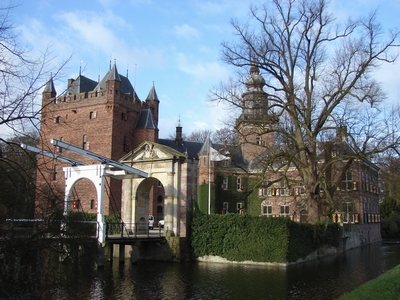
Nyenrode Castle
Nyenrode Castle was established around 1260 by knight Gerard Splinter van Ruwiel at a strategic location on the narrowest part of the bank of the river Vecht in the Netherlands. This position was crucial as the river served as a vital trade route connecting the city of Utrecht to the Zuiderzee (Dutch South Sea). The castle's location was also in a contested area between the Bishops of Utrecht and the Counts of Holland, making it a significant stronghold in regional power struggles. The original lords of Nyenrode pledged allegiance to the Count of Holland, reflecting the political landscape of the time.
Medieval origins and strategic importance
The castle's initial construction in the High Medieval period was typical of fortifications designed to control important waterways and trade routes. Nyenrode's early structure likely included defensive walls and a keep to oversee the river traffic and protect the surrounding lands. However, the castle suffered destruction twice, first in 1481 and again in 1511, events that underline the turbulent history of the region during the late medieval period.
Renaissance transformation under the barons van den bongard
In 1539, the estate came into the possession of the Barons Van den Bongard. Between 1632 and 1642, Bernard van den Bongard III undertook a significant transformation of the castle, converting it into a castle-manor that embodied the characteristics of a Dutch Renaissance style knightly mansion. This renovation introduced a house with a castle-like form, complete with a drawbridge, blending residential comfort with fortified elements. The Renaissance style of Nyenrode is marked by its balanced proportions and decorative details, reflecting the architectural trends of the Dutch Golden Age.
Military history and destruction in the 17th century
The castle's military significance persisted into the 17th century. In 1672, during the Franco-Dutch War, the French army established their headquarters at Nyenrode. As the forces of Stadtholder William III, Prince of Orange, advanced, the French set fire to the castle on 6 September 1673 to prevent its use by enemy troops. This act of scorched earth warfare caused extensive damage, necessitating later repairs.
Ownership by the ortt family and later industrialists
Following the fire, Johan Ortt purchased Nyenrode in 1675 and restored the castle. The Ortt family, prosperous merchants involved in cloth manufacturing and corn trading in Amsterdam, retained ownership until 1853. The castle was acquired thereafter by the industrial family De Heus, who maintained it for two generations. This period saw Nyenrode as a symbol of wealth and social status, reflecting the rise of merchant and industrial classes in Dutch society.
20th-century restorations and modern use
Between 1907 and 1934, Michiel Onnes, a German coffee merchant, resided at Nyenrode and undertook extensive restorations to revive the castle and its surrounding park to their former splendor from the Van den Bongard era. Notably, the gatehouse was constructed and the coach house rebuilt between 1916 and 1918. The keep was also completely rebuilt on its original foundations and raised by an additional storey, enhancing its prominence.
Later, the estate was owned by the art dealer Jacques Goudstikker, who tragically died in an accident in May 1940 while fleeing the German occupation during World War II. After the war, his widow, Ms Désirée Goudstikker, leased Nyenrode to the Foundation Nederlands Opleidings-Instituut voor het Buitenland (N.O.I.B.) in 1946. The foundation later evolved into the Nyenrode Business Universiteit, which currently operates on the estate, preserving the castle's legacy and adapting it for educational purposes.
Architectural features and style
Nyenrode Castle exemplifies a blend of medieval fortification and Dutch Renaissance architecture. The castle-manor features a characteristic castle-like form with defensive elements such as a drawbridge, thick walls, and a prominent keep. The Renaissance influence is evident in the symmetrical layout, decorative brickwork, and the integration of residential comfort with defensive capabilities. The surrounding park and estate complement the architecture, reflecting the status and taste of its historical owners.
The keep and gatehouse
The keep stands as a central architectural element, reconstructed in the early 20th century but rooted in its medieval origins. It was raised by one storey during restoration, enhancing its defensive and symbolic presence. The gatehouse, built between 1916 and 1918, serves as an imposing entrance, combining functional design with stylistic details that echo the Renaissance aesthetic of the main building.
Cultural and heritage significance
Today, Nyenrode Castle is not only a historical monument but also an active center for business education. Its preservation and adaptive reuse demonstrate the evolving role of historic estates in the Netherlands. The castle's location on the river Vecht and its architectural heritage make it a notable example of Dutch medieval and Renaissance castle development. It attracts visitors interested in history, architecture, and the Dutch Golden Age.
Visitor information
The castle is accessible for educational purposes and special events. Visitors can appreciate the architectural features and the landscaped park. The estate's connection to the Nyenrode Business Universiteit ensures ongoing maintenance and public engagement with the site’s rich history.
Frequently asked questions (FAQ)
- How do I get to Nyenrode Castle?
- Nyenrode Castle is located in Breukelen, Netherlands, and is easily accessible by car and public transport. If you're traveling by train, Breukelen Station is the nearest stop, and from there, it's a short taxi ride or a pleasant walk to the castle.
- What is the historical significance of Nyenrode Castle?
- Nyenrode Castle dates back to the 13th century and has been a pivotal site in Dutch history. Originally built for defense, it has served various roles over the centuries, including as a noble residence and now as part of Nyenrode Business University.
- When was Nyenrode Castle built?
- Nyenrode Castle was constructed in the 13th century, around the year 1260. Its design reflects the architectural styles of medieval fortifications, and it has undergone several renovations while preserving its historical essence.
- Can I visit Nyenrode Castle?
- Yes, Nyenrode Castle is open to visitors, but access is often limited to guided tours or specific events. It's best to check the official website for the latest information on tour availability and any special events that may be occurring.
- Why is Nyenrode Castle an important architectural site?
- Nyenrode Castle is a prime example of medieval architecture, featuring classic elements such as a moat, drawbridge, and fortified walls. Its design not only served defensive purposes but also reflects the lifestyle and status of the nobility during its time.
- Is it possible to host events at Nyenrode Castle?
- Yes, Nyenrode Castle offers facilities for hosting various events, including weddings and corporate functions. The picturesque setting and historical ambiance make it a unique venue for special occasions.
- What are the opening hours for Nyenrode Castle?
- Nyenrode Castle's opening hours can vary, so it’s recommended to check their official website before planning your visit. Typically, the castle is open for tours on weekdays, but hours may differ on weekends and holidays.
- What are the ticket prices for visiting Nyenrode Castle?
- Ticket prices for Nyenrode Castle can vary depending on the type of tour or event. It’s advisable to visit the official website for the most current pricing information and any available discounts for groups or students.
- When is the best time to visit Nyenrode Castle?
- The best time to visit Nyenrode Castle is during the spring and summer months when the gardens are in full bloom and the weather is pleasant. However, autumn also offers a beautiful backdrop with colorful foliage, making it a lovely time for photography and exploration.
- Are there any nearby attractions to Nyenrode Castle?
- Yes, several attractions are located near Nyenrode Castle, including the picturesque town of Breukelen and various walking and cycling paths along the River Vecht. Additionally, nearby museums and parks offer further opportunities for exploration and enjoyment.
Information
Sources & official resources
Verify the information above using these authoritative references.
Loading map...
Visitor reviews
No reviews yet. Been here? Write the first review and help other travelers!
Write the first reviewVisited this castle? Share your experience
Your review helps other travelers and adds first-hand knowledge to our encyclopedia.