Nottingham Castle
Nottingham Castle stands prominently atop Castle Rock, a natural limestone promontory rising approximately 130 feet above the surrounding landscape in Nottingham, United Kingdom. Its strategic location overlooking the city and the nearby River Trent made it a vital military and administrative site from its earliest days. Originally constructed shortly after the Norman Conquest, this hill castle has evolved through centuries, reflecting England's shifting political and architectural history.
The castle's foundation began in 1068 when William the Conqueror ordered the building of a wooden motte-and-bailey fortress to establish Norman control over the region. This initial structure was typical of early Norman military architecture, featuring a raised earthwork (motte) with a wooden keep and an enclosed courtyard (bailey). Its purpose was both defensive and symbolic, asserting Norman dominance over the local Anglo-Saxon population and securing a key crossing point near the river.
The medieval stone castle and its strategic significance
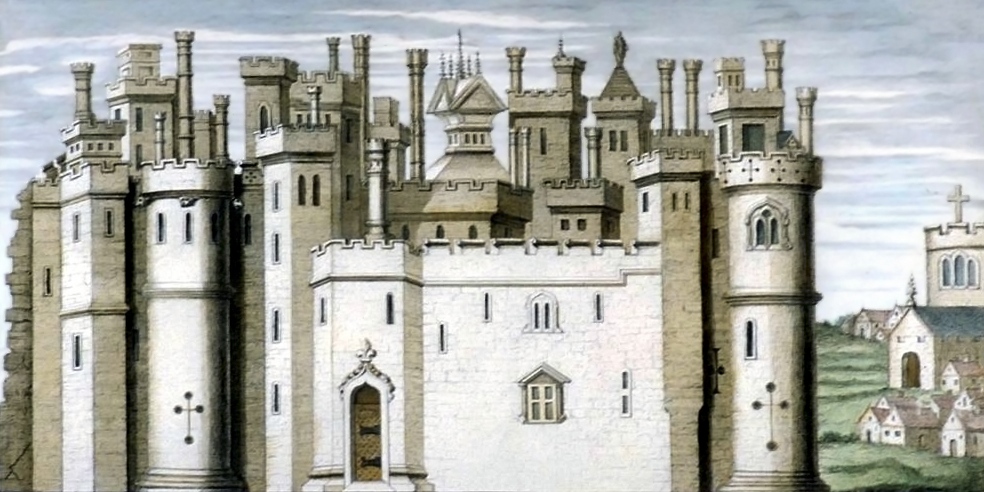
During the reign of King Henry II in the 12th century, Nottingham Castle underwent significant transformation. The original wooden fortifications were replaced with a more durable stone castle, constructed to provide greater defense and to serve as a royal residence. This phase introduced a complex layout comprising three baileys arranged on the rocky outcrop. The upper bailey occupied the summit of Castle Rock, while the middle bailey to the north housed the royal apartments and administrative buildings. The outer bailey to the east contained additional fortifications and service structures.
The castle's stone walls, towers, and gatehouses reflected medieval military architecture designed to withstand sieges and attacks. Nottingham Castle played a pivotal role in several key historical events. In 1194, during the conflict between King Richard I and his brother Prince John, the castle was besieged and recaptured by Richard after John had seized it during Richard's absence on the Crusades. This event underscored the castle's importance in the power struggles of the time.
Political center and royal residence in the 14th and 15th centuries
Throughout the 14th century, Nottingham Castle functioned as both a royal residence and a center of political activity. It hosted state councils and served as a prison for notable captives, including King David II of Scotland and the parliamentary figure Peter de la Mare. The castle's defenses were periodically enhanced with new towers and a prison to maintain its security and status.
In the early 15th century, the castle was the residence of Queen Joan of Navarre for over thirty years. Although its military role diminished over time, Nottingham Castle regained some prominence during the Wars of the Roses. It was here that Edward IV declared himself king and ordered further construction to reinforce the site.
Decline, destruction, and transformation into a ducal mansion
By the 16th century, Nottingham Castle had fallen into partial disrepair. However, under Henry VIII, it saw renewed military enhancements amid the Pilgrimage of Grace uprising in 1536. Defensive works such as a new drawbridge and increased garrison troops were added to counter the unrest opposing the king's religious reforms.
The castle ceased to function as a royal residence before the end of the 16th century, rendered obsolete by advancements in artillery and changing military tactics. During the English Civil War, it was held by Parliamentarian forces under John Hutchinson. In 1651, to prevent its future military use, the castle was deliberately slighted and largely destroyed.
Following the Restoration of the monarchy in 1660, the site was transformed with the construction of a grand new ducal mansion by William Cavendish, 1st Duke of Newcastle, completed in the late 17th century by his son. This mansion replaced the medieval upper bailey defenses and was designed in an Italianate style influenced by contemporary European architecture, particularly the works of Peter Paul Rubens. Its distinctive Artisan Mannerism style made it unique among English country houses of the period.
The 19th-century fire and restoration
In 1831, during widespread protests against the Reform Bill, rioters set fire to the ducal mansion, leaving it in ruins for several decades. The building was later restored in the 1870s by architect Thomas Chambers Hine. The restoration converted the mansion into Nottingham Castle Museum, notable as the first municipal art gallery established outside London. The restoration included the addition of a top-lit picture gallery inspired by the Louvre's Grand Gallery, and interior reconfigurations that did not strictly follow the original floor plans or window placements.
Architectural features and surviving remains
Today, Nottingham Castle retains significant elements from both its medieval and ducal phases. Beneath the mansion lie rock-cut cellars and pointed arches from the Norman and medieval castle, providing tangible links to its early history. Portions of the original gatehouse and outer bailey walls survive, some incorporated into garden boundaries, though others were lost to 19th-century urban development.
The ducal mansion itself is an important historic structure, with its Italianate design and unique Artisan Mannerism architecture. While the mansion's eastern exterior staircase was removed after the 1831 fire to create a parade ground for a local rifle regiment, the building remains a prominent feature of Nottingham's heritage.
A subterranean passage known as Mortimer's Hole extends from beneath the mansion down to the base of Castle Rock. This passage is part of guided tours that illustrate the layered history of the site.
The castle grounds also include Brewhouse Yard, a collection of 17th-century farm buildings at the foot of Castle Rock. These buildings are integrated into the museum complex and reflect the site's extended use beyond military and noble functions.
Recent archaeological discoveries and cultural significance
In 1996, a landslip caused by a leaking water main led to the collapse of part of the earth and retaining wall adjacent to the mansion's Restoration terrace. This event exposed sections of the original castle foundations embedded in the limestone bedrock, revealing construction details previously hidden. The terrace was rebuilt with a traditional stone façade to preserve these archaeological features.
Nottingham Castle's image has become culturally recognizable, notably appearing on John Player & Sons tobacco packaging, where its elegant, non-fortress-like appearance made it an iconic symbol. Today, the castle and mansion serve as a museum and art gallery, housing collections of fine and decorative arts, local history, and regimental heritage related to the Sherwood Foresters. Exhibition spaces such as the Long Gallery display British and European artworks, while educational programs explore the castle's medieval past and its connections to the Robin Hood legend.
Frequently asked questions (FAQ)
- When was Nottingham Castle originally built?
- Nottingham Castle was originally constructed in 1068 as a wooden motte-and-bailey fortress ordered by William the Conqueror shortly after the Norman Conquest.
- What architectural styles are present at Nottingham Castle?
- The castle features a mix of medieval stone castle architecture from the 12th century and later Italianate Artisan Mannerism from the 17th-century ducal mansion.
- Can visitors explore the medieval remains at Nottingham Castle?
- Yes, visitors can see surviving medieval elements such as rock-cut cellars, pointed arches, and parts of the original gatehouse incorporated into the castle grounds and museum.
- What happened to Nottingham Castle during the English Civil War?
- During the English Civil War, Nottingham Castle was held by Parliamentarian forces and was deliberately destroyed in 1651 to prevent its future military use.
- Is Nottingham Castle connected to the legend of Robin Hood?
- Yes, the castle is closely linked to the Robin Hood legend and features educational exhibits and tours exploring this historical connection.
Information
Sources & official resources
Verify the information above using these authoritative references.
Loading map...
Visitor reviews
No reviews yet. Been here? Write the first review and help other travelers!
Write the first reviewVisited this castle? Share your experience
Your review helps other travelers and adds first-hand knowledge to our encyclopedia.