Nordborg Castle
Nordborg Castle, located on the southern shore of Nordborg Lake (Nordborg Sø) on the island of Als in Sønderborg Municipality, Denmark, is a historic Renaissance hill castle with origins dating back to the 12th century. Originally founded as Alsborg around 1150 by Svend Grathe, the castle was strategically positioned a few kilometers inland to provide early warning against coastal attacks by the Wends, who dominated the Danish coast at the time. Its inland location allowed the local population to seek refuge within its walls, a common defensive strategy in medieval fortifications.
Medieval origins and early history
The first documented mention of Alsborg appears at the end of the 12th century, notably recording the imprisonment of Bishop Valdemar of Slesvig there between 1192 and 1197. During the Middle Ages, the castle was part of the Danish king's properties and served as a valuable asset, sometimes providing income for the king's widow. The castle's importance is underscored by its use as a royal stronghold and its role in regional power dynamics.
Transition to nordborg and ducal ownership
Following the construction of Sønderborg Castle, Alsborg was renamed Nordborg. In 1571, the castle and surrounding estates of Als and Sundeved were inherited by Hans the Younger, brother to King Frederik II, from their mother Dorothea. Hans was a proactive landowner who undertook extensive expansions and improvements to his properties over the next five decades, including a series of building projects at Nordborg. After his death in 1622, his estates were divided into dukedoms, with Nordborg passing first to his son Hans Adolf and then to his other son Frederik following Hans Adolf's early death.
Military conflicts and destruction
During the turbulent Swedish wars of the 17th century, Nordborg Castle changed hands multiple times, being occupied by Swedish, Brandenburgian, and Polish troops. The castle remained under Swedish control until the peace treaty of 1660. In 1665, a devastating fire severely damaged the castle, leading to its partial destruction. The financial ruin of Duke Johan Bugislaw resulted in the forfeiture of the estate, which then reverted to August of Plön.
Rebuilding and later ownership
Reconstruction of Nordborg Castle began in 1678, during which the ducal coat-of-arms was prominently placed above the main entrance, symbolizing its noble heritage. In 1730, the castle was reclaimed by the Danish crown. The estate originally encompassed around 400 hectares, but over the following decades, much of the land was parceled out into farms. By 1766, the castle was sold to private owners, leading to the demolition of some buildings and the sale of materials for construction elsewhere.
20th-century restoration and modern use
In 1909, the town of Nordborg purchased the castle. The pro-German mayor at the time, Klinkers, envisioned establishing a high school to serve as a cultural counterbalance to Danish schools north of the border. Architect Eugen Fink was commissioned to restore the castle, and by 1910 it was leased to the German high school association in Northern Schleswig.
Following the reunification of Southern Jutland with Denmark in 1920, the castle was acquired by merchant Johan Hansen. He founded the Nordborg Slot Foundation, which has managed the castle since 1922 as a Danish boarding school, known as Nordborg Slots Efterskole. The castle grounds also serve as the venue for the annual Nord-Als Musikfestival, linking the historic site with contemporary cultural events.
Architectural features and setting
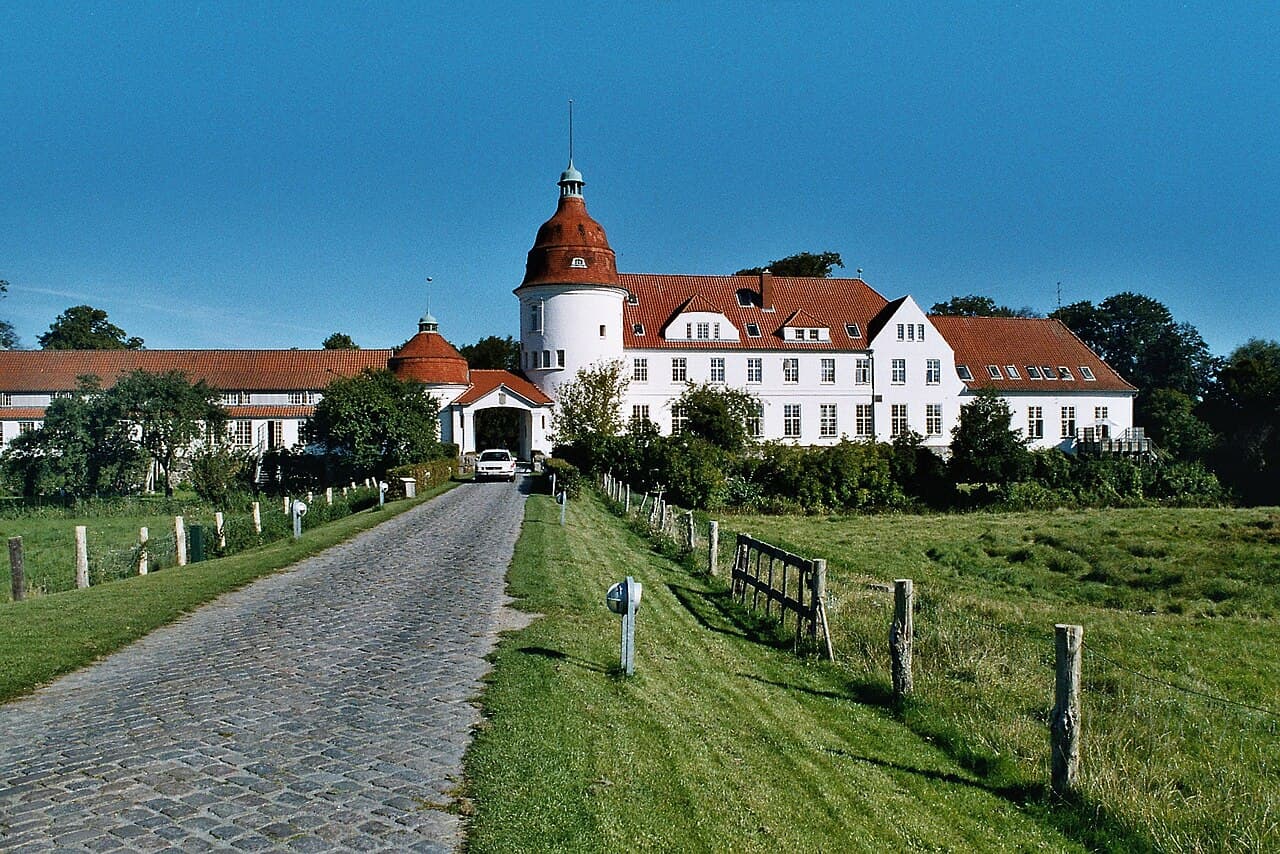
Nordborg Castle exemplifies a Renaissance hill castle adapted over centuries to meet changing defensive and residential needs. Its position on a hill overlooking Nordborg Lake provides natural defensive advantages and scenic views. The castle complex includes traditional elements such as fortified walls, gatehouses, and courtyards, which have been modified and restored through various phases of construction and reconstruction.
The 17th-century rebuilding introduced characteristic Renaissance architectural details, including the ducal coat-of-arms and refined masonry work. Restoration efforts in the early 20th century aimed to preserve these historic features while adapting the castle for educational use, balancing heritage conservation with functional modernization.
Cultural and historical significance
Nordborg Castle holds a unique place in Danish history as a site of medieval royal power, ducal residence, and cultural transformation. Its survival through wars, fires, and changing political landscapes reflects the resilience of Danish heritage sites. Today, it stands not only as a monument to the past but also as a living institution fostering education and the arts.
Frequently asked questions (FAQ)
- What is the historical significance of Nordborg Castle?
- Nordborg Castle was founded around 1150 as Alsborg and played a key role in medieval Danish defense and royal affairs. It later became a ducal residence and survived multiple occupations during the Swedish wars.
- Can I visit Nordborg Castle today?
- Yes, Nordborg Castle currently operates as a Danish boarding school and cultural venue. While it is not a traditional museum, visitors can attend events such as the Nord-Als Musikfestival or arrange visits through the school.
- When was Nordborg Castle rebuilt after the fire?
- The castle was severely damaged by fire in 1665 and rebuilding began in 1678 under the ownership of August of Plön, restoring its Renaissance features.
- Who was responsible for the 20th-century restoration of Nordborg Castle?
- Architect Eugen Fink led the 1909 restoration commissioned by the town of Nordborg to convert the castle into a high school and cultural center.
- What architectural style is Nordborg Castle?
- Nordborg Castle is primarily Renaissance in style, reflecting the 17th-century rebuilding and subsequent restorations that preserved its historic character.
Photo gallery

Information
Architect
Eugen Fink
Current owner
Nordborg Slot Foundation
Loading map...
Visitor reviews
No reviews yet. Been here? Write the first review and help other travelers!
Write the first reviewVisited this castle? Share your experience
Your review helps other travelers and adds first-hand knowledge to our encyclopedia.