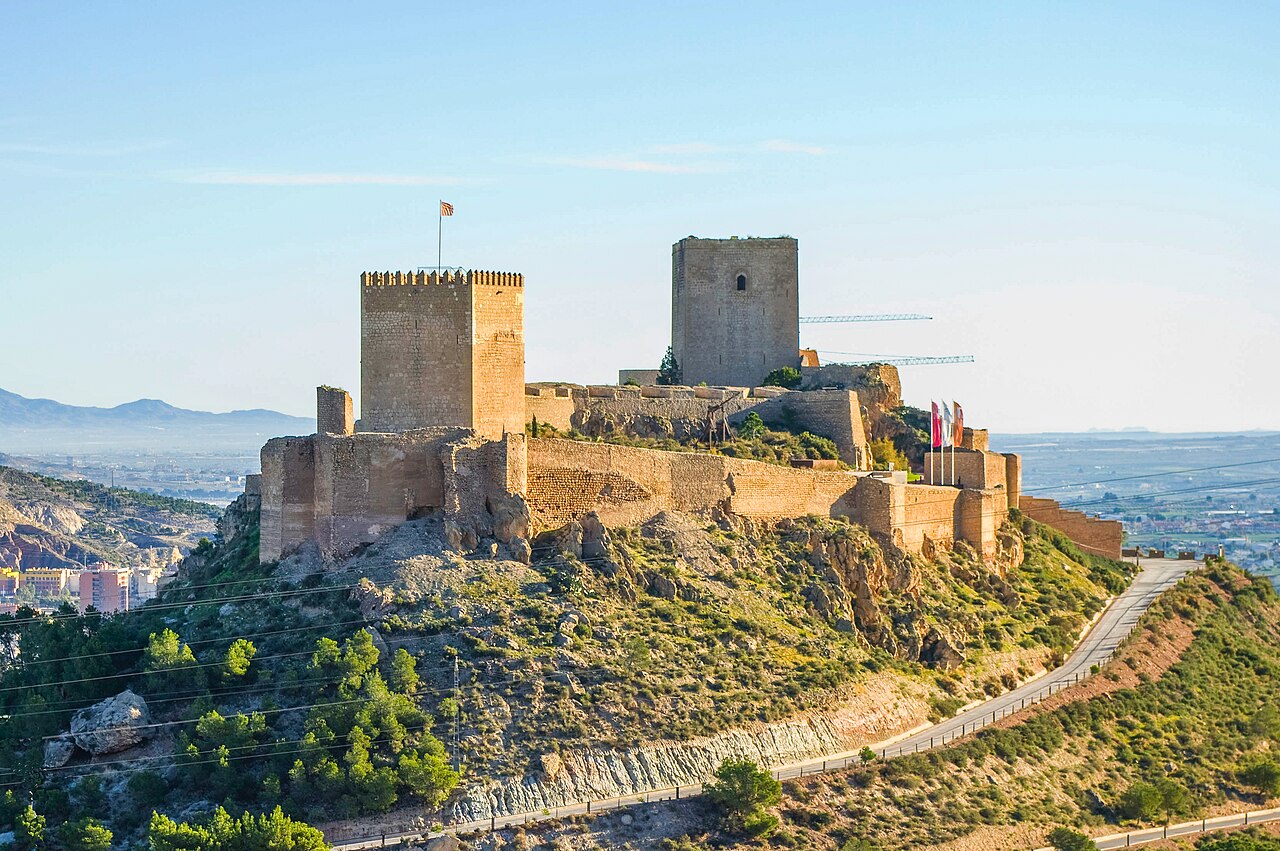
Nogalte Castle
Nogalte Castle, known locally as Castillo de Nogalte, is a significant medieval fortress perched on a hill in Puerto Lumbreras, within the Murcia region of Spain. This castle's strategic location provided control over vital water sources and key routes connecting important cities such as Lorca, Murcia, Granada, and Almería. The site reflects a rich tapestry of human occupation, spanning from the Bronze Age through the Islamic and Christian medieval periods to the early modern era.
The origins of Nogalte Castle trace back to the early 13th century, during the Islamic rule of the Kingdom of Murcia. Its earliest phase, the upper enclosure, was likely constructed as a fortified granary to protect agricultural resources amidst a period of insecurity. This phase is characterized by a polygonal plan covering approximately 1,000 square meters, with defensive features such as a bent entrance passage designed to hinder direct access. Inside, archaeologists uncovered multiple adjoining rooms containing millstones and a large cistern built with hydraulic mortar, underscoring the site's role in grain storage and water management.
Historical context and phases of construction
Islamic period and early construction
Constructed during the High Medieval period under Muslim rule, Nogalte Castle was part of a network of rural fortifications built to safeguard agricultural villages and estates. The castle's original function as a fortified barn or granary reflects the socio-economic priorities of the time, emphasizing resource protection in a landscape marked by political fragmentation and frequent conflict.
Christian conquest and modifications
Following the Christian Reconquista in the mid-13th century, the castle's strategic importance heightened due to its proximity to the newly established border with the Nasrid Emirate of Granada. In 1261, under the reign of Alfonso X of Castile, the fortress underwent significant expansion and reinforcement. The construction of a lower enclosure complemented the existing upper section, and defensive walls were strengthened to face potential threats from the south.
The addition of a tower and the reinforcement of walls during this phase demonstrate adaptation to evolving military needs. The passage connecting the two enclosures was designed with a triple bend (or triple codo), a defensive architectural feature intended to complicate enemy access. The castle was granted to a Castilian noble, Don Juan García de Villamayor, although the surrounding area remained sparsely populated due to ongoing conflicts.
Architectural features and materials
Fortification layout
The castle comprises two main enclosures surrounded by walls constructed using rammed earth techniques, a method involving compacted soil to create robust defensive structures. The upper enclosure is polygonal, measuring roughly 60 meters long by 18 meters wide, with an eastern entrance that turns sharply to prevent direct assault.
Inside the upper enclosure, the discovery of at least three adjoining rectangular rooms containing millstones indicates its use for grain storage and processing. The presence of a large cistern, approximately 12.5 by 2.8 meters, highlights the importance of water conservation for sustaining the fortress's inhabitants and protecting food supplies during sieges.
Lower enclosure and defensive enhancements
The lower enclosure, added during the Christian phase, includes remnants of northern, eastern, and southern walls and a complex of earth-built rooms. The fortification's towers, oriented towards the north and west, reflect defensive concerns about attacks from the Nasrid Kingdom to the south. The use of rammed earth for walls and towers is consistent with regional construction practices of the period.
Later occupation and cave houses
18th-century cave dwellings
From the 18th century onwards, the hill around Nogalte Castle was transformed by the construction of numerous cave houses carved into the rock. These troglodyte homes were modest family dwellings that adapted the natural landscape for habitation. This form of rupestrian architecture is a distinctive feature of the region and represents an important cultural layer in the site's history.
Many of these cave houses have been preserved and converted into small museums, offering visitors insight into traditional living conditions and local heritage. The combination of the medieval fortress and the cave complex provides a unique historical and architectural experience.
Current condition and visitor experience
Today, Nogalte Castle stands as a partially restored ruin, with extensive conservation efforts aimed at stabilizing the structure and enhancing visitor access. While some restorations have altered the site's original historic ambiance, the castle remains a valuable cultural landmark.
The site is freely accessible during daytime hours and includes a visitor center that offers guided tours. Visitors can explore both the medieval fortifications and the cave houses, gaining a comprehensive understanding of the area's long history of human settlement and defense.
Overall, Nogalte Castle is a remarkable example of Islamic and Christian military architecture in southeastern Spain, enriched by a unique troglodyte village that illustrates centuries of adaptation to the landscape and changing political realities.
Frequently asked questions (FAQ)
- How do I get to Nogalte Castle?
- Nogalte Castle is located in Puerto Lumbreras, Spain, and can be reached by car or public transport. The castle is situated just a few kilometers from the town center, making it easily accessible for visitors. Local roads are well-maintained, and there is parking available nearby.
- What is the historical significance of Nogalte Castle?
- Nogalte Castle dates back to the 15th century and served as a defensive stronghold during the Reconquista. Its strategic location allowed it to oversee the surrounding area, making it an important military site. Today, it stands as a testament to the region's rich history and architectural evolution.
- When was Nogalte Castle built?
- Construction of Nogalte Castle began in the early 15th century, with significant modifications made over the years. It reflects various architectural styles that evolved during its use, particularly during the Middle Ages. The castle has been preserved to showcase its historical significance and architectural beauty.
- Can I visit Nogalte Castle year-round?
- Yes, Nogalte Castle is open to visitors year-round, although opening hours may vary by season. It is recommended to check the official website or local tourist information for the most current visiting hours. Guided tours are also available to enhance your experience.
- Why is Nogalte Castle a popular tourist attraction?
- Nogalte Castle is popular for its stunning views of the surrounding landscape and its well-preserved architecture. Visitors are drawn to its historical significance and the opportunity to explore a key site from Spain's past. The castle also hosts cultural events and exhibitions, adding to its appeal.
- Is it possible to access Nogalte Castle with mobility issues?
- While Nogalte Castle is a historic site, some areas may be challenging for those with mobility issues due to uneven terrain and stairs. However, efforts have been made to improve accessibility for visitors. It is advisable to contact the castle administration for specific accessibility accommodations before planning your visit.
- What are the ticket prices for visiting Nogalte Castle?
- Tickets for Nogalte Castle are reasonably priced, usually ranging from a few euros for adults, with discounts available for children, seniors, and groups. Special rates may apply for guided tours or events. Be sure to check the official website for the latest pricing information and any special offers.
- What is the best time to visit Nogalte Castle?
- The best time to visit Nogalte Castle is during the spring and fall when the weather is mild and comfortable for exploring. Summer can be quite hot, while winter may bring cooler temperatures. Early mornings and late afternoons are ideal for fewer crowds and picturesque lighting for photography.
- Are there any nearby attractions to visit along with Nogalte Castle?
- Yes, visitors to Nogalte Castle can also explore the beautiful town of Puerto Lumbreras, which offers charming streets and local shops. Nearby attractions include the archaeological site of La Bastida and the stunning natural landscapes of the Sierra Espuña Regional Park. These sites provide a full day of exploration and enjoyment in the area.
Information
Address
Calle Tejera 33, Puerto Lumbreras, Murcia, Spain
Loading map...
Visitor reviews
No reviews yet. Been here? Write the first review and help other travelers!
Write the first reviewVisited this castle? Share your experience
Your review helps other travelers and adds first-hand knowledge to our encyclopedia.