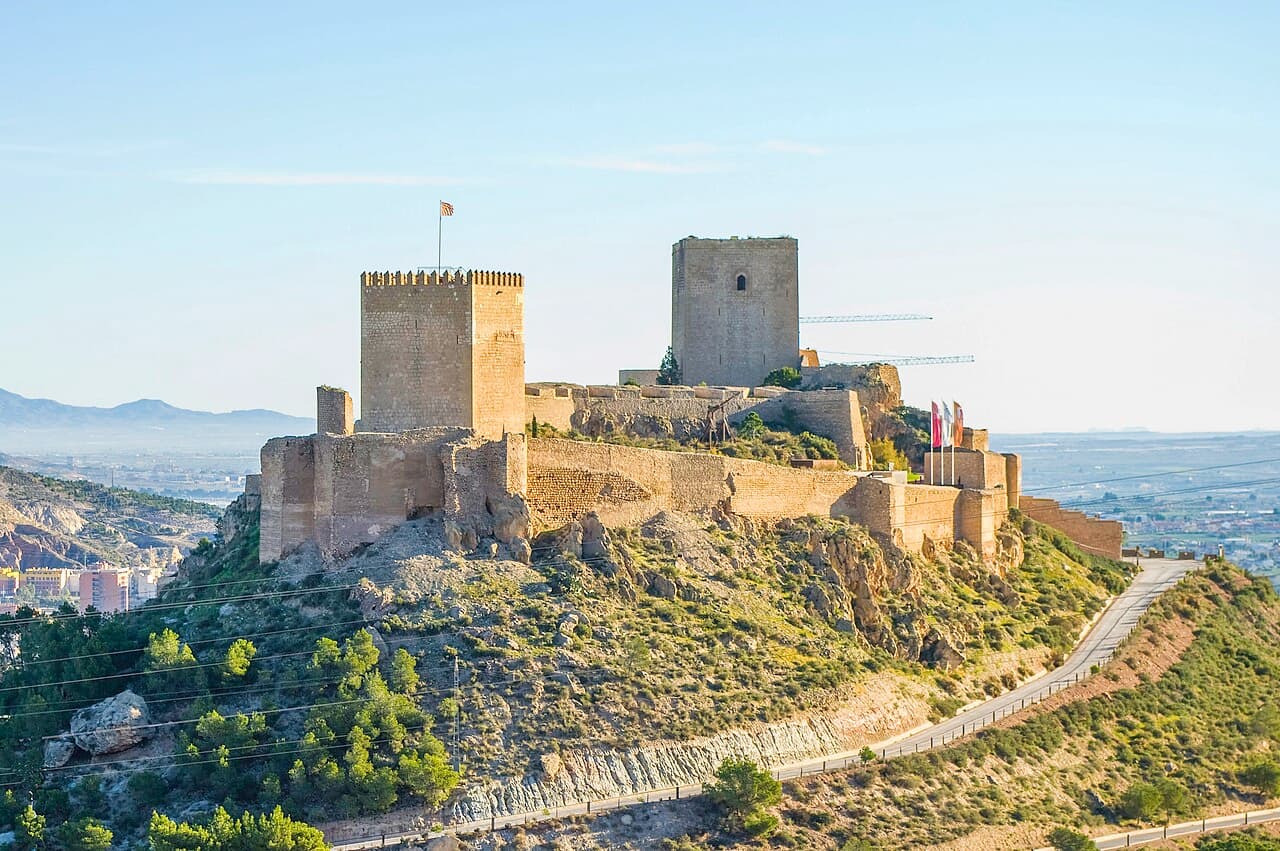
Lorca Castle
Lorca Castle, locally known as Castillo de Lorca or Fortaleza del Sol, is a monumental fortress perched on a mountain ridge overlooking the city of Lorca in the Murcia region of southeastern Spain. This medieval fortress stands as one of the largest castles in Spain, stretching approximately 640 meters long and 120 meters wide, encompassing an extensive fortified complex that reflects a rich history spanning from the Neolithic period through the Middle Ages and into modern times.
The site of Lorca Castle has been inhabited since the Neolithic and Bronze Ages, with archaeological evidence of an Argaric culture settlement beneath the fortress, including homes, funerary sites, and a protective wall. The first documented mention of a castle at Lorca dates back to the 9th century during the Muslim rule of the Iberian Peninsula, when the city was known as Lurqa and was part of the Cora of Tudmir, an administrative district of Al-Andalus.
Muslim origins and fortress design
During the Muslim era, Lorca Castle was a formidable alcazaba built on a mountain ridge running east to west. The fortress was divided by the Espaldón Wall into two main sections: the western bailey served as a protected area for storing livestock and grain during times of siege, while the eastern bailey, known as the barrio de Alcalá, was a residential quarter that included several cisterns and a significant Jewish neighborhood. The castle's walls extended beyond the main fortress to enclose surrounding neighborhoods and markets, reflecting its role as a key military and urban center in the region.
Strategic importance during the reconquista
In 1243, following the Treaty of Alcaraz which made the Muslim Taifa of Murcia a protectorate of Castile, Lorca refused to accept the treaty terms. This led to a siege in 1244 by a large Castilian army commanded by the future King Alfonso X of Castile. The fortress surrendered after the siege, marking the beginning of Christian rule.
Subsequently, Lorca Castle became a vital defensive stronghold on the frontier against the Nasrid Kingdom of Granada. For over two and a half centuries, it served as a watchpoint and military bastion guarding the southeastern border of Christian Spain.
Christian reconstruction and architectural evolution
In the latter half of the 13th century, the castle underwent extensive reconstruction under Christian rule. The outer walls were reinforced and two prominent keeps were constructed: the Alfonsina Tower in the eastern bailey and the Espolón Tower in the western bailey. These towers replaced most of the original Muslim structures, leaving only foundational elements and the Espaldón Wall as remnants of the earlier phase.
The Alfonsina Tower is a rectangular structure measuring approximately 22.7 by 19.4 meters, with walls up to four meters thick and a height nearing 30 meters. It contains three floors and a terrace, with brick vaults featuring diamond-shaped panels and arrow slits for lighting and defense. The Espolón Tower, square in plan with sides of 13 meters, features brick ribbed vaults supported by stone ribs, a battlemented terrace, and a basement cistern for water storage. Both towers were integral to the castle’s defensive capabilities.
The jewish quarter within the alcazaba
Within the fortress lies the remains of a Jewish quarter (Judería), covering about 5,700 square meters. Archaeological excavations uncovered twelve homes and a synagogue dating from the 14th century, the only known medieval synagogue in the Murcia region. The homes were rectangular with multiple rooms, elevated bedrooms, built-in benches, kitchens, and storage spaces. The synagogue is semi-subterranean, designed to maximize interior height while maintaining a discreet exterior profile, featuring a women's gallery and Gothic-style plasterwork decorating the niche for Torah scrolls.
Decline and later history
After the conquest of Granada in 1492, the frontier shifted southward, diminishing Lorca Castle’s military significance. The expulsion of Jews from Spain shortly thereafter led to the abandonment of the Jewish quarter and significant depopulation of the fortress area. Over the following centuries, the castle fell into ruin, with much of its structure deteriorating by the 18th century.
The castle saw a revival during the early 19th century amid the Peninsular War (War of Spanish Independence), when walls and structures were repaired and modified, including the installation of artillery batteries that altered its medieval appearance.
Modern recognition and preservation efforts
In the 20th century, Lorca Castle gained official recognition for its cultural and historical value. The Alfonsina Tower and the castle were declared a National Historic Monument in 1931, and the historic center of Lorca, including the castle, was designated a Historic-Artistic Group in 1964.
The castle suffered serious damage during the 2011 Lorca earthquake, particularly to the walls and the Espolón Tower. Restoration work was undertaken and completed by 2012, although some battlements were not reconstructed due to lack of historical documentation.
Today, the castle precinct includes a Parador de Turismo, a luxury hotel integrated within the fortress that incorporates archaeological remains discovered during excavations, including parts of the Jewish quarter and synagogue. The castle is open to visitors for a fee and remains a significant cultural landmark and tourist attraction in the Murcia region.
Frequently asked questions (FAQ)
- What is the historical significance of Lorca Castle?
- Lorca Castle, also known as the Castle of the Sun, is a medieval fortress that dates back to the 9th century, showcasing a rich blend of Islamic and Christian architectural styles. It played a crucial role in the Reconquista and served as a strategic military stronghold throughout its history.
- When was Lorca Castle built?
- The construction of Lorca Castle began in the 9th century during Muslim rule in the region. It was expanded and modified over the centuries, particularly after the Christian conquest in 1244, reflecting various architectural influences.
- How do I get to Lorca Castle?
- Lorca Castle is easily accessible by car or public transportation. If you're traveling by train, the Lorca train station is approximately 10 minutes away by taxi, and local buses also connect the station to the castle.
- What are the opening hours of Lorca Castle?
- Lorca Castle is open to visitors throughout the year, with varying hours depending on the season. Typically, it opens daily from 10:00 AM to 7:00 PM, but it's advisable to check the official website for any seasonal changes or special closures.
- Can I purchase tickets in advance for Lorca Castle?
- Yes, tickets for Lorca Castle can be purchased in advance online through the official website, which is recommended during peak tourist seasons. This allows you to avoid long queues and secure your preferred visit time.
- Is Lorca Castle accessible for visitors with mobility issues?
- Lorca Castle has made efforts to improve accessibility for all visitors, including those with mobility issues. However, due to its historical nature, some areas may still be challenging to navigate, so it's best to check with staff for assistance and available facilities.
- What is the best time to visit Lorca Castle?
- The best time to visit Lorca Castle is during the spring and fall when temperatures are mild, making for a comfortable exploring experience. Additionally, these seasons often feature fewer crowds, allowing for a more enjoyable visit.
- Are there any nearby attractions to explore?
- Yes, nearby attractions include the historic city center of Lorca, featuring charming streets and local shops, as well as the Basilica de San Patricio and the archaeological museum. These sites enhance your visit and provide a deeper insight into the region's history.
- What are the ticket prices for Lorca Castle?
- Ticket prices for Lorca Castle are generally affordable, with discounts available for children, seniors, and groups. Check the official website for the most current pricing and any special offers that may be available during your visit.
Photo gallery

Photo by Jose Lorca•Public domain
Information
Sources & official resources
Verify the information above using these authoritative references.
Loading map...
Visitor reviews
No reviews yet. Been here? Write the first review and help other travelers!
Write the first reviewVisited this castle? Share your experience
Your review helps other travelers and adds first-hand knowledge to our encyclopedia.



