Nitra Castle
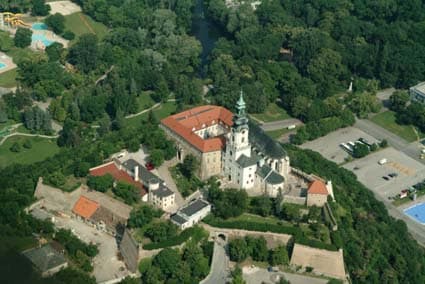
Nitra Castle stands prominently on a hill overlooking the city of Nitra in Slovakia, a site with a rich history dating back to the High Medieval period. Constructed initially in the 11th century on the foundations of an earlier fortification, the castle complex has evolved over centuries, reflecting the region's shifting political, military, and religious landscape. It remains a significant cultural monument, combining architectural styles from Romanesque to Baroque, and serving historically as a fortress, episcopal seat, and administrative center.
Early history and strategic importance
The site of Nitra Castle was first fortified in the late 8th century as part of a Slavic principality, making it one of the earliest centers of power in the region. The hill, rising approximately 220 meters above sea level and naturally defended on three sides by the Nitra River, provided an ideal location for defense and control. During the 9th century, under the influence of Great Moravia, the fortress was expanded and strengthened to serve as a princely seat, marking its importance in early medieval politics.
The earliest written records mention a basilica dedicated to Saint Emeram (also known as Jimram), which is part of the current castle complex and dates back to the 11th century. This church, built in the Romanesque style, is the oldest surviving structure within the castle grounds and symbolizes the early Christianization of the region.
Medieval development and architectural evolution
Throughout the High Medieval period, Nitra Castle underwent significant transformations. The original Romanesque church was complemented in the 14th century by the construction of the Upper Gothic Church, showcasing the transition to Gothic architectural elements such as pointed arches and ribbed vaults. The castle's fortifications were reinforced during this era, including the erection of Vazil's Tower, a key defensive structure associated with local legends.
The castle's defenses were tested during the 13th century, surviving the Mongol invasion of 1241 with limited damage. However, in 1271, the fortress was besieged and largely damaged by forces under Prěmysl Otakar II, leading to the burning of Saint Emeram's church and destruction of parts of the defensive walls. Subsequent restoration efforts rebuilt the church and strengthened the fortifications.
From the 14th to 16th centuries, the castle was influenced by prominent rulers such as Matúš Čak Trenčiansky, Sigismund of Luxembourg, and Matthias Corvinus. The castle suffered heavy damage in 1465 during conflicts involving Corvinus's troops but was rebuilt, reflecting the ongoing military and administrative importance of the site.
Renaissance and baroque modifications
In response to the rising threat of the Ottoman Turks during the 16th century, Nitra Castle's defenses were further reinforced. New fortifications, including an inner gate and a Renaissance-style palace, were constructed to enhance the castle's military capabilities while providing improved residential and administrative facilities.
Despite robust defenses, the castle was briefly occupied by Turkish forces in 1663, after which extensive reconstruction of the defensive system took place. The 17th and 18th centuries saw the addition of the Lower Church and the transformation of the Bishop's Palace from its original Gothic form into a Late Baroque style building, reflecting changing tastes and the castle's ecclesiastical function.
Architectural highlights and surviving structures
The castle complex today showcases a blend of architectural styles and historical layers. The Romanesque Church of St. Emmeram remains the oldest part of the complex, notable for its robust stone construction and early medieval design. The Upper Gothic Church, with its characteristic pointed arches and ribbed vaults, highlights the castle's evolution during the 14th century.
Vazil's Tower stands as a surviving medieval fortification element, linked to local legends of imprisonment within its dungeons. The Bishop's Palace, remodeled in the 18th century, exhibits the elegant forms of Late Baroque architecture, serving as a residence and administrative center for the bishopric.
Fortification walls from various periods survive, including medieval stone walls with projecting bastions and later Renaissance defensive structures designed to counter artillery threats. The inner gate from the 16th century remains intact, illustrating the castle's adaptation to changing military technologies.
Cultural significance and current status
Nitra Castle has served as the seat of the Nitra bishopric since 1296, following a royal grant by King Andrew III to Bishop Pascház, who also undertook repairs after earlier conflicts. This long-standing ecclesiastical role has shaped much of the castle's architectural and cultural development.
Today, the castle is a well-preserved hill castle and a dominant landmark in the city of Nitra. It attracts visitors interested in medieval history, architecture, and Slovak cultural heritage. The ongoing remodeling of the church and preservation efforts aim to maintain the castle's historical integrity while enhancing its accessibility and educational value.
The castle's layered history, combining military, religious, and administrative functions, offers a rich narrative of Central European history from the early medieval period through the Baroque era. Its architectural diversity and strategic location continue to make Nitra Castle a significant monument in Slovakia's cultural landscape.
Frequently asked questions (FAQ)
- What is the best time to visit Nitra Castle?
- The best time to visit Nitra Castle is during the warmer months from late spring to early autumn, when the weather is pleasant and the castle grounds are fully accessible.
- Can I tour the interior of St. Emmeram's Cathedral at Nitra Castle?
- Yes, visitors can tour the interior of St. Emmeram's Cathedral, which is a central feature of the castle complex, although some areas may be undergoing remodeling.
- How do I get to Nitra Castle from the city center?
- Nitra Castle is located on a hill in the city center of Nitra and is accessible on foot via well-marked paths from the town square, making it an easy walk for most visitors.
- Are there guided tours available at Nitra Castle?
- Guided tours are available at Nitra Castle, offering detailed historical and architectural insights to enhance the visitor experience.
- Is Nitra Castle suitable for families with children?
- Yes, Nitra Castle is family-friendly, with open spaces and engaging historical exhibits that can interest children and adults alike.
Photo gallery

Information
Sources & official resources
Verify the information above using these authoritative references.
Loading map...
Visitor reviews
No reviews yet. Been here? Write the first review and help other travelers!
Write the first reviewVisited this castle? Share your experience
Your review helps other travelers and adds first-hand knowledge to our encyclopedia.