
Nihonmatsu Castle
Nihonmatsu Castle, also known as Kasumiga-jo, is a historically significant hill castle located in Nihonmatsu city, Fukushima Prefecture, Japan. It stands as a remarkable testament to the turbulent Late Medieval period in Japanese history, specifically during the Muromachi period (1333-1573). The castle complex uniquely comprises the ruins of two distinct castles built on the same hill but at different times and by different ruling clans.
The original castle was constructed between 1394 and 1427 by the Hatakeyama clan, a powerful samurai family during the Muromachi era. This early fortress occupied the summit of the hill, commanding a strategic vantage point over the surrounding landscape. The castle's honmaru (main bailey) was fortified with robust stone walls that still partially survive today. The elevated position provided natural defense advantages, typical of hill castles (yamajiro) in Japan, allowing defenders to monitor approaching enemies and control the nearby routes.
The original castle and its dramatic history
The original Hatakeyama-built castle played a pivotal role in the regional conflicts of the late 16th century. In 1585, Hatakeyama Yoshitsugu captured Date Terumune, the father of the famous warlord Date Masamune. This event triggered a violent confrontation when Masamune, who was hunting nearby, quickly pursued Yoshitsugu’s party to the Abukuma River. The ensuing clash resulted in the death of Terumune and the entire party, marking a significant moment in the castle's history.
Following this, a coalition of samurai from Hitachi Province (modern-day Ibaraki Prefecture), including warriors from the Satake, Ashina, Iwaki, and Ishikawa clans, attempted to seize Nihonmatsu Castle. They engaged Date forces near present-day Motomiya in the battle of Hitotoribashi. The battle ended in a stalemate, leaving Kasumiga-jo independent from either faction's control.
In April 1586, Date Masamune's forces laid siege to Kasumiga-jo once again. By July, the son of Hatakeyama Yoshitsugu set fire to the castle and fled to Aizu, leading to the castle's abandonment and the end of its original incarnation.
The second castle and its legacy
After the destruction of the original castle, a new fortress was constructed at the base of the hill by the Niwa clan. This second castle served as the main seat of power in Nihonmatsu for several centuries. The Niwa clan controlled the castle from 1643 until the Meiji Restoration in the late 19th century, overseeing a period of relative peace and administrative governance rather than military conflict.
The castle's architecture evolved during this time, reflecting the changing needs from a purely defensive stronghold to a residence and administrative center. Although much of the original structures have not survived intact, remnants of stone walls and gates remain, providing insight into the castle's layout and construction techniques.
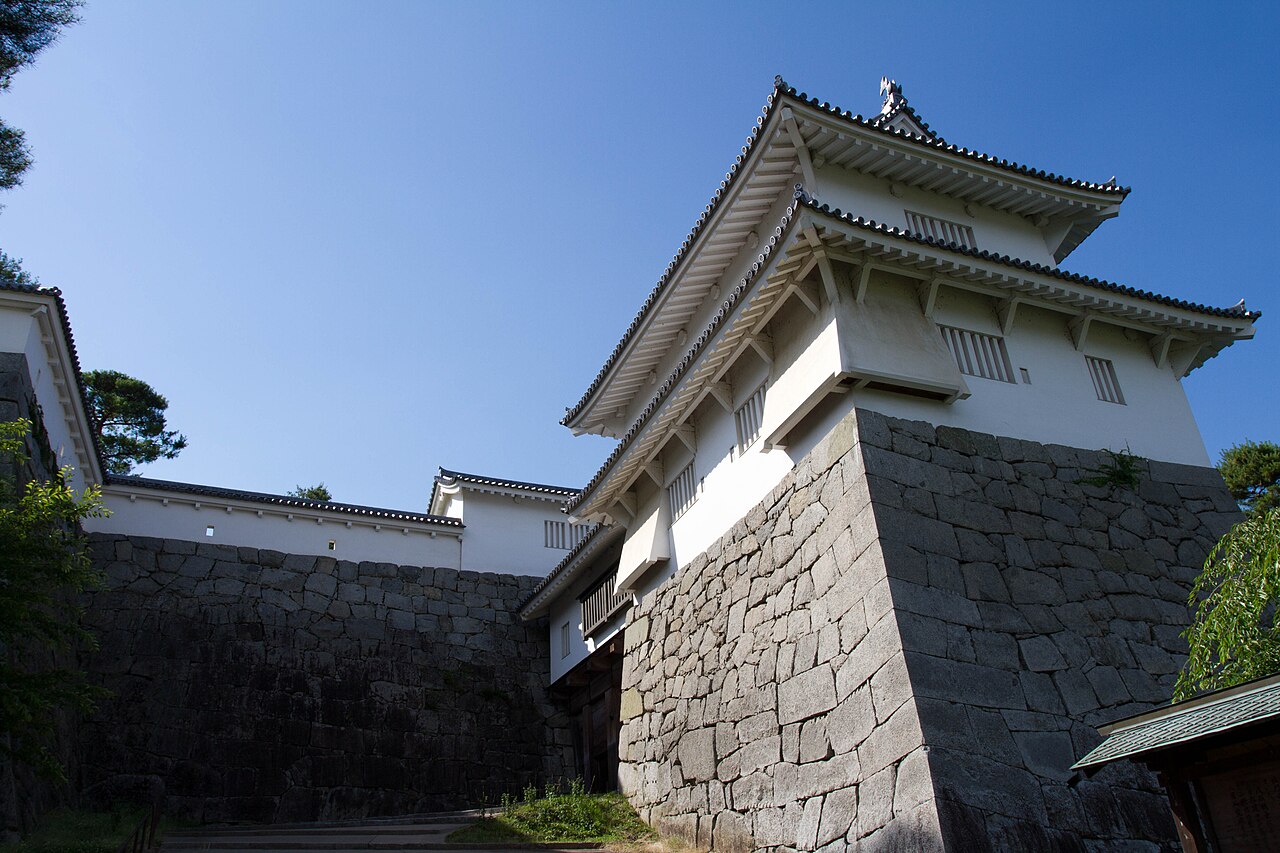
Photo by baku13 • CC BY-SA 2.1 jp
Architectural features and site layout
The castle complex is characterized by its honmaru at the summit, surrounded by stone fortifications typical of the period. Visitors today can hike to the top of the hill to explore the ruins and appreciate the commanding views of the surrounding Fukushima landscape. The reconstructed Minowa Gate near the base serves as an entrance point and a reminder of the castle's historical significance.
The castle grounds include remnants of defensive walls, moats, and baileys that illustrate the strategic design employed by the Hatakeyama and later the Niwa clans. The use of natural topography combined with man-made fortifications exemplifies classic yamajiro defensive architecture.
Modern cultural significance and visitor experience
Today, Nihonmatsu Castle is a cherished cultural heritage site attracting visitors interested in Japanese history and castle architecture. The castle ruins are partially preserved, allowing for exploration and educational opportunities. The site is particularly famous for its Chrysanthemum Festival, held annually from October to November, which showcases elaborate floral displays and traditional celebrations, enhancing the cultural experience for visitors.
The hiking trail to the honmaru and stone walls is a popular activity, offering both historical insight and scenic beauty. The panoramic views from the hilltop provide a unique perspective on the castle's strategic location and the surrounding region.
Access and visitor information
Visitors can reach the castle ruins by a short hike from the reconstructed Minowa Gate. The site is accessible year-round, with the autumn months being the most popular due to the Chrysanthemum Festival. While the castle is not fully restored, the partially preserved ruins and interpretive signage help visitors understand the site's historical context and architectural features.
Overall, Nihonmatsu Castle offers a compelling glimpse into Japan's feudal past, combining natural beauty with rich historical narratives and architectural heritage.
Frequently asked questions (FAQ)
- How do I get to Nihonmatsu Castle?
- Nihonmatsu Castle is located in Nihonmatsu city, Fukushima Prefecture. Visitors can reach the castle ruins by a short hike from the reconstructed Minowa Gate, which serves as the main entrance.
- What is the historical significance of Nihonmatsu Castle?
- Nihonmatsu Castle played a key role in regional conflicts during the Late Medieval period, especially involving the Hatakeyama and Date clans. Its strategic hilltop location made it a vital military stronghold.
- When is the best time to visit Nihonmatsu Castle?
- The best time to visit Nihonmatsu Castle is during the Chrysanthemum Festival held from October to November, when the castle grounds are adorned with impressive floral displays and cultural events.
- Can I explore the castle ruins?
- Yes, visitors can hike to the honmaru at the summit to explore the stone walls and ruins. Interpretive signage helps provide historical context during the visit.
- Is Nihonmatsu Castle fully restored?
- No, Nihonmatsu Castle is partially preserved with some reconstructed elements like the Minowa Gate. The main structures remain in ruins, offering an authentic historic experience.
Photo gallery

Information
Website
Visit websiteSources & official resources
Verify the information above using these authoritative references.
Loading map...
Visitor reviews
No reviews yet. Been here? Write the first review and help other travelers!
Write the first reviewVisited this castle? Share your experience
Your review helps other travelers and adds first-hand knowledge to our encyclopedia.