Niemodlin
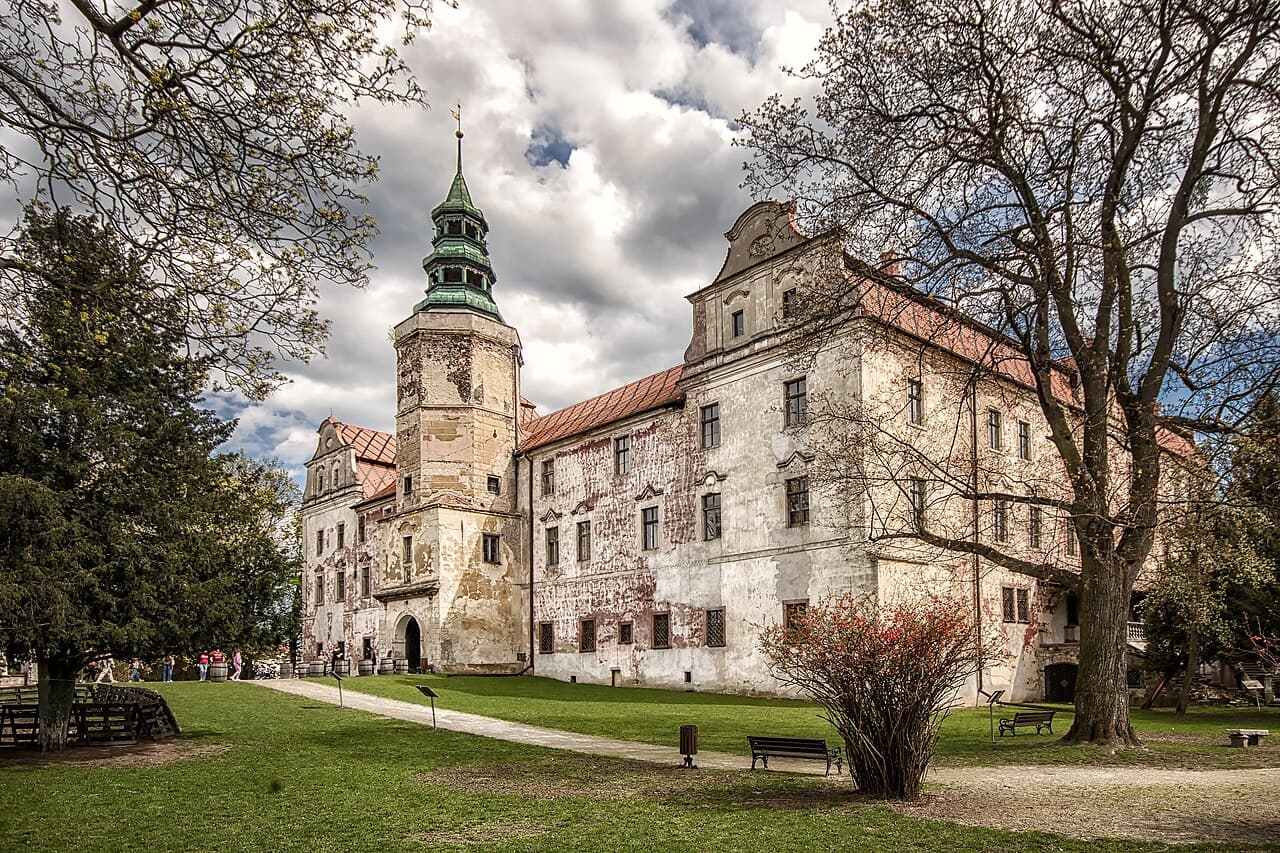
Niemodlin Castle stands as a remarkable example of architectural evolution from a medieval defensive tower to a Renaissance palace nestled in the town of Niemodlin, Poland. Its origins trace back to the early 13th century when Prince Kazimierz I of Opole established the first fortified structure on a strategic site near the Ścinawa Niemodlińska river. This initial stronghold, a rectangular stone tower surrounded by a water-filled moat, served multiple roles: a symbol of princely power, a military bastion, and an administrative checkpoint collecting tolls from merchants traveling along intersecting trade routes.
By the late 13th century, the settlement was granted German town rights and renamed Falkenberg, becoming the seat of a newly created castellany. In 1294, the first castellan Syghard, representing Duke Bolko I of Opole, was recorded. The original tower was replaced by a larger, more imposing stone tower with robust buttresses, constructed on a rectangular plan with foundations of fieldstones and broken limestone, and upper parts likely built of brick. This tower was incorporated into the town’s defensive walls, with its moat connected to the city moat, enhancing the fortress's protection.
Medieval origins and early development
Following Duke Bolko I's death in 1313, Niemodlin became the capital of a smaller duchy under his son Bolko II Niemodliński. The castle complex expanded with a brick defensive wall supported by buttresses enclosing an inner courtyard of nearly 1400 square meters, where wooden residential buildings were erected. The main gate faced southeast, and an economic suburb developed northwest of the castle. The castle's strategic location near river fords and trade routes made it a vital regional power center.
The 15th century brought turmoil; in 1428, during the Hussite Wars, the castle and town were severely damaged by the Taborite forces. Reconstruction efforts led by Duke Bernard, who inherited the duchy around 1400, involved dismantling the old tower and erecting a three-story residential building on the site, utilizing the filled southeastern moat section for its foundation. This new structure featured four rooms per floor, a grand hall adorned with colorful polychrome paintings, and a castle chapel in the eastern corner. Defensive features were maintained with narrow pointed-arch windows and buttresses supporting the exterior walls. The courtyard was enlarged by moving the northeast wall, and a new gate was positioned on the northwest curtain wall.
Renaissance transformation and architectural expansion
After Duke Bernard’s death in 1450, Niemodlin passed through various hands, including the Opole dukes and eventually the Habsburg monarchy in 1532. The castle suffered a devastating fire in 1552, after which it was pledged and sold to the Pückler family in the late 16th century. The Pücklers initiated an extensive Renaissance reconstruction, lasting from 1581 to 1619, transforming the medieval fortress into a stately palace.
This phase saw the addition of three-story arcaded galleries, a masonry kitchen, and a new northwest wing featuring a gate tower with sgraffito decoration and a distinctive high spire. A spiral staircase tower was inserted in the courtyard corner between buildings. The gate tower was equipped with a clock and two plate bells, marking an advancement in functional and decorative elements. The castle’s layout evolved into a closed quadrangle with a large arcaded courtyard, while still retaining its defensive moat and drawbridge access.
Further expansions in the early 17th century under the Promnitz family included the construction of northeast and southeast wings, connected by two-story corridors with stair towers crowned by attics. An outer defensive wall with bastions and a gate led to the economic suburb, emphasizing the castle's dual role as a noble residence and fortified stronghold.
Baroque modifications and decline
In the mid-17th century, Bernard von Zierotin acquired Niemodlin, inheriting a heavily indebted estate and a castle damaged by the Thirty Years’ War. Restoration efforts included modest Baroque updates to the façade, replacing the drawbridge with a stone bridge adorned with Baroque sculptures of saints Wendelin, Florian, Anthony of Padua, and John of Nepomuk. The castle remained in the Zierotin family until 1779, after which it passed to the Praschma family.
Between the late 18th and early 19th centuries, the castle underwent significant interior alterations: the cloister galleries were walled up and fitted with windows, mansard roofs replaced earlier roofing, and corner towers lost their Renaissance attics. The moat was filled in and replaced by an English-style park, signaling a shift from fortress to palatial residence. The Baroque chapel was remodeled in the 19th century with Neo-Gothic elements, and the gatehouse received an eclectic makeover. A terrace supported by arcades was added to the southwest wing, enhancing the castle's residential character.
20th century restoration and modern use
In the early 20th century, Hans Praschma undertook a careful restoration aimed at reviving the castle’s Renaissance-Baroque appearance, guided by conservation authorities. Renovations included exposing the lower cloister galleries, refurbishing the main hall with its historic polychrome decorations, and restoring the sgraffito façade of the gate tower. The Praschma family left Niemodlin in 1945 amidst the turmoil of World War II and never returned.
Post-war, the castle served various institutional functions, including a gymnasium, a high school, and a military officers' school. Structural deterioration led to the removal of educational facilities in the late 1970s, and the property was transferred to the Ministry of Justice. Archaeological excavations uncovered remains of the earliest medieval towers, enriching the understanding of the castle’s origins. In 1990, Niemodlin Castle entered private ownership, and subsequent management has focused on preservation and cultural activities.
Architectural features and cultural significance
The castle today consists of three tall wings and a lower southeast wing closing the quadrangle. The courtyard is surrounded on three sides by arcaded galleries, with stair towers at each corner. The prominent gate tower with its passageway retains elements of Renaissance and Gothic construction, including decorative sgraffito and a family coat of arms cartouche.
Inside, visitors can explore basement corridors beneath three wings, the chapel, and several ground-floor rooms. Noteworthy features include a medieval torture chamber and a replica Amber Room, although access to the latter is currently restricted. The castle’s parkland hosts a herd of fallow deer, maintaining a connection to its noble past.
Niemodlin Castle exemplifies the transformation of a lowland medieval fortress into a magnate’s palace, reflecting the complex history of Silesian nobility and architectural trends from the Middle Ages through the Renaissance and Baroque periods. Its preservation and adaptive reuse continue to make it a significant cultural landmark in Poland.
Frequently asked questions (FAQ)
- What is the historical significance of Niemodlin Castle?
- Niemodlin Castle, originally built in the 13th century, is an important example of medieval architecture in Poland. It served as a residence for various noble families and played a crucial role in regional politics and military history during its time.
- When was Niemodlin Castle constructed?
- The construction of Niemodlin Castle began in the 13th century, with significant modifications and expansions occurring in the following centuries. The castle's structure reflects various architectural styles that evolved over time, marking its long-standing presence in the area.
- What are the opening hours for Niemodlin Castle?
- Niemodlin Castle is typically open to visitors from Wednesday to Sunday, with specific hours that may vary by season. It is advisable to check the official website or local tourist information for the most current opening times before planning your visit.
- Can I take guided tours of Niemodlin Castle?
- Yes, guided tours are available at Niemodlin Castle, providing visitors with in-depth knowledge of its history and architectural features. These tours are a great way to explore the castle while learning about its significance and stories from knowledgeable guides.
- Is it possible to purchase tickets in advance for Niemodlin Castle?
- Yes, tickets for Niemodlin Castle can often be purchased in advance through the official website or at local tourist information centers. Buying tickets ahead of time is recommended, especially during peak tourist seasons, to ensure your spot.
- What is the best time to visit Niemodlin Castle?
- The best time to visit Niemodlin Castle is during the late spring and early autumn months when the weather is pleasant, and the surrounding gardens are in full bloom. These seasons also offer fewer crowds, allowing for a more enjoyable experience.
- Are there any nearby attractions to Niemodlin Castle?
- Yes, nearby attractions include the charming town of Niemodlin itself, as well as other historical sites and natural parks in the region. Visitors can explore local museums, parks, and other castles, making for a full day of sightseeing.
- How accessible is Niemodlin Castle for visitors with mobility challenges?
- Niemodlin Castle has made efforts to improve accessibility for visitors with mobility challenges, but some areas may still present difficulties due to the castle's historical architecture. It is advisable to contact the castle management in advance to inquire about specific accommodations and accessibility options.
Photo gallery

Information
Website
Visit websiteSources & official resources
Verify the information above using these authoritative references.
Loading map...
Visitor reviews
No reviews yet. Been here? Write the first review and help other travelers!
Write the first reviewVisited this castle? Share your experience
Your review helps other travelers and adds first-hand knowledge to our encyclopedia.



