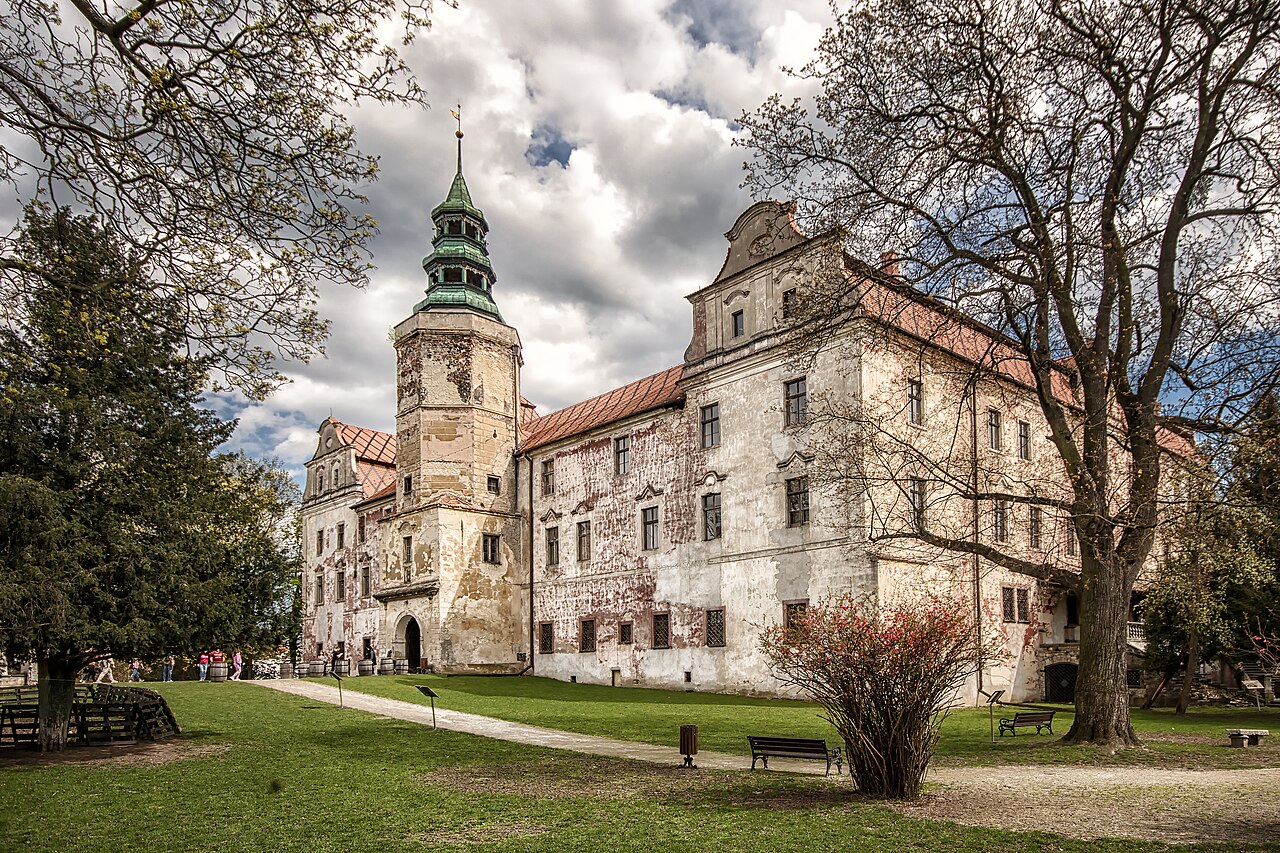
Kantorowice
Kantorowice Castle stands as a notable example of a Renaissance hill castle in Poland, with its origins dating back to around 1600. Located in the village of Kantorowice, the castle's history is deeply intertwined with the regional developments of the late 16th and early 17th centuries. The first recorded mention of Kantorowice village appears in 1359, but it was not until the end of the 16th century that the site gained prominence when it became the property of the dukes of Brzeg. Under their patronage, the castle was constructed as a residence reflecting the architectural trends of the late Renaissance period.
Architectural design and features
The castle was originally built as a two-story rectangular building featuring a distinctive square tower at the eastern corner, which housed a staircase. This tower not only provided vertical circulation but also served as a defensive lookout point, typical of Renaissance fortified residences. The castle's facades were adorned with sgraffito decoration, a popular Renaissance technique involving layered plaster and contrasting colors to create intricate patterns and motifs, which added an artistic and elegant touch to the exterior walls.
Surrounding the main residential building were auxiliary farm buildings arranged around a small courtyard, demonstrating the castle's role as both a noble residence and a functional estate. The entire complex was protected by a sourced from a tributary of the Nysa Kłodzka River, enhancing its defensive capabilities and aesthetic appeal.
Historical developments and ownership changes
During the mid-17th century, the castle underwent unspecified renovations or modifications, likely reflecting changes in ownership or adaptations to new residential or defensive needs. By 1720, the castle had passed into the ownership of the city of Brzeg, marking a shift from noble to municipal control.
In the 19th century, significant changes were made to the castle's structure. Portions of the original buildings were dismantled, and the remaining parts were remodeled in a way that stripped away many of their original stylistic features. This period of alteration reflects broader trends in castle adaptation during the 19th century, when many historic fortifications were repurposed or modernized.
Further restoration work was carried out in 1936, aimed at preserving the remaining structure and adapting it for contemporary use.
Current state and usage
Today, Kantorowice Castle remains a well-preserved two-story plastered building crowned with a gable roof featuring dormers covered with traditional roof tiles. The square tower with the staircase remains a prominent architectural feature, maintaining the castle's historic silhouette.
Adjacent to the castle stand 19th-century buildings that complement the site, reflecting the estate's evolution over time. The castle has been adapted for residential use and currently functions as an apartment complex, providing a unique living environment within a historic structure. Remnants of the original moat still survive, offering a glimpse into the castle's defensive past and enhancing its historic ambiance.
Significance and heritage value
Kantorowice Castle is an important cultural landmark that illustrates the transition from medieval fortified residences to Renaissance noble estates in the region. Its sgraffito façade and moat are distinctive features that highlight the castle's architectural and defensive characteristics. The castle's adaptation over centuries—from noble residence to municipal property to modern apartments—reflects broader historical and social changes in Poland.
Visitors and scholars alike value the castle for its preserved Renaissance elements and its role in the local history of the Brzeg area. The castle's survival through various phases of renovation and its current condition as a well-preserved Renaissance hill castle make it a notable example of historic architecture in southwestern Poland.
Frequently asked questions (FAQ)
- When was Kantorowice Castle built?
- Kantorowice Castle was constructed around the year 1600 during the Renaissance period under the patronage of the dukes of Brzeg.
- What architectural style characterizes Kantorowice Castle?
- The castle is characterized by Renaissance architectural features, including sgraffito decoration on its facades and a rectangular plan with a square tower.
- Is Kantorowice Castle open to the public?
- Currently, Kantorowice Castle has been adapted for residential use as apartments, so it is not generally open for public tours.
- What defensive features did Kantorowice Castle have?
- The castle was originally surrounded by a water-filled moat supplied by a tributary of the Nysa Kłodzka River, enhancing its defense.
- What changes occurred to the castle in the 19th century?
- In the 19th century, parts of the castle's original buildings were dismantled, and the remaining structures were remodeled, losing many stylistic elements.
Information
Loading map...
Visitor reviews
No reviews yet. Been here? Write the first review and help other travelers!
Write the first reviewVisited this castle? Share your experience
Your review helps other travelers and adds first-hand knowledge to our encyclopedia.