Nidau Castle
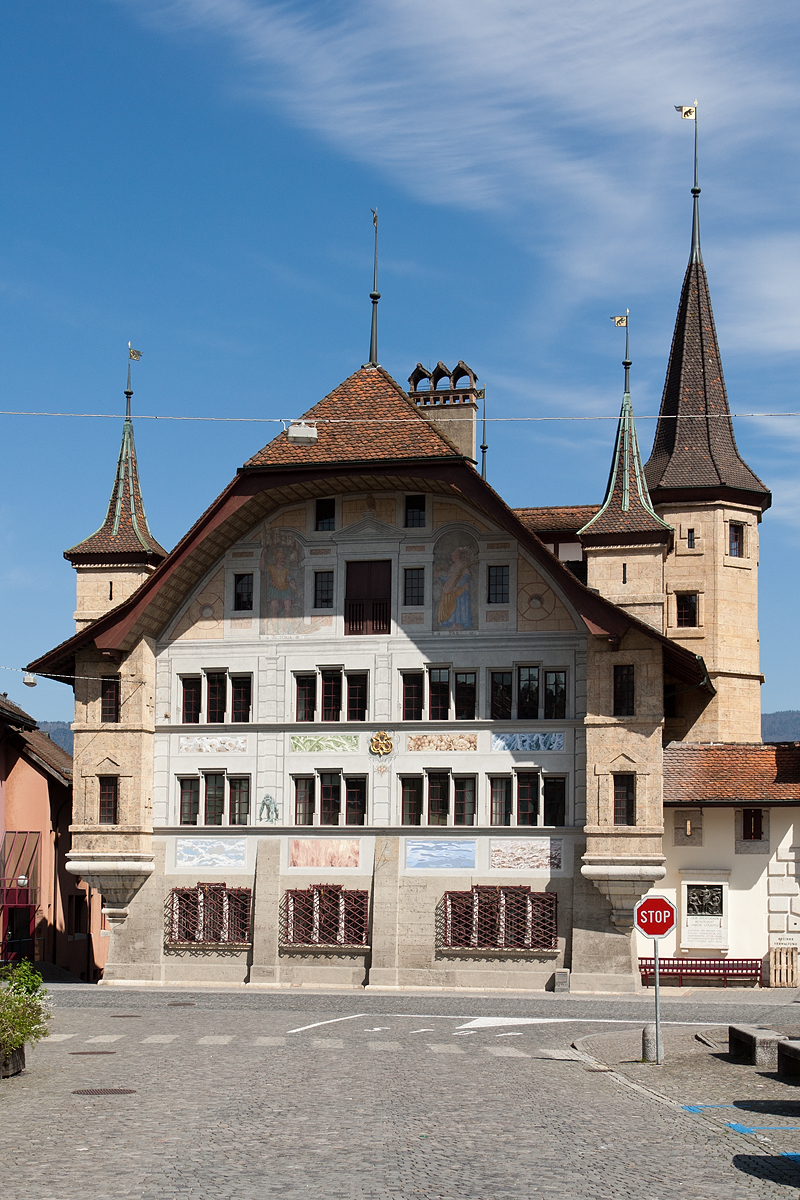
Nidau Castle stands as a prominent hill castle in the municipality of Nidau, located in the Canton of Bern, Switzerland. It is recognized as a Swiss heritage site of national significance. The castle's origins trace back to the early 12th century, with the first wooden fortifications erected in 1140. A second wooden structure followed in 1180, marking the site's strategic importance along the Zihl river. The earliest documented mention of the castle dates to 1196 in a deed by Count Ulrich III of Neuchâtel, confirming its established presence during the High Medieval period.
Medieval origins and architectural development
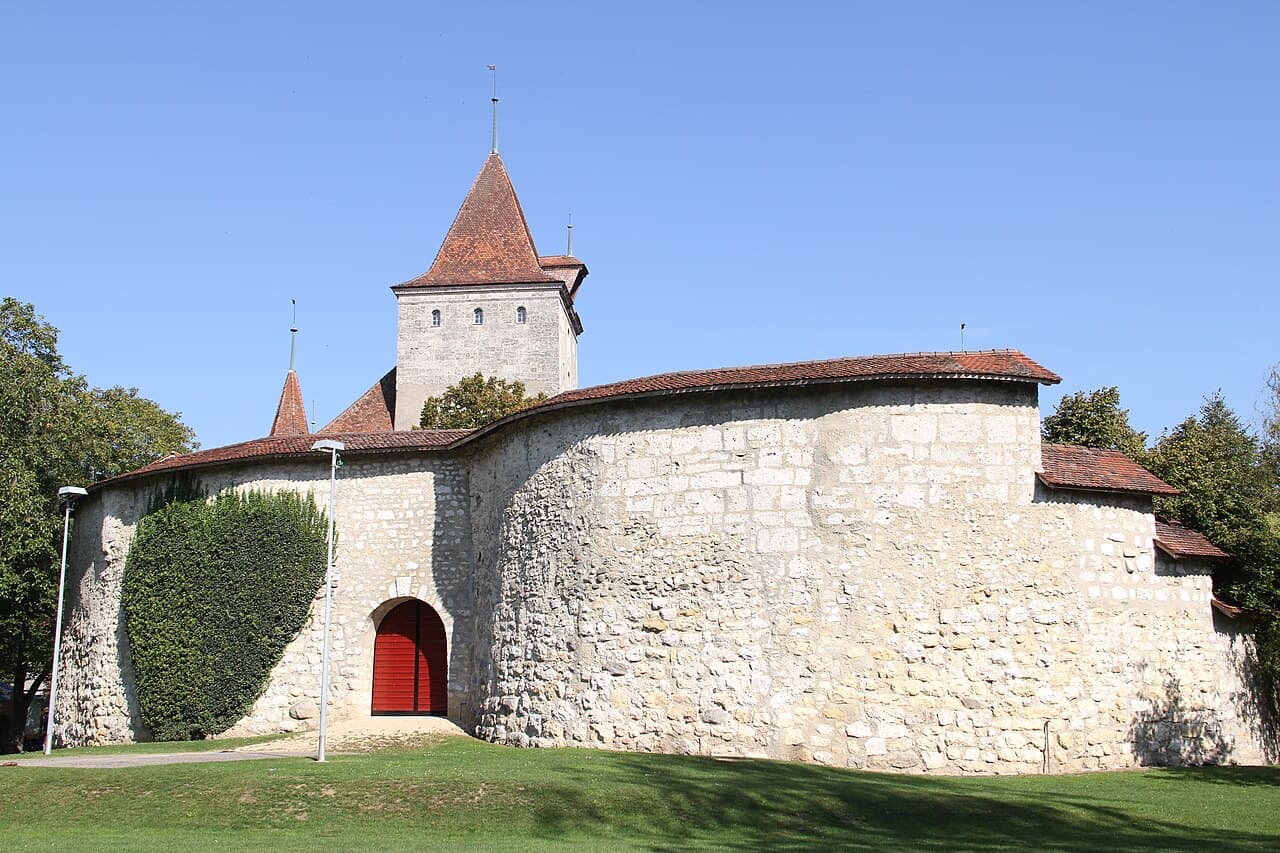
The transition from wood to stone construction began in the early 13th century with the erection of the first stone castle. This initial stone structure featured a square keep approximately 11.2 meters on each side, surrounded by robust walls designed for defense. The main tower, a dominant feature, rose to about 40 meters, serving both as a lookout and a symbol of power. By the mid-13th century, the castle complex expanded to include three round towers and a ring wall, enhancing its defensive capabilities. These fortifications were complemented by a surrounding moat and the natural protection of the adjacent Zihl river.
Builders and early ownership
The stone castle was likely constructed under the auspices of either Count Ulrich III or his son, Rudolf I of Nidau. The establishment of the town of Nidau to the south of the castle by 1338 indicates the castle's role as a focal point for regional administration and settlement.
Historical significance through conflict and ownership changes
The castle's history is marked by notable figures and turbulent events. The last count of Nidau, Rudolf IV, died in 1375 during the Gugler War. Subsequently, the castle passed to the Prince-Bishop of Basel, Johann von Venningen, but his defeat in 1376 led to control by the Counts of Kyburg. In 1379, the Habsburgs acquired the castle and town, granting it as a fief to Enguerrand de Coucy, a former Gugler commander, in 1387.
During the Sempach War in May 1388, the castle and town endured a seven-week siege by forces from the Swiss Confederation, specifically troops from Bern and Solothurn. The siege resulted in heavy damage to the castle and significant casualties on both sides. Following the conflict, the castle and town were awarded to Bern under the peace settlement, marking the beginning of Bernese administration lasting four centuries as the seat of the Nidau bailiwick.
Renaissance and early modern modifications
Throughout the 16th and 17th centuries, Nidau Castle underwent several architectural modifications. In 1546, a new gatehouse was constructed, reflecting evolving defensive needs. The rebuilt towers of 1587 and the addition of a residential wing to the main tower during the 17th century transformed the castle from a purely military fortress to a more comfortable administrative residence. Ancillary buildings such as stables, servants' apartments, and a fountain were also added, enhancing the castle's functionality and livability.
Changes in the modern era and preservation efforts
The political upheavals of the late 18th century, including the 1798 French invasion and the establishment of the Helvetic Republic, led to the dissolution of the Nidau bailiwick. The 1803 Act of Mediation reorganized the region, creating the district of Nidau with the castle serving as the seat of the Oberamtmann. Significant changes to the castle's surroundings occurred when the moat was filled in and parts of the ring wall were demolished.
The Jura water correction projects initiated in 1868 dramatically altered the castle's environment by lowering the water levels of the Zihl river and Lake Biel. This engineering feat ended the castle's historic status as a water-surrounded fortress. Throughout the 20th century, Nidau Castle has been the subject of multiple renovations and repairs to preserve its structure and historical character.
Museum and cultural role today
Today, Nidau Castle houses the cantonal administration and a museum that features exhibits on regional history, including the significant Jura water correction projects. The museum provides visitors with insights into the castle's strategic importance, architectural evolution, and the broader historical context of the region. The castle remains a key cultural landmark in Nidau, attracting visitors interested in medieval architecture and Swiss history.
Frequently asked questions (FAQ)
- What are the visiting hours of Nidau Castle?
- Nidau Castle is typically open to visitors during regular museum hours, which may vary seasonally. It is advisable to check the official website or local tourist information for current opening times before planning your visit.
- What historical events is Nidau Castle known for?
- Nidau Castle is notable for its involvement in the Gugler War and the Sempach War, including a significant siege in 1388 by Swiss Confederation forces. It also played a central role as the seat of the Nidau bailiwick under Bernese control for four centuries.
- Can I visit the museum inside Nidau Castle?
- Yes, the castle houses a museum open to the public that showcases exhibits on the Jura water correction and the castle's history. It offers educational displays about the region's medieval and early modern periods.
- Is Nidau Castle accessible to people with mobility issues?
- Access to Nidau Castle may be limited in some areas due to its medieval architecture. Visitors with mobility concerns are advised to contact the castle's administration ahead of their visit to inquire about accessibility options.
- Why was the moat around Nidau Castle filled in?
- The moat was filled in during the 19th century after the Jura water correction projects lowered the water levels of the Zihl river and Lake Biel, removing the natural water defenses around the castle.
Photo gallery

Information
Current owner
Cantonal administration
Loading map...
Visitor reviews
No reviews yet. Been here? Write the first review and help other travelers!
Write the first reviewVisited this castle? Share your experience
Your review helps other travelers and adds first-hand knowledge to our encyclopedia.