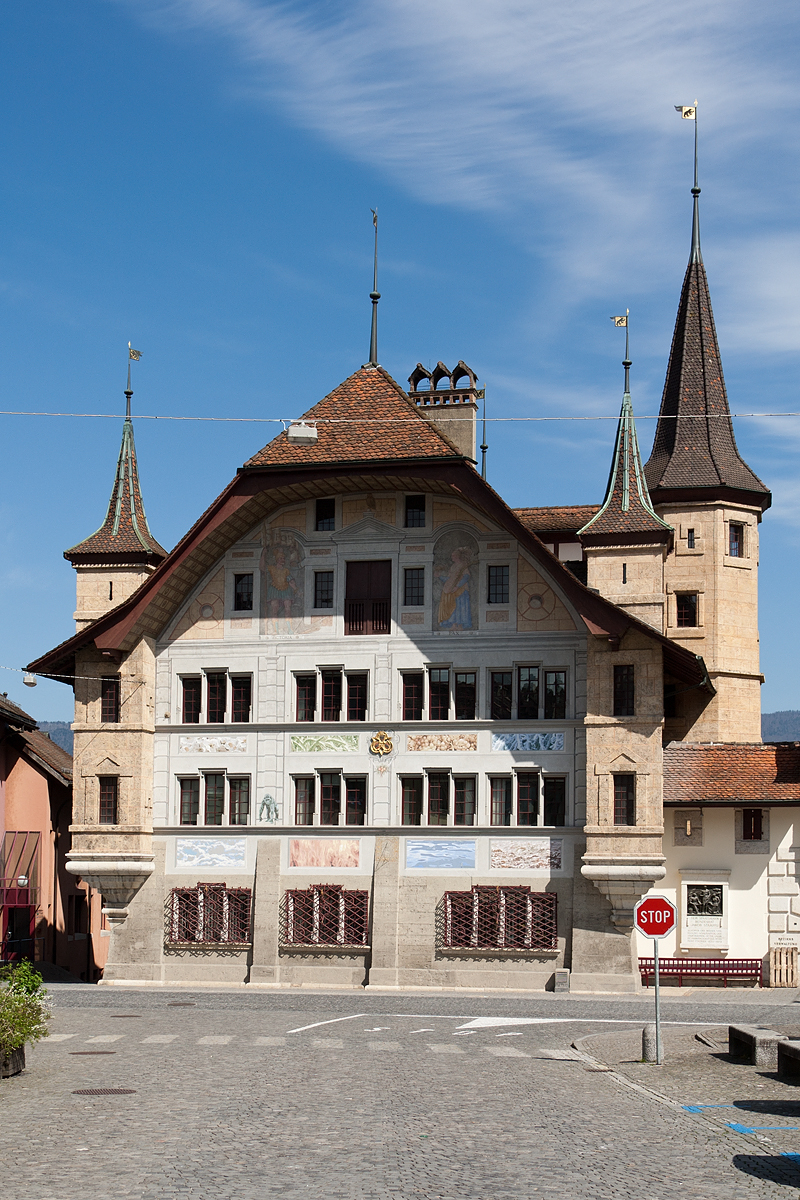
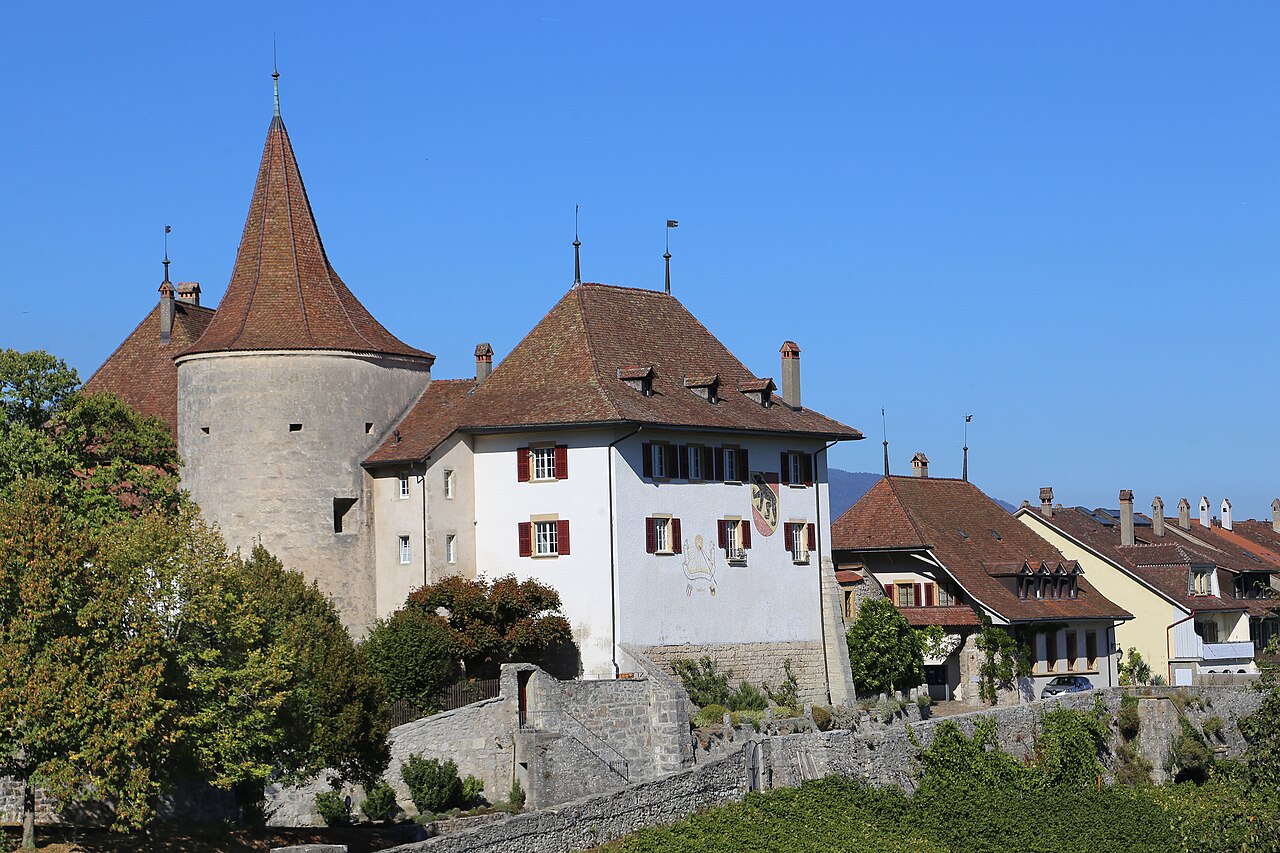
Aarberg Castle

Aarberg Castle: medieval stronghold in Switzerland
Aarberg, Bern, Switzerland
High Medieval (11th–13th c.)
Well Preserved

Aarberg Castle is a significant medieval fortress located in the town of Aarberg, Switzerland. Constructed in the 13th century, it was established during the founding of the city, which took place between 1220 and 1225 by Count Ulrich III of Neuchâtel. The castle's precise builder remains unknown, but its strategic location on an island near a key bridge made it an ideal seat of power and defense for the newly acquired territory under the count's rule.

Founding and strategic importance

The foundation of Aarberg and its castle coincided with Count Ulrich III's acquisition of the region. The choice of the island and the adjacent bridge was deliberate, providing natural defense advantages and control over important trade and travel routes. This positioning allowed the castle to serve as a center of administration and military oversight for the count's expanding domain.

Architecture and construction features

While detailed architectural records from the initial construction period are scarce, the castle originally featured typical high medieval defensive elements. These likely included thick stone walls, a fortified gatehouse, and a keep or main tower serving as the lord's residence and last line of defense. The castle's roof was notably replaced with a new shingle roof in 1380, reflecting ongoing maintenance and adaptation to the needs of its occupants.

Reconstruction after fires

The castle and the town of Aarberg suffered major setbacks due to fires in 1419 and again in 1477. Both events caused significant destruction, necessitating extensive rebuilding efforts. The reconstruction preserved the castle's strategic functions while likely incorporating architectural updates consistent with late medieval building practices. These restorations ensured the castle remained a viable administrative and defensive structure well into the later medieval period.

Political history and ownership changes

The castle's political significance is intertwined with the fortunes of its rulers. By 1358, Count Peter von Aarberg faced financial difficulties that compelled him to seek buyers for the city and its associated rights. After years of attempts, the city and castle were sold to the powerful city-state of Bern between 1377 and 1379. Following this transfer, the Bernese bailiff established residence in Aarberg Castle in 1379, marking a new phase in the castle's administrative role under Bernese control.

Military significance and sieges

Aarberg Castle played a defensive role during several conflicts in the 14th century. The town and castle endured sieges in 1339, 1382, and 1386, yet the fortress was never captured. These sieges underscore the castle's robust fortifications and strategic importance in regional power struggles. Its resilience contributed to the stability of the area and the maintenance of Bernese influence after acquisition.

Preservation and current status

Today, Aarberg Castle stands as a well-preserved example of high medieval fortifications. While the structure has undergone repairs and restorations following historical fires and changes in ownership, it retains key architectural features that reflect its original defensive and administrative functions. The castle remains a prominent landmark in Aarberg, contributing to the town's historical identity and cultural heritage.

Visiting Aarberg Castle

Visitors to Aarberg can explore the castle's exterior and surrounding historic town, appreciating the medieval architecture and the strategic location that shaped its history. The castle's proximity to the old bridge and the island setting enhances its picturesque appeal. While interior access may be limited depending on current use, the castle's imposing presence and historical significance make it a worthwhile destination for those interested in Swiss medieval history.

Frequently asked questions (FAQ)

How do I get to Aarberg Castle?
Aarberg Castle is easily accessible by public transport, with regular train and bus services connecting it to major Swiss cities. If you are driving, there are parking facilities available nearby, making it convenient for visitors traveling by car.
What is the historical significance of Aarberg Castle?
Aarberg Castle dates back to the 13th century and played a vital role in the region's defense and governance. It is a well-preserved example of medieval architecture and offers insight into the historical development of the area.
When was Aarberg Castle built?
Construction of Aarberg Castle began in the early 1200s, and it has undergone various modifications over the centuries. Its architecture reflects different historical periods, showcasing the evolution of castle design in Switzerland.
Can I take guided tours of Aarberg Castle?
Yes, guided tours are available, providing visitors with an in-depth understanding of the castle's history and architecture. These tours are led by knowledgeable guides who share fascinating stories about the castle and its past.
Why is Aarberg Castle a popular tourist destination?
Aarberg Castle attracts visitors for its stunning architecture, rich history, and beautiful surroundings. Its picturesque location along the Aare River and proximity to charming Aarberg town make it a perfect spot for both history enthusiasts and casual tourists.
Is it possible to hold events at Aarberg Castle?
Yes, Aarberg Castle offers facilities for various events, including weddings, conferences, and cultural activities. The unique historical setting provides a memorable backdrop for any occasion.
What are the opening hours of Aarberg Castle?
Aarberg Castle is open to visitors year-round, with varying hours depending on the season. It is advisable to check the official website for the most current opening hours before planning your visit.
What are the ticket prices for Aarberg Castle?
Ticket prices for Aarberg Castle are quite affordable, with discounts available for children, students, and seniors. Special rates may apply for guided tours, so it's best to check the official website for up-to-date pricing information.
When is the best time to visit Aarberg Castle?
The best time to visit Aarberg Castle is during the spring and summer months when the weather is pleasant, and the gardens are in full bloom. Additionally, many cultural events and festivals take place during this period, enhancing the visitor experience.
Are there any nearby attractions to visit while at Aarberg Castle?
Yes, nearby attractions include the charming town of Aarberg with its historic streets and local shops, as well as the picturesque Aare River ideal for walks and picnics. Visitors can also explore other castles and historical sites in the surrounding area, making it a perfect day trip.

Information

Hill Castle

Loading map...

Visitor reviews

No reviews yet. Been here? Write the first review and help other travelers!

Write the first review

Visited this castle? Share your experience

Your review helps other travelers and adds first-hand knowledge to our encyclopedia.
Write a review

(5/5)

0/2000 characters

Your review will be visible after admin approval

Nearby castles

9.7 km
Nidau Castle — Switzerland castle

Nidau Castle

Nidau, Switzerland

Nidau Castle stands as a prominent hill castle in the municipality of Nidau, located in the Canton of Bern, Switzerland. It is recognized as a Swiss heritage site of national significance. The castle's origins trace back to the early 12th century, with the first wooden fortifications erected in 1140. A second wooden structure followed in 1180, marking the site's strategic importance along the Zihl river. The earliest documented mention of the castle dates to 1196 in a deed by Count Ulrich III of Neuchâtel, confirming its established presence during the High Medieval period. Medieval origins and architectural development The transition from wood to stone construction began in the early 13th century with the erection of the first stone castle. This initial stone structure featured a square keep approximately 11.2 meters on each side, surrounded by robust walls designed for defense. The main tower, a dominant feature, rose to about 40 meters, serving both as a lookout and a symbol of power. By the mid-13th century, the castle complex expanded to include three round towers and a ring wall, enhancing its defensive capabilities. These fortifications were complemented by a surrounding moat and the natural protection of the adjacent Zihl river. Builders and early ownership The stone castle was likely constructed under the auspices of either Count Ulrich III or his son, Rudolf I of Nidau. The establishment of the town of Nidau to the south of the castle by 1338 indicates the castle's role as a focal point for regional administration and settlement. Historical significance through conflict and ownership changes The castle's history is marked by notable figures and turbulent events. The last count of Nidau, Rudolf IV, died in 1375 during the Gugler War. Subsequently, the castle passed to the Prince-Bishop of Basel, Johann von Venningen, but his defeat in 1376 led to control by the Counts of Kyburg. In 1379, the Habsburgs acquired the castle and town, granting it as a fief to Enguerrand de Coucy, a former Gugler commander, in 1387. During the Sempach War in May 1388, the castle and town endured a seven-week siege by forces from the Swiss Confederation, specifically troops from Bern and Solothurn. The siege resulted in heavy damage to the castle and significant casualties on both sides. Following the conflict, the castle and town were awarded to Bern under the peace settlement, marking the beginning of Bernese administration lasting four centuries as the seat of the Nidau bailiwick. Renaissance and early modern modifications Throughout the 16th and 17th centuries, Nidau Castle underwent several architectural modifications. In 1546, a new gatehouse was constructed, reflecting evolving defensive needs. The rebuilt towers of 1587 and the addition of a residential wing to the main tower during the 17th century transformed the castle from a purely military fortress to a more comfortable administrative residence. Ancillary buildings such as stables, servants' apartments, and a fountain were also added, enhancing the castle's functionality and livability. Changes in the modern era and preservation efforts The political upheavals of the late 18th century, including the 1798 French invasion and the establishment of the Helvetic Republic, led to the dissolution of the Nidau bailiwick. The 1803 Act of Mediation reorganized the region, creating the district of Nidau with the castle serving as the seat of the Oberamtmann. Significant changes to the castle's surroundings occurred when the moat was filled in and parts of the ring wall were demolished. The Jura water correction projects initiated in 1868 dramatically altered the castle's environment by lowering the water levels of the Zihl river and Lake Biel. This engineering feat ended the castle's historic status as a water-surrounded fortress. Throughout the 20th century, Nidau Castle has been the subject of multiple renovations and repairs to preserve its structure and historical character. Museum and cultural role today Today, Nidau Castle houses the cantonal administration and a museum that features exhibits on regional history, including the significant Jura water correction projects. The museum provides visitors with insights into the castle's strategic importance, architectural evolution, and the broader historical context of the region. The castle remains a key cultural landmark in Nidau, attracting visitors interested in medieval architecture and Swiss history.

High Medieval (11th–13th c.)
Details
12.9 km
Büren Castle — Switzerland castle

Büren Castle

Büren an der Aare, Switzerland

Büren Castle, located in Büren an der Aare in the canton of Bern, Switzerland, is a significant example of Renaissance architecture serving administrative and residential functions in the early 17th century. Constructed between 1621 and 1624, the castle was established as the official residence of the Bernese Landvogt, the regional governor appointed by the city of Bern to oversee the surrounding territories. Historical context and construction The castle was built on the site of four former farmhouses, marking a deliberate transformation from rural agricultural land to a fortified administrative center. This change reflects the political and social structures of the period, where the Bernese authorities consolidated control over their territories through the establishment of local government seats. The construction of Büren Castle during the Renaissance period aligns with broader trends in Swiss castle building, where defensive features were combined with residential comfort and administrative utility. Architectural features and design Büren Castle is classified as a hill castle, situated on elevated ground overlooking the town and the nearby Aare River. The castle's layout includes robust stone walls that incorporate both defensive and aesthetic elements typical of the early 17th century. The structure features a central courtyard surrounded by residential and administrative wings. Notable architectural details include the presence of 17th-century murals that adorn the interior walls, reflecting the artistic styles and cultural influences of the Renaissance era. These murals were carefully restored in 2003 to preserve their original appearance, highlighting the castle's cultural heritage value. Role of the Bernese Landvogts From its completion until the 1798 French invasion, Büren Castle served as the residence for a total of 77 Bernese Landvogts. These officials were responsible for local governance, justice administration, and tax collection on behalf of Bern. The castle was thus a center of political power and regional administration for nearly two centuries. The castle's walls bear physical marks of its turbulent history, including visible bullet scars from the troops that invaded during the 1798 conflict, which led to the collapse of the Old Swiss Confederacy and the establishment of the Helvetic Republic under French influence. Preservation and current use Today, Büren Castle remains well preserved and continues to serve the community as the seat of the municipal administration and government offices. Its ongoing use ensures the maintenance and accessibility of the castle to the public. The restoration efforts in 2003, particularly of the 17th-century murals and other artistic elements, demonstrate a commitment to preserving the castle's historical and cultural significance. The castle is recognized as a Swiss heritage site of national significance, underscoring its importance in the architectural and political history of the region. Architectural and cultural significance Büren Castle exemplifies the transformation of Swiss castles from purely military fortifications to multifunctional centers combining defense, governance, and residential purposes during the Renaissance. Its position as a hill castle provided strategic oversight of the surrounding area while its design incorporated the aesthetic values of its time. The castle's survival through periods of conflict and political change, along with its preserved artistic features, offers valuable insights into the governance and cultural life of Bernese territories in the early modern period. Visiting Büren Castle While primarily serving administrative functions today, the castle's historical and architectural features attract visitors interested in Swiss heritage. The visible bullet scars and restored murals provide tangible connections to the region's past. Visitors can appreciate the castle's Renaissance architecture and its role in the political history of the canton of Bern.

Renaissance (15th–17th c.)
Details
13.7 km
Erlach Castle — Switzerland castle

Erlach Castle

Erlach, Switzerland

Erlach Castle stands as a significant medieval hill castle located in the municipality of Erlach, within the Canton of Bern, Switzerland. Constructed between 1090 and 1100 by Burkart von Fenis, the Bishop of Basel, this fortress was originally established as a center of ecclesiastical authority and territorial control during the High Medieval period. Its strategic position on a hill overlooking the surrounding landscape provided both defensive advantages and administrative oversight for the region. Early history and foundation The foundation of Erlach Castle reflects the medieval practice of bishops and religious authorities establishing fortified residences to secure their influence. Burkart von Fenis, who held the bishopric of Basel, initiated the construction of the castle to assert control over the surrounding lands and to serve as a stronghold in this part of Switzerland. The castle's location was carefully chosen for its defensive potential, commanding views of the nearby town and the vital routes along Lake Biel. Transition to noble control and the house of savoy In 1224, the castle and its adjacent town became the property of the Counts of Nidau, marking a shift from ecclesiastical to secular noble control. This transfer integrated Erlach into the feudal network of local nobility. Subsequently, in 1265, Peter II of Savoy extended the influence of the House of Savoy over the region by bringing the counts and their castle under his feudal authority. Under Savoyard rule, the castle was administered by a warden appointed by Peter II, who managed the estates and governance from this stronghold. The von erlach family emergence The knights serving as wardens adopted the name von Erlach, derived from their association with the castle and town. This family rose to prominence in the region, becoming influential in both military and political spheres. Notably, Rudolf von Erlach emerged as a key figure, renowned for his leadership as the Swiss commander who secured victory at the Battle of Laupen in 1339. By around 1300, the von Erlach family had established themselves as citizens of the city of Bern, reflecting their integration into the urban aristocracy and expanding their influence beyond the castle's immediate domain. Later medieval developments and bernese acquisition Following the death of Isabella of Neuchatel in 1395, who was the widow of the last Count of Nidau, the House of Savoy assumed direct control over Erlach. The town was subsequently mortgaged to the de Chalon family in 1407, indicating a period of noble administration under different hands. This arrangement lasted until the late 15th century, during which the castle remained an important administrative center. During the Burgundian Wars in 1474, Bernese troops captured Erlach Castle and the town, bringing them under the jurisdiction of the city of Bern. This conquest was part of Bern's territorial expansion and consolidation of power in the region. Following the takeover, Rudolf von Erlach, who had previously served as castellan under the de Chalon family, was appointed the first governor of the district under Bernese control. From this point onward, Erlach remained within the Bernese territory, playing a role in the canton’s governance and defense. Architectural features and castle structure While detailed architectural descriptions of Erlach Castle are scarce, its classification as a hill castle suggests typical features of medieval fortifications built on elevated terrain. Such castles generally included stone curtain walls, defensive towers, and a central keep or donjon that served as the last line of defense. The castle’s location would have been chosen for visibility and control over the surrounding area, including the nearby town and lake. The castle likely had a courtyard enclosed by walls, with residential quarters for the warden or castellan and spaces for administrative functions. Defensive elements such as battlements, , and possibly a or natural water defenses would have enhanced its security. However, no specific records detail the layout or distinctive architectural embellishments of the castle, nor have significant archaeological excavations revealed such features. Current status and cultural significance Today, Erlach Castle is recognized as a Swiss heritage site of national significance. Although the physical remains are limited and detailed descriptions of the castle’s architecture are not well documented, its historical importance as a seat of power through successive ruling families and political transformations is well acknowledged. The castle’s legacy is closely tied to the von Erlach family, whose members played key roles in Swiss medieval history, and to the broader historical narrative of Bernese territorial expansion. The castle’s presence in Erlach continues to attract interest from historians, archaeologists, and visitors intrigued by medieval Swiss history and feudal architecture. Its role in regional governance, military history, and noble lineage underscores its importance beyond the physical structure itself. Frequently asked questions about erlach castle What is the historical significance of Erlach Castle? Erlach Castle was a medieval administrative center built in the late 11th century, linked to the bishopric of Basel, the House of Savoy, and the influential von Erlach family. When was Erlach Castle built? Construction began around 1090-1100 under Bishop Burkart von Fenis. Can visitors tour Erlach Castle today? The castle remains are limited and not extensively developed for tourism, but the site is accessible for visitors interested in its historical context. What architectural style characterizes Erlach Castle? As a High Medieval hill castle, it likely featured typical medieval defensive elements, though specific stylistic details are undocumented. How did the von Erlach family influence Swiss history? The von Erlach family produced notable leaders like Rudolf von Erlach, commander at the Battle of Laupen, contributing to Bern’s military and political history. Is Erlach Castle part of any heritage protection? Yes, it is listed as a Swiss heritage site of national significance.

High Medieval (11th–13th c.)
Details