Newtown Castle
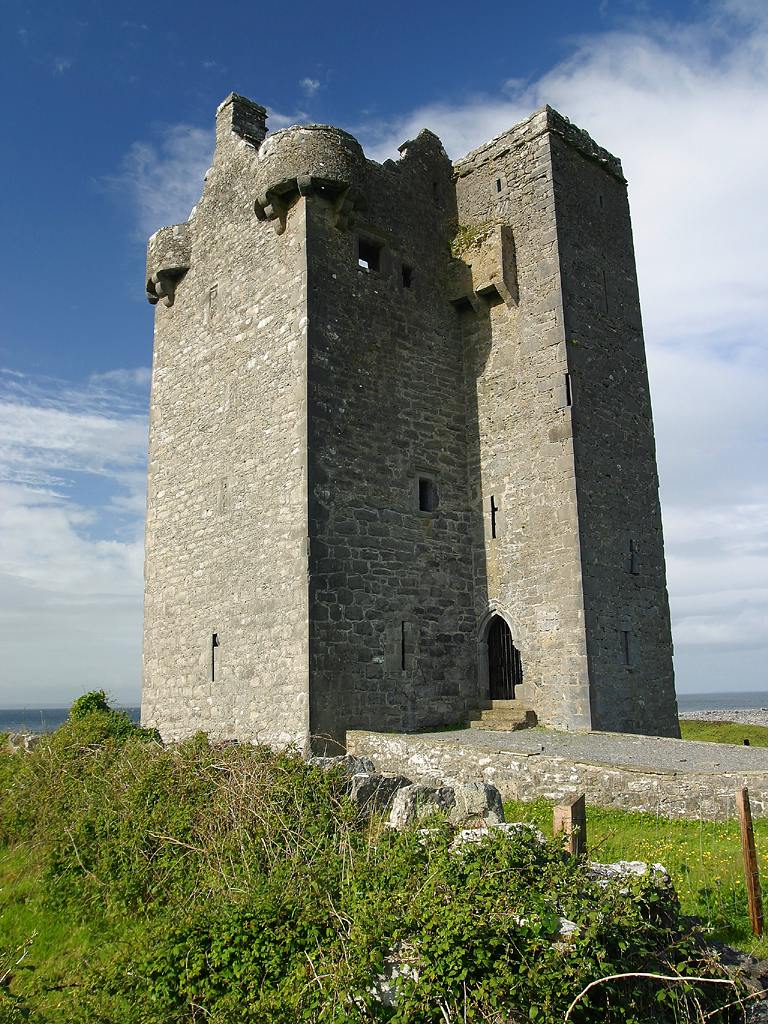
Newtown Castle stands as a remarkable example of a 16th-century Irish tower house located in Newtown, County Clare, Ireland. Constructed around 1550 by the Gaelic O'Brien clan, it was an important fortified residence within their regional holdings. This castle is distinguished by its unique architectural design, featuring a cylindrical upper tower resting upon a square pyramidal base, a form unparalleled among the majority of Irish tower houses.
The castle's history is closely intertwined with the powerful Gaelic families of the area. After the O'Briens, the castle passed to the O’Lochlainn family, notable figures in the nearby Burren region. Prominent members such as Charles O’Loghlen, known as the "King of the Burren," and Peter O’Loghlen, the "Prince of the Burren," maintained the castle as a symbol of their local influence well into the 19th century.
Historical context and ownership
The earliest records, including the 1641 Forfeitures and Distribution documents, list Donogh O’Brien as the owner, confirming the castle's role within Gaelic lordship during the turbulent mid-16th and 17th centuries. In 1848, the property was sold by the financially distressed Marquess of Buckingham to interests represented by Richard Samuel Guinness on behalf of Colonel Henry White. This transaction marked a shift in ownership from Gaelic families to landed gentry, reflecting broader social changes in Ireland during the 19th century.
Adjacent to the castle stood a rectory built circa 1820, which housed Reverend Hugh B. Howlett in the 1850s, illustrating the evolving use of the estate and its surroundings.
Architectural uniqueness and defensive features
Newtown Castle's architecture is exceptional among Irish tower houses, of which only about 30 out of approximately 3,000 are round in shape. Its cylindrical tower atop a square pyramidal base creates a distinctive silhouette. The base walls are extraordinarily thick, measuring about four meters, providing both structural support and cool storage space on the ground floor.
The tower comprises four floors above ground. The ground and first floors feature vaulted ceilings constructed using a traditional Irish technique involving woven hazel rods beneath wooden laths, secured with mortar mixed with animal blood. This method provided a resilient foundation for the stone floors above.
Defensive elements include small gun-loops on the first floor, allowing defenders to fire while remaining protected. Narrow, stone-framed windows with shooting slits face all directions, offering comprehensive surveillance and defense capabilities. A now-absent adjoining building was once accessible from a second-floor doorway via a ladder or rope, indicating a larger complex originally surrounded the tower.
Interior spaces and domestic features
The third floor contains a spacious hall with an elegant balcony and windows oriented toward the four cardinal points, providing commanding views over Galway Bay and the Burren landscape. This vantage point emphasized the castle's strategic and symbolic prominence.
Inside, the first floor houses a restored open fireplace with a limestone lintel, reflecting the domestic use of the space. The second floor, called the Scriptorium, is dedicated to displaying high-quality reproductions of medieval Irish manuscripts, including the Egerton 88 legal manuscript and the Book of Kells. This highlights the region's rich tradition of learning and law.
Restoration and modern use
During restoration in the early 1990s, archaeological investigations uncovered evidence of a significant historical settlement near the castle, including animal remains, shellfish, and a large cobbled area. These findings suggest that "Newtown" originally referred to a community established around the castle rather than the tower house alone.
The restoration work completed in 1993–94 included the reconstruction of the tower's conical oak roof. Following this, the castle was adapted to serve as the Burren College of Art, officially opened in 1994 by then-President Mary Robinson. Since then, Newtown Castle has functioned as an educational venue and a site for cultural events, blending its historical legacy with contemporary use.
External architectural features
The tower's base is reinforced by projecting buttresses that expand its footprint into a square pyramid shape, enhancing stability and defense. The overall structure exemplifies a blend of practical fortification and symbolic status, characteristic of Gaelic tower houses of the period.
Newtown Castle remains a well-preserved example of Irish tower house architecture, notable for its rare form and rich historical associations. It stands as a testament to the Gaelic aristocracy's resilience and adaptation through centuries of social and political change.
Frequently asked questions (FAQ)
- What is the historical significance of Newtown Castle?
- Newtown Castle is a remarkable example of medieval architecture in the United Kingdom, showcasing the rich history of the region. Built in the late 16th century, it has served various roles throughout its existence, including defense and residence, making it an important landmark in the study of British heritage.
- When was Newtown Castle built?
- Newtown Castle was constructed in the late 1500s, specifically around 1580. Its design reflects the transitional period from medieval fortifications to more modern living quarters, highlighting the evolution of castle architecture in England.
- Can I visit Newtown Castle?
- Yes, Newtown Castle is open to visitors, allowing you to explore its fascinating history and architecture. Guided tours are available, providing insights into its past and the various historical figures associated with it.
- What are the opening hours for Newtown Castle?
- Newtown Castle is typically open to the public from 10 AM to 5 PM, but hours may vary seasonally. It's advisable to check the official website before your visit for the most accurate and up-to-date information.
- Is it possible to access Newtown Castle for those with mobility issues?
- Yes, Newtown Castle strives to be accessible to all visitors, including those with mobility challenges. While some areas may have limited access due to historical preservation, staff are available to assist and provide alternative routes where necessary.
- What is the best time to visit Newtown Castle?
- The best time to visit Newtown Castle is during the spring and summer months when the weather is pleasant and the gardens are in full bloom. Additionally, special events and activities often take place during these seasons, enhancing the visitor experience.
- Are there any nearby attractions to visit along with Newtown Castle?
- Yes, there are several nearby attractions, including beautiful gardens and historical sites that complement a visit to Newtown Castle. Local museums and scenic parks provide great opportunities for exploration and relaxation in the surrounding area.
- How much does it cost to enter Newtown Castle?
- Ticket prices for Newtown Castle are generally affordable, with discounts available for children, seniors, and families. For the latest pricing information and any special promotions, it's best to check the official website prior to your visit.
Information
Website
Visit websiteSources & official resources
Verify the information above using these authoritative references.
Loading map...
Visitor reviews
No reviews yet. Been here? Write the first review and help other travelers!
Write the first reviewVisited this castle? Share your experience
Your review helps other travelers and adds first-hand knowledge to our encyclopedia.