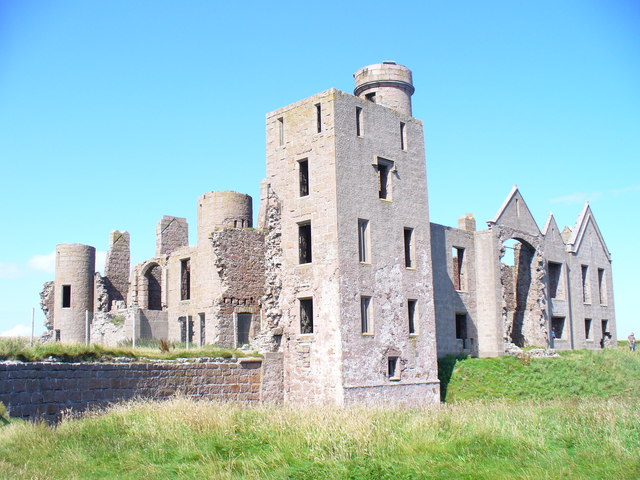
Inverugie Castle
Inverugie Castle, also known as Cheyne's Tower, stands today as the evocative ruins of a once significant medieval motte-and-bailey castle located near Peterhead in Aberdeenshire, Scotland. The site comprises a modest earthwork mound approximately three metres high beside the River Ugie, marking the footprint of the original wooden fortification constructed in the 12th century by the powerful Cheyne (Le Chen) family. This early defensive structure was strategically positioned to guard the ford across the river, with the bailey's ditch likely filled by the river waters to enhance its defensive capability.
The castle's evolution from timber to stone reflects the broader architectural and military developments of the High Medieval period. While the earliest phase was a wooden motte-and-bailey, the surviving stone ruins date from later centuries, illustrating a transition to more durable fortifications. The remains include the foundations of an oblong tower house with a basement used for storage and kitchen purposes, a main hall for entertaining on the level above, and multiple round towers accessed via small turnpike staircases in the hall's corners. A third tower on the west side contained the main staircase, opening onto a cobbled courtyard protected by a wall running alongside the river.
Historical background and ownership transitions
The castle's origin traces to the Cheyne family, who established the initial fortification in the 12th century. The estate passed through inheritance and marriage to the Keith family, specifically the Earls Marischal, in the mid-14th century after the death of Reginald le Chen, Baron Inverugie, in 1345. This transfer occurred through the marriage of Edward Keith to Marjory, daughter of Reginald le Chen and Helen de Strathearn. The Keiths held their principal seat at the nearby Dunnottar Castle, a coastal fortress of great strategic importance.
Around 1660, the Keith family constructed the stone castle ruins that remain today, situated south of the original wooden motte. This later phase of construction represents a shift from the earlier timber defenses to a more permanent stone residence and stronghold. However, the castle's fortunes declined following the Jacobite Rebellion, after which the Keith lands were forfeited. Subsequently, ownership passed to James Ferguson, the third Laird of Pitfour, who maintained the castle in good condition until his death in 1820.
Architectural features and layout
Motte-and-bailey origins
The original motte-and-bailey castle featured a wooden keep atop a raised earth mound (the motte), with an enclosed courtyard (the bailey) surrounded by a defensive ditch. The proximity to the River Ugie allowed the bailey ditch to be flooded, creating a natural moat that enhanced the castle's defenses. This design was typical of early medieval fortifications in Scotland, prioritizing quick construction and strategic control of river crossings.
Stone tower house and courtyard
The later stone castle built by the Keiths included an oblong tower house with multiple levels. The basement functioned as storage and kitchen space, essential for sustaining the household during sieges or long winters. The main hall on the level above was a central feature for social and administrative functions. Access to the round towers at the north and south corners was via small turnpike staircases, which also served defensive purposes by controlling movement within the castle. A third tower on the west side housed the main staircase and faced a cobbled courtyard bordered by a protective wall running alongside the river.
Decline and ruin
Following the forfeiture of the Keith estates after the Jacobite Rebellion, the castle's upkeep deteriorated. Although James Ferguson, the third Laird of Pitfour, preserved the building well until 1820, his successors neglected the property. The fifth Laird stripped the castle of its restoration efforts, and subsequent owners allowed further decay. By the late 19th century, the castle was in a precarious state. Severe weather events, including gales in April 1890, caused significant structural damage, including the collapse of walls and the stair tower.
After further storms on New Year's Day 1899, local authorities declared the ruins unsafe. In an effort to prevent accidents, the estate factor, William Ainslie, likely acting under instructions from the then Laird, arranged for much of the remaining structure to be demolished using explosives. This demolition further weakened the castle, leaving only scant ruins visible today.
Significance and current state
Today, Inverugie Castle remains as an evocative ruin, representing the layered history of medieval Scottish fortifications and noble family dynamics. The site offers insights into the evolution from timber to stone castles, the strategic importance of river crossings in medieval defense, and the impact of political upheaval on aristocratic estates. The modest earthworks and stone remnants provide a tangible connection to the 12th-century origins and subsequent centuries of Scottish history.
Visitors to the site can observe the remains of the motte beside the River Ugie, the foundations of the later stone tower house, and the layout of the defensive courtyard. Although much of the castle has been lost, the surviving features allow for an appreciation of medieval castle architecture and the historical narrative of the Cheyne and Keith families.
Information
Loading map...
Visitor reviews
No reviews yet. Been here? Write the first review and help other travelers!
Write the first reviewVisited this castle? Share your experience
Your review helps other travelers and adds first-hand knowledge to our encyclopedia.