Hofburg Palace
Hofburg Palace stands as a monumental testament to over seven centuries of imperial power, architectural evolution, and cultural significance in the heart of Vienna, Austria. Originally constructed in the 13th century, this vast palace complex has been the residence of the Habsburg dynasty and the seat of various empires, including the Holy Roman Empire and the Austro-Hungarian Empire. Today, it serves as the official workplace and residence of the President of Austria and houses numerous federal institutions, museums, and cultural venues.
From its origins as a fortified castle, the Hofburg evolved into a sprawling palatial complex that reflects a rich tapestry of architectural styles, including Gothic, Renaissance, Baroque, Classicism, and Historicism. The palace's layered construction narrates the political and artistic history of Austria and central Europe, with each wing and courtyard bearing witness to centuries of dynastic ambition, cultural patronage, and historical events.
Early history and medieval origins
The Hofburg Palace's earliest documented origins date back to 1279, during the rule of the Babenberg dynasty. Initial construction began under Duke Leopold VI and was completed under King Ottokar II Přemysl of Bohemia. The original structure was a fortified hill castle designed with defensive features such as thick walls, corner towers, and a surrounding moat, characteristic of medieval military architecture. This early phase established the Hofburg as a strategic residence for the sovereign dukes of Austria.
Fortifications and the swiss wing
The oldest surviving part of the palace is the Swiss Wing (Schweizertrakt), dating from the 13th century. It retains the medieval defensive character with its roughly square plan and four robust corner towers. The wing also includes the Gothic Burgkapelle (court chapel) from the 15th century, a rare surviving element of the medieval Hofburg. The Swiss Gate, added in 1552 by Pietro Ferrabosco, marks the entrance to this wing and is adorned with imperial inscriptions and the emblem of the Order of the Golden Fleece. Nearby, the Swiss Court Fountain rises from the distinctive white limestone known as Kaiserstein.
Renaissance transformation and imperial residence
In the mid-16th century, under Emperor Ferdinand I, the Hofburg transitioned from a primarily defensive castle to a grand imperial residence. This period saw the introduction of Renaissance architectural elements and the establishment of the palace as the winter residence of the Habsburg emperors, complementing the summer residence at Schönbrunn Palace. The Amalienburg, constructed between 1575 and 1611 and named after Empress Amalie Wilhelmine, exemplifies late Renaissance style with its distinctive onion dome and astronomical clock.
Baroque expansion and artistic grandeur
The late 17th and early 18th centuries brought extensive Baroque expansions under emperors such as Leopold I. The Leopoldinischer Trakt, built in the 1660s by architect Filiberto Lucchese and Italian artists Carl Martin and Domenico Carlone, showcases this ornate style. After the 1683 siege of Vienna, the wing was rebuilt and enhanced by Giovanni Pietro Tencalla. The Kammerkapelle chapel was renewed in 1772, reflecting ongoing artistic patronage.
The Reichskanzleitrakt, constructed between 1723 and 1730 by Johann Lucas von Hildebrandt and Joseph Emanuel Fischer von Erlach, originally served as offices for the Imperial Vice-Chancellor and the Imperial Court Council. It later housed apartments for notable figures such as the Duke of Reichstadt and Emperor Franz Joseph I.
Winter riding school and ceremonial halls
Between 1729 and 1735, the Winter Riding School was built by Johann Bernhard Fischer von Erlach. This spacious hall is historically significant as the venue for the first sessions of the Austrian parliament in 1848. The adjacent Redoutensaaltrakt contains the Redoutensäle, two grand ballrooms and concert halls adapted from a 17th-century opera house under Empress Maria Theresa. After a fire in 1992, these halls were meticulously restored, with interior decoration by artist Josef Mikl.
The Ceremonial Hall Wing (Zeremoniensaaltrakt), built in 1804 by Louis Montoyer, features the magnificent Zeremoniensaal supported by 24 Corinthian columns made of imitation marble. Historically, this hall hosted imperial events such as the marriage proposal of Napoleon to Empress Marie Louise and grand court balls illuminated by over a thousand candles in crystal chandeliers.
19th and 20th century developments
The Michaelertrakt, connecting the Winter Riding School and Reichskanzleitrakt, was planned in 1726 but completed only between 1889 and 1893 by Ferdinand Kirschner. Its notable features include a large bronze dome and fountains symbolizing Austria’s naval and land military power.
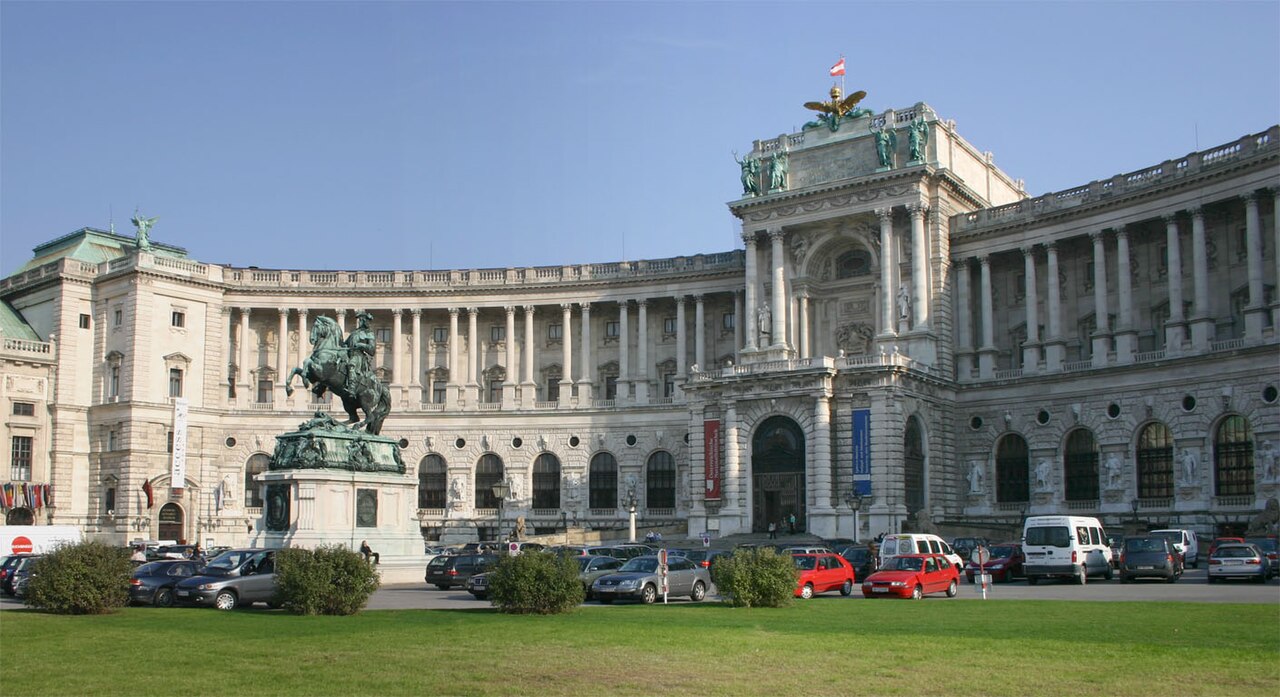
The Neue Burg wing, constructed between 1881 and 1913 as part of the ambitious but incomplete Kaiserforum project, houses museums and the reading rooms of the Austrian National Library. The Große Festsaal (Great Festival Hall) within the Neue Burg is the palace's largest hall, richly decorated with ceiling paintings by Alois Hans Schramm and lunettes depicting prominent Austrian historical figures by Eduard Veith and Viktor Stauffer.
Hofbibliothek and cultural institutions
The Hofbibliothek or Imperial Library, begun by Johann Bernhard Fischer von Erlach and completed by his son Joseph Emanuel in 1735, contains the magnificent Prunksaal (State Hall). This Baroque masterpiece features a ceiling fresco by Daniel Gran and statues of emperors sculpted by Paul Strudel, epitomizing imperial grandeur and artistic excellence.
The palace complex also integrates the Augustinertrakt, which includes the Augustinian Church and Monastery, and the Palais Erzherzog Albrecht, home to the Albertina art collection. The Stallburg, originally a residence for Maximilian II, was converted into stables and now houses the famous Spanish Riding School, renowned for its classical equestrian tradition.
Historical significance and notable events
Hofburg Palace has been the backdrop for many pivotal moments in European history. It was the seat of the Holy Roman Emperors from 1438 to 1583 and from 1612 to 1806, and the residence of the Emperors of Austria until the monarchy's dissolution in 1918. The palace hosted the first session of the Austrian parliament in 1848 and witnessed the proclamation of the Anschluss by Adolf Hitler from the balcony of the Neue Burg in 1938.
Since the end of the monarchy, the Hofburg has transitioned to serve political, cultural, and diplomatic functions. It currently houses the office of the President of Austria and the permanent headquarters of the Organization for Security and Co-operation in Europe (OSCE). The palace also preserves the Imperial Treasury, which holds the Imperial Regalia of both the Holy Roman and Austrian Empires, a key cultural treasure.
Museums and visitor attractions
The Hofburg offers visitors a rich experience of imperial history and art. The Imperial Silver Collection in the Imperial Chancellery Wing displays over 7,000 items of court silverware, illustrating the opulence of Habsburg dining culture. The Sisi Museum is dedicated to Empress Elisabeth, known as Sisi, showcasing over 300 personal items including clothing, poetry, and beauty recipes, providing insight into her life and legacy.
Visitors can explore lavishly decorated apartments reflecting Empire, Baroque, and Rococo styles, offering a glimpse into the private lives of the Habsburg family. The palace grounds include several courtyards and gardens, monuments to emperors and military leaders such as Franz I, Joseph II, Prince Eugene of Savoy, and Archduke Charles.
Architectural complexity and preservation
The Hofburg Palace complex spans approximately 300,000 square meters, bordered by prominent squares including Michaelerplatz, Josefsplatz, Heldenplatz, and Ballhausplatz. Its architecture is a palimpsest of styles and functions, from medieval fortifications to grand ceremonial halls and cultural institutions.
Despite centuries of expansions and renovations, the palace retains elements of its original defensive character, such as thick walls and remnants of fortifications. Excavations have revealed foundations of the Kunstkammer, the first purpose-built museum north of the Alps, dating from the mid-16th century.
Today, the Hofburg is managed by the Burghauptmannschaft, ensuring the preservation and maintenance of this historic site. It remains a vibrant center of Austrian political life, culture, and heritage, embodying the legacy of the Habsburg monarchy and the evolution of European history.
Frequently asked questions (FAQ)
- What is the historical significance of Hofburg Palace?
- Hofburg Palace has served as the imperial palace of the Habsburg dynasty and is a symbol of Austria's rich history. It has been the seat of power for centuries and now houses several important museums, the Austrian President's office, and the National Library.
- When was Hofburg Palace built?
- The construction of Hofburg Palace began in the 13th century and continued over the centuries, reflecting various architectural styles including Gothic, Renaissance, and Baroque. It has undergone numerous expansions and renovations to accommodate the needs of the Habsburg emperors.
- What are the opening hours for Hofburg Palace?
- Hofburg Palace is typically open to visitors from 9:00 AM to 5:30 PM daily, but it's recommended to check the official website for any seasonal changes or special events that might affect these hours. Extended hours may be available during peak tourist seasons.
- Can I purchase tickets in advance for Hofburg Palace?
- Yes, visitors can purchase tickets online in advance to avoid long queues at the entrance. Buying tickets ahead of time also allows you to secure entry for specific time slots, especially during busy periods.
- Is it possible to access Hofburg Palace with a wheelchair?
- Hofburg Palace is generally accessible to visitors with mobility challenges, with ramps and elevators available in most areas. However, it's advisable to check specific access details for various sections of the palace, as some historical areas may have limitations.
- What is the best time to visit Hofburg Palace?
- The best time to visit Hofburg Palace is during the spring and fall months when the weather is mild and the tourist crowds are smaller. Early mornings or late afternoons are also ideal for a more leisurely experience.
- Are there any nearby attractions to visit while at Hofburg Palace?
- Yes, Hofburg Palace is located near several notable attractions such as the Spanish Riding School, the Vienna State Opera, and the Museum Quarter. A visit to these sites can easily complement your tour of the palace.
- What are the ticket prices for Hofburg Palace?
- Ticket prices for Hofburg Palace vary depending on the type of tour and access to different sections. Generally, a standard ticket costs around €15, while discounted rates are available for students and seniors.
Photo gallery

Information
Website
Visit websiteSources & official resources
Verify the information above using these authoritative references.
Loading map...
Visitor reviews
No reviews yet. Been here? Write the first review and help other travelers!
Write the first reviewVisited this castle? Share your experience
Your review helps other travelers and adds first-hand knowledge to our encyclopedia.