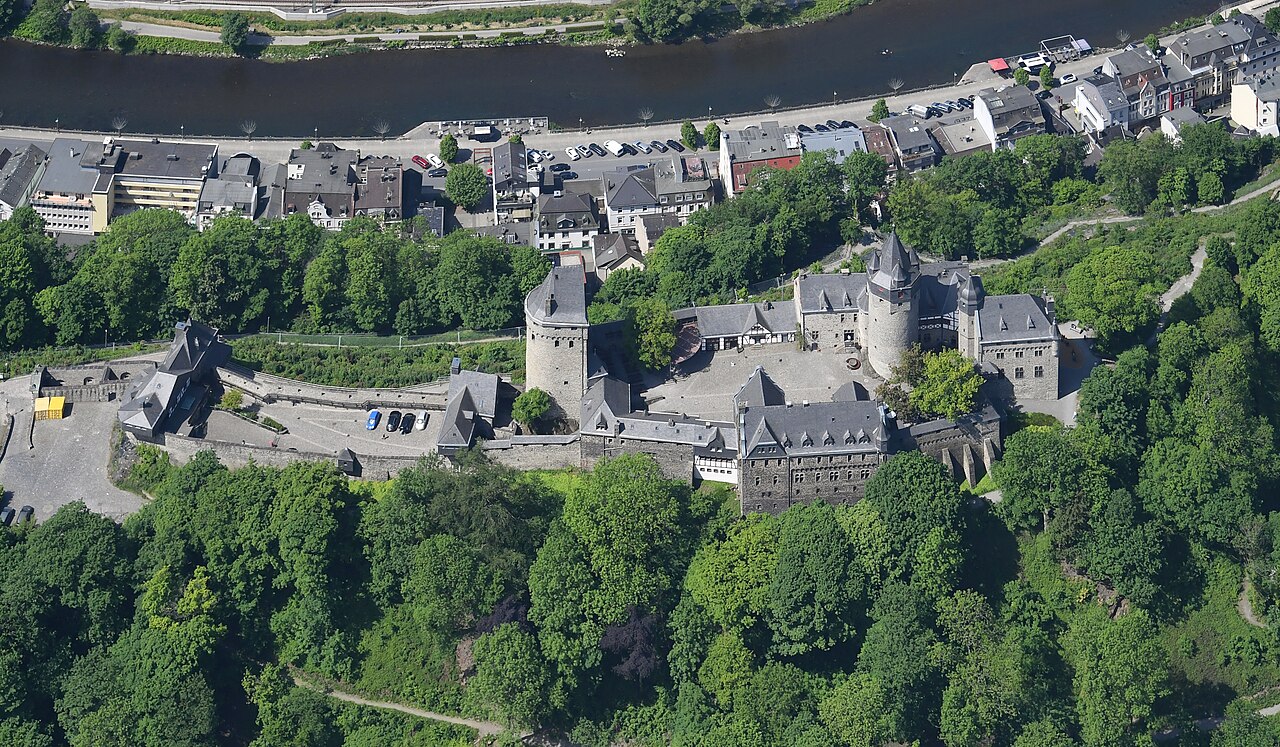
Neuenhof Castle

Neuenhof Castle in Lüdenscheid, Germany
Lüdenscheid, Germany
Late Medieval (14th–15th c.)

Neuenhof Castle, located in Lüdenscheid, Germany, is a notable example of a water castle with origins dating back to the 14th century. First documented in 1326, the castle has undergone significant transformations, reflecting the architectural and historical developments of the region through the Late Medieval period and beyond.

Historical background and development

The earliest records of Neuenhof Castle trace back to the early 14th century, marking it as a medieval stronghold in the Sauerland region. Originally constructed as a defensive residence, the castle's strategic location was enhanced by its surrounding moat, characteristic of water castles designed to utilize natural water defenses.

The castle experienced major rebuilding in 1643, during the turbulent years of the Thirty Years' War, a period that saw many fortifications in Germany either destroyed or reinforced. This reconstruction gave rise to the current main structure, a rectangular two-storey house that remains the centerpiece of the castle complex.

Following a destructive fire in 1693, Neuenhof Castle was restored, preserving its historical layout and architectural integrity. The restoration efforts maintained the castle's distinctive features, including its towers and courtyard arrangement, which continue to reflect the Late Medieval and early modern architectural influences.

Architectural features and layout

The castle's main building is notable for its rectangular plan and two-storey height, which was typical for fortified residences of the period. The building's courtyard side is flanked by two towers, which provided both defensive capabilities and residential space.

These towers are integral to the castle's silhouette, contributing to its imposing appearance and serving as vantage points for surveillance. The presence of a moat around the castle further emphasizes its defensive purpose, categorizing Neuenhof as a classic water castle.

The castle complex includes ancillary buildings and fortifications that supported the daily life and defense of its inhabitants, although many of these structures have been altered or lost over time.

Significance and preservation

Neuenhof Castle is an important cultural landmark within the Lüdenscheid region, illustrating the evolution of castle architecture from the medieval period through the early modern era. Its survival through war, fire, and restoration highlights the resilience of such structures and their continued relevance in understanding regional history.

The castle remains partially preserved, with the main building and towers intact, offering visitors a glimpse into the architectural styles and defensive strategies employed in the Late Medieval period. Its water defenses and structural design make it a valuable example of fortified residences in Germany.

Visiting Neuenhof Castle

While primarily a historic site, Neuenhof Castle attracts visitors interested in medieval architecture and German history. The castle's picturesque setting and surviving features provide a compelling destination for cultural tourism.

Information about public access, guided tours, and events may be available through local heritage organizations or the municipality of Lüdenscheid, which manages many regional historic sites.

Frequently asked questions (FAQ)

What is the historical significance of Neuenhof Castle?
Neuenhof Castle, located in Lüdenscheid, Germany, dates back to the 13th century and is a remarkable example of medieval architecture. It served as a noble residence and played a significant role in the region's history, showcasing the power dynamics of the local nobility during its time.
When was Neuenhof Castle built?
Neuenhof Castle was constructed in the early 13th century, with its first documented mention occurring in 1250. Over the centuries, it has undergone various renovations and restorations, reflecting the architectural styles and needs of different historical periods.
Can I visit Neuenhof Castle?
Yes, Neuenhof Castle is open to visitors, allowing you to explore its beautiful grounds and historic architecture. Guided tours are often available, providing insight into the castle's rich history and significance.
What are the opening hours of Neuenhof Castle?
Neuenhof Castle typically opens to the public from April to October, with specific hours varying by day and season. It is advisable to check the castle's official website or contact the visitor information center for the most current opening hours before planning your visit.
Is it possible to access Neuenhof Castle by public transport?
Yes, Neuenhof Castle is accessible by public transport, with several bus routes serving the area. Visitors can also find parking nearby if they choose to drive, making it easy to reach the castle from Lüdenscheid.
What is the best time to visit Neuenhof Castle?
The best time to visit Neuenhof Castle is during the spring and summer months when the weather is pleasant and the gardens are in full bloom. Additionally, many special events and guided tours are organized during this period, enhancing the visitor experience.
Are there any nearby attractions to visit along with Neuenhof Castle?
Yes, the area surrounding Neuenhof Castle offers several attractions, including beautiful hiking trails in the surrounding countryside and other historical sites in Lüdenscheid. Visitors can also explore local cafes and shops that highlight the region's culture.
What are the ticket prices for visiting Neuenhof Castle?
Ticket prices for Neuenhof Castle are generally affordable, with discounts available for students, seniors, and children. It is best to check the official website for the latest pricing information and any special offers that may be available during your visit.

Loading map...

Visitor reviews

No reviews yet. Been here? Write the first review and help other travelers!

Write the first review

Visited this castle? Share your experience

Your review helps other travelers and adds first-hand knowledge to our encyclopedia.

Write a review

(5/5)

0/2000 characters

Your review will be visible after admin approval

Nearby castles

11.2 km

Burg Holtzbrinck

Altena, Germany

Burg Holtzbrinck is a notable hill castle located in the city of Altena, Germany. Its origins date back to at least the 16th century, placing its initial construction in the late medieval or early modern period. The castle's name, translating roughly to "wooden bridge castle," reflects its historical role as a fortified residence and local landmark. Historical background and ownership The earliest documented reference to Burg Holtzbrinck appears in 1643, when it was acquired by Georg Holtzbrinck, a prominent city official holding the titles of Rentmeister and Freigraf. Following Georg's death in 1664, ownership passed to his son, Stephan Johann Holtzbrinck. Between 1673 and 1689, Stephan Johann undertook significant renovations and expansions, which largely shaped the castle's current architectural form. The Holtzbrinck family maintained ownership of the castle until the late 19th century. In 1894, the estate passed through marriage to Hans von Carlowitz, who became the new proprietor by marrying Louise Eva Anna von Holtzbrinck. Hans's second wife, Elfriede von Carlowitz, later spearheaded restoration efforts and adapted parts of the estate, including former stables and service buildings, converting them into residential apartments. In 1972, Elfriede von Carlowitz sold Burg Holtzbrinck to the city of Altena. The municipality initiated a careful restoration project, completed in the mid-1970s, to preserve the historical character of the building. By 1976, Burg Holtzbrinck was officially designated as a civic center, serving as a multifunctional public venue. Architectural features and design Burg Holtzbrinck exhibits a fortress-like design typical of hill castles from the 16th century onward, emphasizing strength and protection. The castle's robust structure conveys a sense of status and security, characteristic of residences that balanced residential comfort with defensive considerations. The castle complex includes a variety of rooms adapted for both public and private uses. The main meeting area accommodates about 60 people and is equipped with practical amenities such as a bar and kitchen, supporting its role as a civic center. Additional notable interiors include the Blue Room, an intimate space designed for wedding ceremonies seating up to 10 guests, and the Fireplace Room, which hosts mid-sized gatherings of around 30 people around a hearth that adds warmth and ambiance. The largest interior space, the Georg-von-Holtzbrinck Hall, can accommodate up to 160 guests, making it suitable for larger events and community functions. Rococo garden and modern adaptations One of the castle's distinctive features is its Rococo-style garden, created in the early 1980s atop a subterranean parking garage constructed directly in front of the castle. This garden integrates 18th-century decorative art elements with modern urban infrastructure, blending historical aesthetics with contemporary needs. The transformation of former stables and service buildings into residential apartments by Elfriede von Carlowitz reflects the castle's adaptive reuse. These apartments have been noted in contemporary literature, including works by Günter Wallraff, who highlighted the challenging living conditions experienced by some residents, adding a social dimension to the castle's history. Restoration and preservation efforts The city of Altena's restoration efforts in the 1970s focused on preserving Burg Holtzbrinck's historical integrity while adapting it for modern civic use. These efforts have maintained much of the castle's original form and architectural character, ensuring its continued relevance as a public venue. Today, Burg Holtzbrinck stands as a layered historic structure that combines its 16th-century origins with later architectural interventions and modern urban adaptations. Its fortress-like preservation and versatile interior spaces demonstrate a commitment to maintaining both heritage and functionality within the community. Cultural significance and public use As a civic center, Burg Holtzbrinck plays an active role in Altena's community life. It hosts a range of events, including weddings, meetings, and cultural gatherings, leveraging its historic ambiance and functional spaces. The castle's garden and public areas provide a scenic and historically rich environment, attracting visitors interested in architecture, history, and local culture. Its integration of historical preservation with contemporary civic utility exemplifies successful heritage management. Visitor facilities and accessibility The castle offers various rooms tailored to different event sizes, from intimate ceremonies in the Blue Room to large gatherings in the Georg-von-Holtzbrinck Hall. Amenities such as a bar and kitchen support event hosting. The Rococo garden offers an elegant outdoor space for visitors and event attendees.

Late Medieval (14th–15th c.)
Details
11.6 km
Altena Castle — Germany castle

Altena Castle

Altena, Germany

Altena Castle stands as a remarkable example of a high medieval hill castle in the Sauerland region of North Rhine-Westphalia, Germany. Founded in the early 12th century by the brothers Adolf and Everhard von Berg, the castle was originally named Wulfeshagen and strategically built on the rocky promontory of Klusenberg hill overlooking the Lenne River. This location provided natural defenses and control over important trade routes, particularly those linked to the region's burgeoning iron industry. The castle's initial construction around 1108 marked the establishment of the County of Altena, which later evolved into the County of Mark after the ruling family expanded their territory near Hamm in the late 12th century. The counts shifted their primary residence to Mark Castle but continued to use Altena Castle as an administrative center and residence for their stewards from the late 14th century onward. Medieval origins and strategic importance Altena Castle's foundation by the von Berg brothers was part of a broader pattern of territorial consolidation in the Holy Roman Empire during the high medieval period. The castle's elevated position on a spur of the Klusenberg hill allowed it to dominate the surrounding landscape and protect vital trade routes through the Sauerland, a region known for its iron mining and metalworking industries. The castle's fortifications included stone curtain walls, towers, and a gatehouse, typical of early 12th-century military architecture. By 1161, Altena Castle had become the seat of the County of Altena under Count Eberhard I von Berg-Altena. The counts expanded their influence by acquiring the County of Mark near Hamm by 1198. This acquisition prompted a shift in the family's main residence but did not diminish Altena's administrative and strategic roles. Architectural evolution and functions Over the centuries, Altena Castle underwent various modifications reflecting changes in military technology and residential needs. After a significant fire in 1455, the castle was only partially rebuilt, which contributed to its gradual decline as a noble residence. From the early 17th century, it served as a garrison for Brandenburg troops and later housed a criminal court and prison, illustrating its adaptation to administrative and judicial functions. The castle complex includes a keep (donjon), inner courtyard, and remnants of the outer bailey. While some sections were lost or fell into ruin, restoration efforts in the early 20th century aimed to preserve and reinterpret the castle's medieval character. The restoration introduced elements of romantic neo-Gothic Tudor style, which, while not strictly historically accurate, enhanced the castle's picturesque appeal. The world's first youth hostel and cultural significance One of Altena Castle's most notable contributions to modern culture is its role as the site of the world's first permanent youth hostel. In 1912, educator Richard Schirrmann established this pioneering institution within the castle walls, providing affordable accommodation for young travelers and promoting cultural exchange and outdoor education. The youth hostel continues to operate today, maintaining its historic rooms and welcoming visitors from around the world. In addition to the youth hostel, Altena Castle houses several museums that celebrate the region's history and heritage. These include the Museum of the County of Mark, which traces local history from early times through the medieval period to modernity, the Märkisches Smithy Museum showcasing traditional metalworking, and the German Hiking Museum, reflecting the area's natural landscape and hiking culture. Modern restoration and visitor experience Restoration efforts in the 20th and 21st centuries have focused on preserving Altena Castle's structural integrity and enhancing visitor access. A notable addition is the visitor elevator installed in 2014, which connects the town's pedestrian zone with the castle courtyard, featuring an interpretive experience path that narrates the castle's 900-year history. Between 2016 and 2018, the castle gates underwent meticulous restoration, recognized by heritage authorities for their historical and architectural significance. Today, visitors can explore the castle's medieval halls, fortified walls, and courtyards, enjoy exhibitions, and dine in the castle's restaurant, which offers a scenic setting within the historic walls. Educational programs and family activities Altena Castle places a strong emphasis on museum pedagogy, particularly for children. Interactive programs allow young visitors to engage with medieval history through activities such as treasure hunts, knightly training exercises, and demonstrations of armor and weaponry. These educational offerings make the castle a popular destination for school groups and families seeking an immersive historical experience. Overall, Altena Castle remains a vital cultural landmark that bridges its high medieval origins with contemporary educational and tourism functions. Its unique combination of historical architecture, pioneering youth hostel legacy, and diverse museums makes it a significant destination for those interested in German history, medieval castles, and cultural heritage.

High Medieval (11th–13th c.)
Details
14.9 km

Gimborn Castle

Marienheide, Germany

Gimborn Castle is a notable example of a former moated castle located in the scenic upper Leppe valley near Marienheide, Germany. Constructed in the 13th century during the High Medieval period, the castle originally served as a strategic stronghold and noble residence. Its location in a remote valley provided natural defense advantages, complemented by its water defenses characteristic of water castles of the era. Medieval origins and historical significance The castle's earliest recorded mention dates to 1273 when it was pledged from the county of Berg to the county of Mark. This transfer highlights the castle's importance in regional power dynamics during the High Medieval period. Later, in 1631, Gimborn Castle became the residence of the House of Schwarzenberg within the county of Gimborn Neustadt, marking a significant chapter in its aristocratic history. Architectural features and layout Originally designed as a moated water castle, Gimborn Castle's defensive system relied heavily on its surrounding water-filled moat, which was typical for castles built to withstand siege warfare in the medieval era. The castle's layout likely included fortified walls, towers, and a gatehouse controlling access across the moat. While the exact architectural details have evolved, the castle's structure reflects the typical High Medieval fortification style, emphasizing both defense and residential comfort. Construction materials and style The castle was primarily constructed using locally sourced stone and timber, materials common in the High Medieval period. Its architectural style aligns with the functional and robust designs of the era, prioritizing fortification over ornamental elements. Over the centuries, modifications may have introduced elements from later architectural movements, but the core remains medieval in character. Ownership and modern use Since 1874, Gimborn Castle has been owned by the Barons von Fürstenberg zu Gimborn, a noble family with historical ties to the region. This ownership has helped preserve the castle's heritage and maintain its structural integrity. In 1969, the castle found a new role as a conference site and meeting place for the International Police Association, blending its historic ambiance with contemporary functions. Cultural events and public access Gimborn Castle opens its gates annually for a traditional festival or fair, allowing visitors to experience its historic atmosphere and regional culture firsthand. This event celebrates the castle's enduring legacy and fosters community engagement with its rich history. Geographical and strategic importance Situated in a remote valley of the upper Leppe, the castle's location was strategically chosen for defense and control over the surrounding territory. The natural landscape, combined with its moated defenses, made Gimborn Castle a formidable stronghold during the turbulent medieval period. Preservation and current condition Today, Gimborn Castle is well preserved, maintaining much of its historical character. Its continued use as a conference venue and cultural site has contributed to ongoing maintenance and restoration efforts, ensuring that this High Medieval water castle remains a significant architectural and historical landmark in the region.

High Medieval (11th–13th c.)
Details