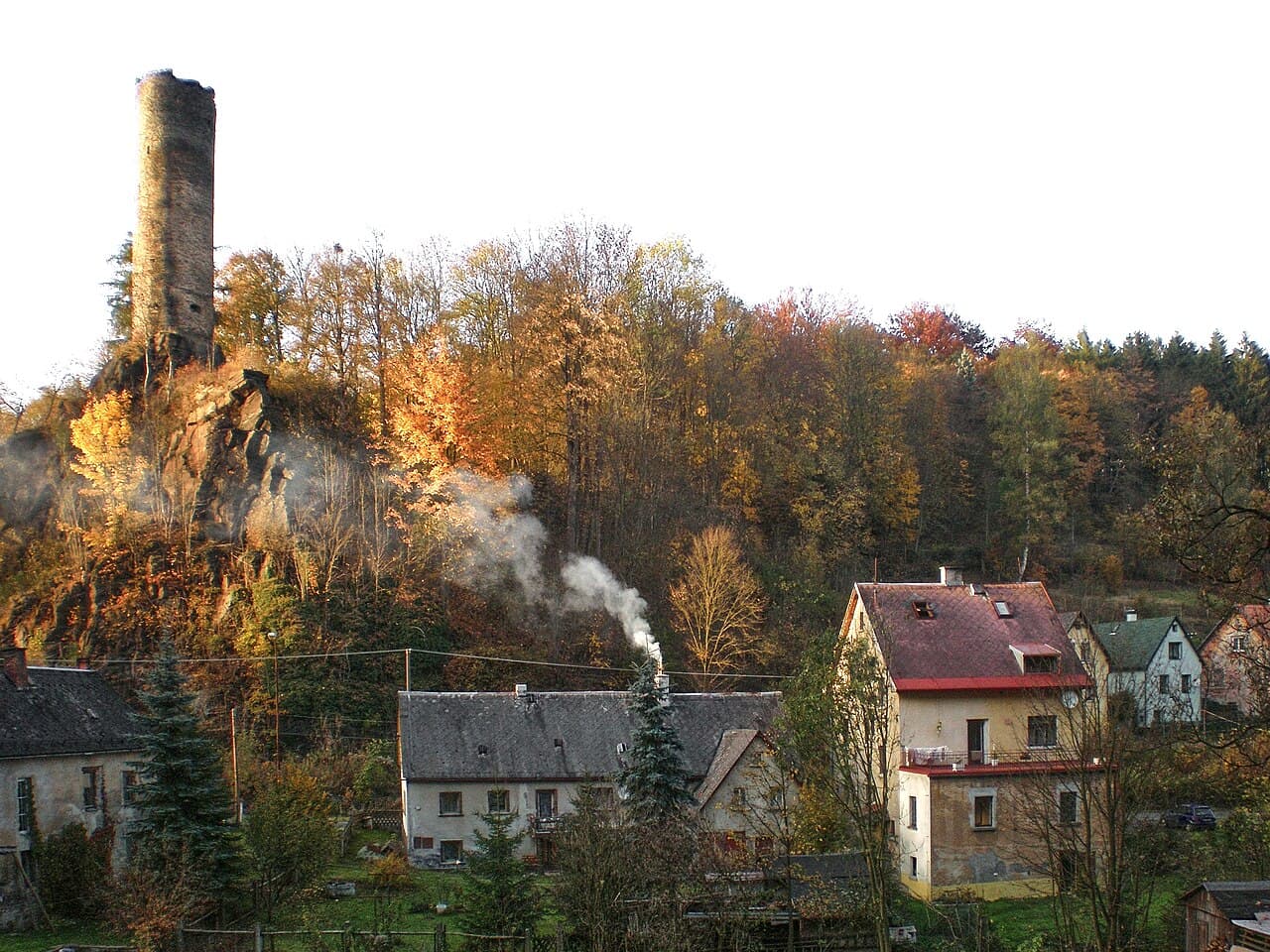
Neuberg Castle
Neuberg Castle is a striking example of a high medieval hill castle located near the village of Podhradí in the Karlovy Vary Region of Czechia. Established in the late 13th century by the noble Neuberg family, the castle played a significant role in regional power dynamics and defense along important trade routes toward Saxony. Although now a ruin, its remaining structures, especially the imposing 22-meter cylindrical bergfried, offer valuable insight into medieval castle architecture and feudal history in Central Europe.
Founding and early history
The origins of Neuberg Castle trace back to the transition between the 12th and 13th centuries, when the Neuberg (Neipperg) family constructed the fortress to assert control over their lands and oversee vital trade corridors. The first written mention of the castle dates to 1288, coinciding with the death of Albrecht von Neuberg. Subsequently, King Rudolph I of Bohemia granted the castle and its surrounding village to the lords of Plauen as a fief, reflecting the feudal practices of the time.
Despite this transfer, the Neuberg family retained influence in the region and eventually regained control. The castle's strategic location made it a focal point for regional conflicts, including raids launched by the Neubergs themselves, which provoked retaliation from King Charles IV. These hostilities resulted in damage to the castle, necessitating repairs and fortification improvements.
Ownership transitions and political significance
In 1327, the Neuberg family formalized their feudal relationship by conveying their hereditary lands to King John of Bohemia and receiving them back as a fief. This act solidified the castle's role within the Bohemian crown's territorial framework. Later, in 1392, ownership passed to the von Zedtwitz family through marriage and purchase, initiating a period of over two centuries during which Neuberg Castle served as the administrative center for the Aš region.
The von Zedtwitz family oversaw the castle's maintenance and adapted it to evolving defensive and residential needs. Their stewardship reflects the castle's dual role as both a military stronghold and a noble residence.
Architectural features and structural layout
Upper and lower castle complexes
Neuberg Castle was originally composed of two main sections: the upper castle (Horní zámek) and the lower castle. These components were interconnected yet served distinct functions within the fortress complex. The castle was situated on a large, flattened rock terrace, providing a natural defensive advantage with steep drops on several sides.
The upper castle retains substantial ruins with walls standing up to three stories high. Noteworthy are the rectangular window openings framed with Baroque stone moldings and cornices, indicating later Renaissance and Baroque modifications. Remnants of original plaster and stucco decorations survive, revealing the castle's evolution from purely military to more comfortable noble habitation.
The lower castle once featured a three-winged structure enclosing a trapezoidal courtyard. Today, only fragments remain, including parts of the southern terrace wall and foundational outlines. This section housed various functional buildings and was integral to the castle's overall defense system.
The bergfried and defensive elements
The castle's most prominent surviving architectural feature is its cylindrical bergfried, a massive defensive tower rising approximately 22 meters above its base. The tower sits atop a rock spur nearly 30 meters high, overlooking the surrounding landscape and trade routes. Measuring about 19 meters in circumference, the bergfried served as a refuge during sieges and a lookout point.
Recent restoration efforts between 2015 and 2018 have stabilized the tower and adapted it as an observation platform, allowing visitors to appreciate the castle's commanding position. The bergfried's robust construction and strategic placement exemplify medieval military architecture in the region.
Destruction, decline, and preservation efforts
Neuberg Castle suffered significant damage over the centuries, notably from a major fire in 1610 that left it seriously impaired. Following this event, the von Zedtwitz family abandoned the fortress and constructed new chateaus in nearby locations such as Aš, Kopaniny, Doubrava, Smrčina, and Podhradí. Materials salvaged from the castle were used in these new residences, marking the transition from medieval fortress to early modern noble estates.
The castle's decline continued through the Thirty Years’ War and into the modern era. A fire in 1902 destroyed the upper castle, which was never rebuilt. The site fell into ruin, with only the bergfried and some walls remaining. During World War II, vaulted cellars located in the southern moat area were repurposed as air-raid shelters, demonstrating the castle's continuing strategic utility.
Preservation efforts began in earnest in the late 20th century, with local authorities and heritage organizations striving to protect the ruins despite limited financial resources. The restoration of the bergfried has been a focal point, ensuring the survival of this key architectural element for future generations.
Cultural and religious context
Adjacent to the castle ruins stands the Evangelical Church of the Good Shepherd, built in the 15th century. This church reflects the religious transformation of the region following the castle's separation from the jurisdiction of Cheb in 1422 and the area's gradual embrace of Lutheranism. The proximity of the church to Neuberg Castle highlights the intertwined nature of secular and ecclesiastical power in medieval and early modern Central Europe.
Visiting Neuberg castle today
Today, Neuberg Castle is a partially preserved high medieval hill castle ruin that attracts visitors interested in medieval history, architecture, and scenic views. The restored bergfried offers panoramic vistas of the surrounding countryside, including the village of Podhradí and the broader Karlovy Vary region.
While large sections of the castle remain in ruins, the site provides a tangible connection to the region’s feudal past and the architectural evolution from medieval fortress to Renaissance noble residence. Efforts by the local council to maintain and protect the ruins continue, although financial constraints pose challenges.
Visitors are encouraged to explore the site respectfully, appreciating both its historical significance and its natural beauty. The castle's elevated location and preserved structures make it an important cultural landmark within Czechia.
Frequently asked questions (FAQ)
- What is the historical significance of Neuberg Castle?
- Neuberg Castle, located in Podhradí, Czechia, dates back to the 13th century and is a remarkable example of medieval architecture. It played a crucial role in regional defense and has witnessed numerous historical events over the centuries, making it a significant landmark in Czech history.
- When was Neuberg Castle built?
- Neuberg Castle was originally constructed in the 13th century, with various modifications and restorations occurring over the years. Its architecture reflects the styles and fortifications typical of that period, showcasing the evolution of castle design in Central Europe.
- Can I visit Neuberg Castle?
- Yes, Neuberg Castle is open to visitors, allowing them to explore its historic interiors and beautiful grounds. It is advisable to check the official website for specific visiting hours and any guided tour options that might be available.
- What are the opening hours for Neuberg Castle?
- Neuberg Castle typically opens to visitors from April through October, with specific hours varying by month. During peak season, the castle may have extended hours, so it's best to verify the latest information online before planning your visit.
- Is it possible to access Neuberg Castle by public transport?
- Yes, Neuberg Castle is accessible by public transport, with regular bus services connecting Podhradí to nearby cities. Visitors are encouraged to check local transport schedules to ensure a smooth journey to the castle.
- What is the best time to visit Neuberg Castle?
- The best time to visit Neuberg Castle is during the spring and early autumn months when the weather is pleasant, and the surrounding landscape is particularly beautiful. Additionally, these seasons often feature fewer crowds, allowing for a more enjoyable exploration of the castle.
- Are there any nearby attractions to see while visiting Neuberg Castle?
- Yes, visitors to Neuberg Castle can explore other nearby attractions, including the picturesque town of Podhradí and various hiking trails in the surrounding countryside. The region is rich in natural beauty and historical sites, making it a perfect destination for a day trip.
- What are the ticket prices for visiting Neuberg Castle?
- Ticket prices for Neuberg Castle vary depending on age and the type of tour selected, with discounts often available for children and seniors. It's recommended to check the official website for the most current ticket pricing and any special offers.
Photo gallery

Information
Website
Visit websiteSources & official resources
Verify the information above using these authoritative references.
Loading map...
Visitor reviews
No reviews yet. Been here? Write the first review and help other travelers!
Write the first reviewVisited this castle? Share your experience
Your review helps other travelers and adds first-hand knowledge to our encyclopedia.



