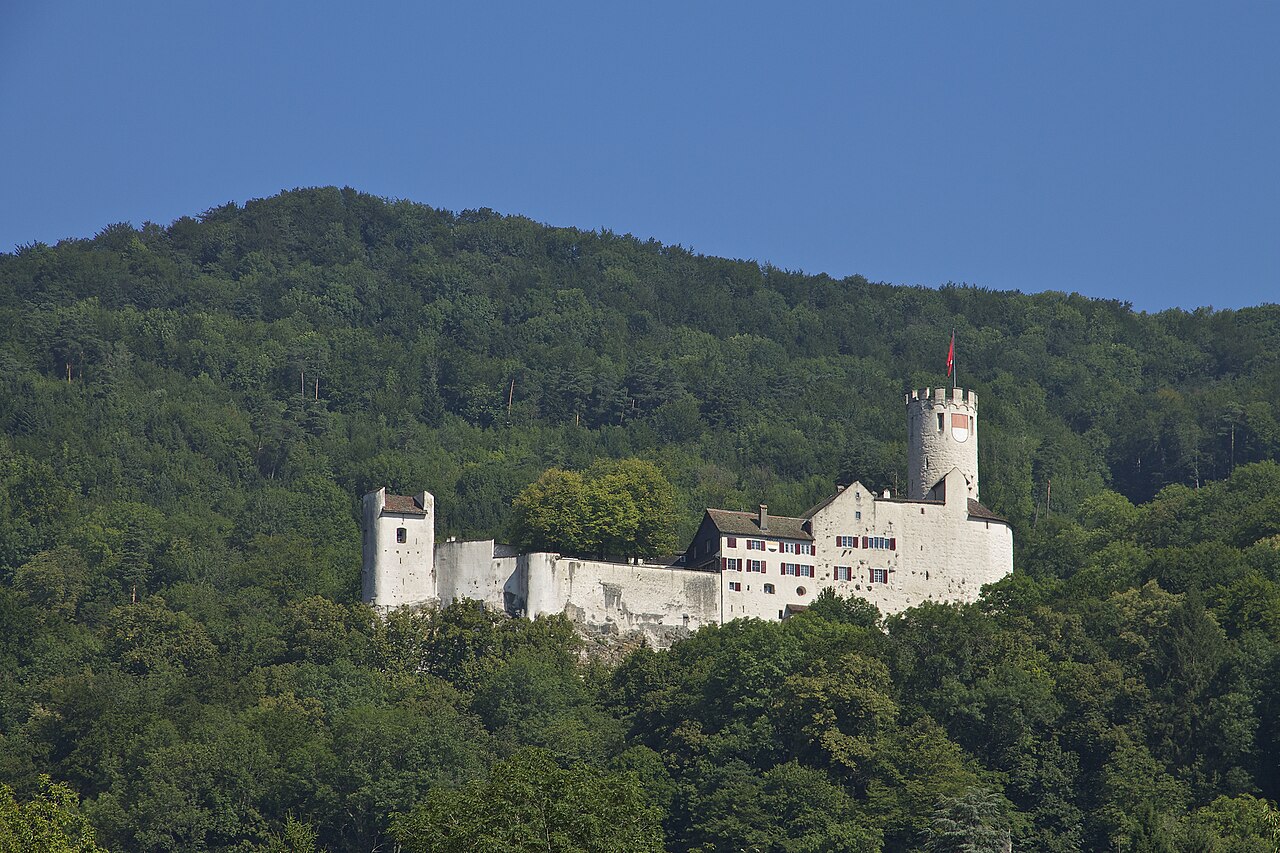
Neu-Falkenstein Castle
Neu-Falkenstein Castle is an evocative medieval fortress located in Balsthal, Switzerland, perched strategically on a hilltop at 595 meters above sea level. This hill castle was originally constructed in the early 12th century by a local noble family to assert territorial control in the region. Its commanding position offers extensive views over the surrounding Jura hills and the town of Balsthal, underscoring its military and administrative significance through the centuries.
The castle’s origins are tied to the High Medieval period, with the earliest possible owners mentioned in a disputed document from 1145 referring to brothers Welf and Ulrich von Falkenstein. By the late 12th century, the estate was held as a fief by the Freiherren von Bechburg under the authority of the Bishop of Basel. A branch of the Bechburg family later adopted the title Counts of Falkenstein and undertook significant expansions, including the construction of a large residential palace and a distinctive circular bergfried tower, typical of medieval defensive architecture.
Historical development and ownership
The documented history of Neu-Falkenstein Castle reflects the complex feudal and political dynamics of the region. Rudolf von Falkenstein, son of Rudolf von Bechburg, appears as the first clearly recorded owner in the mid-13th century. He expanded the castle’s defenses by adding a fortified outer bailey around 1250, which enhanced the stronghold’s military capabilities. The castle was briefly co-owned by Rudolf III von Wart until 1305, a figure later infamous for his involvement in the assassination of King Albert I of Germany in 1308. Rudolf von Wart sought refuge at Neu-Falkenstein but ultimately sold his shares before his arrest and execution, highlighting the castle’s entanglement in regional conflicts.
The fortress suffered severe damage during the 1356 Basel earthquake, one of the most devastating seismic events in Swiss history. The restoration efforts following the earthquake were so extensive that the castle acquired the prefix "Neu" (meaning "new" in German), reflecting its renewed appearance. Further destruction occurred during the Safran War of 1374, a regional conflict involving multiple powers. Henmann von Bechburg, a key figure in this period, attacked a merchant convoy from Basel, prompting a siege led by a coalition including Bern, Basel, and several noble families. The castle was captured after a fourteen-week siege, partially destroyed, and its defenders executed.
Following the Safran War, Henmann von Bechburg received funds to restore the castle but soon pawned it to Rutschmann von Blauenstein. Upon Henmann’s death, full ownership passed to the von Blauenstein family. Ownership disputes involving Henmann’s sister and the counts of Thierstein were resolved when Hans von Blauenstein sold Neu-Falkenstein to the city of Solothurn in 1402. The city formally took possession in 1417, although the Bishop of Basel remained overlord until 1669.
Neu-Falkenstein served as the residence of the Solothurn bailiff, an administrative official, until 1798. During the Helvetic Revolution, the castle was set on fire and destroyed by rebelling peasants. It was subsequently abandoned and fell into ruin, marking the end of its active use as a fortress and residence.
Architectural features and layout
Defensive structures and bergfried
The castle’s layout reveals a complex evolution from two initially separate fortifications into a single fortified complex. The western section is dominated by a tall, round bergfried tower, a hallmark of medieval military architecture designed as a last refuge and lookout point. The tower features a stone staircase with 62 steps leading to a platform approximately 15 meters above ground level. From this vantage point, visitors can appreciate panoramic views of Balsthal and the Jura hills, emphasizing the castle’s strategic importance.
Residential and religious buildings
The eastern part of the castle contains the foundations of a trapezoidal residential wing, representing the oldest inhabited section of the complex. Nearby remains include traces of a chapel, underscoring the religious functions integrated within the castle’s precincts. Foundations of other residential and economic buildings illustrate the castle’s role as a noble residence and administrative center.
Outer defenses and adaptations
The approach to the castle was fortified with an expanded entrance area comprising a forecourt and gatehouse, supplemented by a zwinger—a narrow enclosed space between defensive walls designed to trap attackers. Terraces in the forecourt have been identified as garden areas, reflecting the castle’s domestic aspects. Later additions include an artillery bastion, indicating adaptations to evolving military technology during the early modern period.
Restoration and archaeological investigations
Restoration efforts began around 1900, initiated by a local society in Balsthal dedicated to preserving the castle’s heritage. The initial focus was stabilizing the bergfried, which remains partially restored today. Excavations in 1938 and 1939 uncovered parts of the ruins but were hampered by inadequate archaeological methods, resulting in the loss of many artifacts.
Despite these setbacks, investigations identified at least four major construction phases spanning from the 11th to 12th centuries, through late 13th-century modifications, and further work around 1640. The exact dating of the outer bailey remains uncertain. The ruins today provide valuable insights into medieval castle construction, feudal administration, and military architecture.
Neu-Falkenstein castle in cultural heritage
Today, Neu-Falkenstein Castle stands as an important cultural landmark in the canton of Solothurn. Its ruins, partially restored and accessible to visitors, offer a tangible connection to the region’s medieval history and architectural evolution. The castle’s layered construction phases and historical associations with noble families, regional conflicts, and administrative roles make it a significant site for understanding Swiss medieval heritage.
Visitors to Neu-Falkenstein can explore the remains of its defensive towers, residential quarters, and outer fortifications while enjoying scenic views of the Jura landscape. The site’s preservation reflects ongoing efforts to maintain Switzerland’s historical monuments and promote cultural tourism.
Frequently asked questions (FAQ)
- How do I get to Neu-Falkenstein Castle in Balsthal?
- Neu-Falkenstein Castle is accessible by foot via hiking trails from Balsthal town center. The castle sits on a hilltop, so be prepared for a moderate uphill walk through scenic forest paths.
- What are the opening hours for visiting Neu-Falkenstein Castle?
- The castle ruins are open to the public year-round, with no formal opening hours since it is an outdoor site. Visitors can explore the grounds during daylight hours.
- Is there an entrance fee to visit Neu-Falkenstein Castle?
- Visiting Neu-Falkenstein Castle is free of charge. There are no ticket fees for exploring the ruins and surrounding areas.
- What is the historical significance of Neu-Falkenstein Castle?
- Neu-Falkenstein Castle played a key role in the medieval political and military history of the Solothurn region. It was involved in regional conflicts such as the Safran War and served as the residence of the Solothurn bailiff until the late 18th century.
- Can I climb the bergfried tower at Neu-Falkenstein Castle?
- The bergfried tower has been partially restored and is accessible to visitors. Climbing the 62-step stone staircase leads to a platform with panoramic views of Balsthal and the Jura hills.
- What architectural styles are evident at Neu-Falkenstein Castle?
- The castle features typical <strong>High Medieval</strong> defensive architecture, including a circular bergfried and fortified outer bailey. Later additions reflect adaptations to early modern military technology.
Information
Sources & official resources
Verify the information above using these authoritative references.
Loading map...
Visitor reviews
No reviews yet. Been here? Write the first review and help other travelers!
Write the first reviewVisited this castle? Share your experience
Your review helps other travelers and adds first-hand knowledge to our encyclopedia.