
Nemours Castle
Nemours Castle, located in the town of Nemours in the Seine-et-Marne département of Ile-de-France, is a remarkable example of a high medieval fortress that has evolved through centuries of French history. Situated on the banks of the Loing river, the castle's strategic position near a river ford was crucial for controlling local passage and trade routes. Today, it stands as a restored monument historique that houses a museum with notable collections of pottery, reflecting its cultural significance beyond military architecture.
Early history and foundation
The origins of Nemours Castle date back to around 1120, when the first stones were laid by a figure named Orson on the left bank of the Loing. Archaeological excavations in 1898 revealed Merovingian sarcophagi in the nearby Saint les Nemours area, indicating that the site had been inhabited since early medieval times. Prior to the castle's construction, a village occupied a hill on the left bank, while the first lords likely established a motte-and-bailey style stronghold on the right bank at a site known as "le chatelet." This early fortification capitalized on the nearby ford, essential for crossing the river before the later construction of a bridge.
The rise of the lords of nemours
The earliest recorded lord, Gauthier I de Villebéon, who served as chamberlain to King Louis VII, secured a communal charter in 1170. This charter formalized the town's status and governance, marking Nemours as a recognized administrative entity. The castle and town thus became a focal point of regional power during the high medieval period.
Medieval conflicts and transformations
Nemours Castle witnessed significant turmoil during the Hundred Years' War. In 1359, the town was burned by the forces of Jean de Grailly, the Captal de Buch, reflecting the intense military struggles between French and English factions. Later, in 1404, Nemours was elevated to a duchy-peerage, enhancing its noble prestige. However, the castle fell to English control in 1420, only to be liberated in 1437 by Jacques of Anjou, a key figure in restoring French rule.
Architectural modifications in the late medieval era
During the 15th century, the castle underwent important architectural changes under Jacques d'Armagnac. He introduced mullioned windows to the keep, transforming it from a purely defensive structure into a more comfortable residence. This reflects a broader trend in castle architecture of the period, where fortifications began to incorporate elements of domesticity and prestige.
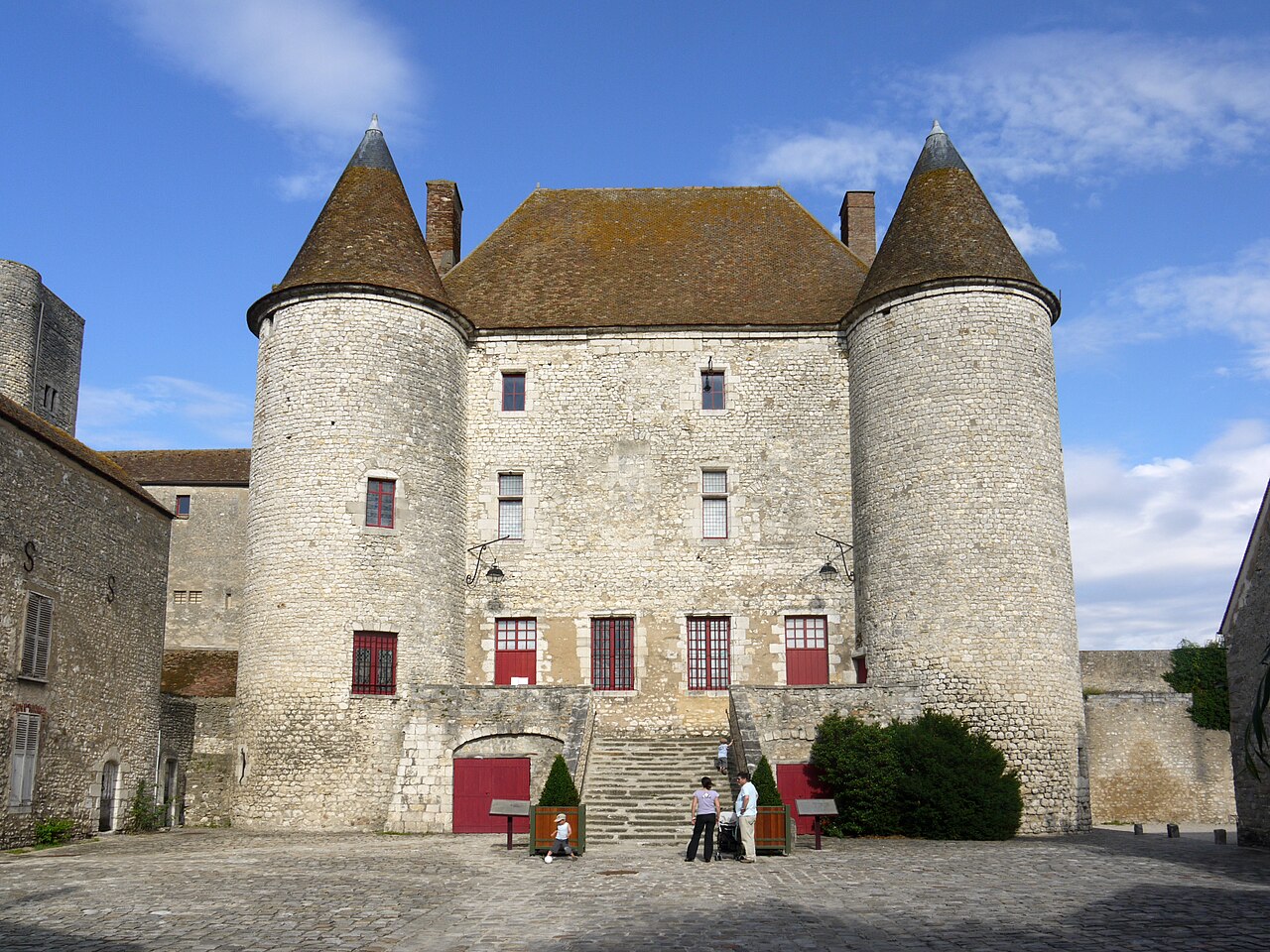
Photo by Pline • CC BY-SA 3.0
The treaty of nemours and religious wars
Nemours Castle played a notable role in the French Wars of Religion. In 1585, the Treaty of Nemours was signed within its walls by Catherine de' Medici and the Duke of Guise. This treaty marked the ascendancy of the Catholic League and demanded the expulsion of Protestants from France. The castle thus stands as a witness to the religious and political conflicts that shaped early modern France, preceding the eventual resolution brought by King Henri IV's Edict of Nantes.
17th-century adaptations and later use
In the mid-17th century, Nemours Castle transitioned from a military fortress to a civic building. Under Anne Hédelin, lieutenant general to the Duke of Orleans, the castle became a law court. Significant alterations were made, including the redesign of the castle entrance to open onto the main courtyard, featuring a monumental staircase (perron). These changes reflect the castle's adaptation to new administrative functions in the early modern period.
Architectural features and layout
The castle's layout is dominated by a girdled keep composed of four round towers and a square watchtower that overlooks the Loing valley. This combination of defensive towers provided comprehensive surveillance and protection. The main courtyard is encircled by medieval houses, which contribute to the historic fabric of the town center alongside communal mills, the church, and the clerical district.
Defensive elements
The castle's fortifications exemplify typical high medieval military architecture, with thick walls and strategically placed towers designed to repel sieges. The river and its ford added a natural defense line, enhancing the castle's security. The presence of a chapel, now partly in ruins but protected as an ancient monument since 1926, indicates the integration of religious functions within the castle complex.
Museum and cultural significance
Between 1903 and 1999, the castle was transformed into a museum, showcasing collections primarily focused on pottery. This cultural adaptation has preserved the castle's heritage and opened it to public appreciation. The designation as a monument historique by the French Ministry of Culture in 1977 underscores its importance as a heritage site.
Visiting nemours castle today
Visitors to Nemours Castle can explore its well-preserved medieval architecture and enjoy the museum's collections. The castle's location in the Ile-de-France region makes it accessible from Paris, offering a glimpse into the region's feudal past and architectural evolution. The surrounding historic town center further enriches the visitor experience with its authentic medieval ambiance.
Access and amenities
The castle is open to the public with visiting hours typically accommodating daytime tours. The museum provides educational exhibits on the castle's history and the region's cultural heritage. Visitors are encouraged to explore the castle's towers, courtyard, and the remnants of the chapel, gaining insight into medieval life and architecture.
Frequently asked questions (FAQ)
- How do I get to Nemours Castle?
- Nemours Castle is located in the charming town of Nemours, France. You can reach the castle by taking a train from Paris to Nemours-St.-Pierre station, which is approximately a 1-hour journey. From the station, it's a short walk or a quick taxi ride to the castle grounds.
- What is the historical significance of Nemours Castle?
- Nemours Castle dates back to the 12th century and served as a vital stronghold during various conflicts in French history. It was constructed to control the surrounding territory and protect against invasions. Today, it stands as a testament to medieval architecture and the rich history of the region.
- When was Nemours Castle built?
- The original construction of Nemours Castle began in the 12th century, with significant modifications and expansions occurring in the following centuries. The castle reflects various architectural styles due to its long history and the numerous renovations it has undergone. It is an excellent example of the evolution of fortifications over time.
- Can I visit Nemours Castle year-round?
- Yes, Nemours Castle is open to visitors throughout the year, although opening hours may vary by season. It’s advisable to check the official website for the most up-to-date information on visiting times and any seasonal events. Guided tours are also available to enhance your experience.
- Why is Nemours Castle popular among tourists?
- Nemours Castle attracts visitors due to its stunning architecture and picturesque setting along the Loing River. The surrounding gardens and historical exhibitions provide a rich cultural experience. Additionally, its proximity to Paris makes it an ideal day trip destination for history enthusiasts and families alike.
- Is it possible to access Nemours Castle for those with mobility challenges?
- Yes, Nemours Castle is committed to being accessible to all visitors. There are facilities in place to assist those with mobility challenges, including ramps and designated pathways. It’s recommended to contact the castle in advance to ensure your visit meets your specific needs.
- What are the ticket prices for Nemours Castle?
- Ticket prices for Nemours Castle are quite reasonable, with discounts available for children, students, and seniors. A family pass is also offered to encourage group visits. Be sure to check the official website for current pricing and any special promotions that may be available during your visit.
- When is the best time to visit Nemours Castle?
- The best time to visit Nemours Castle is during the spring and early fall when the weather is mild, and the gardens are in full bloom. These seasons also see fewer crowds compared to the peak summer months, allowing for a more enjoyable experience. Special events and exhibitions often take place during these times, enhancing your visit.
- What nearby attractions can I explore while visiting Nemours Castle?
- While in Nemours, you can explore the beautiful Parc de la Prévôté, which offers scenic views and walking paths. The town itself is rich in history, with charming streets and local shops to discover. Additionally, the nearby town of Fontainebleau, famous for its own stunning palace, is just a short drive away.
Photo gallery

Information
Website
Visit websiteSources & official resources
Verify the information above using these authoritative references.
Loading map...
Visitor reviews
No reviews yet. Been here? Write the first review and help other travelers!
Write the first reviewVisited this castle? Share your experience
Your review helps other travelers and adds first-hand knowledge to our encyclopedia.