Negombo Fort
Negombo Fort (Sinhala: මීගමුව බලකොටුව, romanized: Migamuwa Balakotuwa; Tamil: நீர்கொழும்புக் கோட்டை, romanized: Nīrkoḻumpuk Kōṭṭai) is a historic bastioned fortress located in Negombo, Sri Lanka, approximately 30 km north of Colombo. This fort holds significant military importance in the island's colonial history, having been constructed initially by the Portuguese in the 17th century as a defensive structure to protect the vital coastal area near Colombo. Although relatively small, the fort was strategically important as it was considered second in importance only to the forts at Colombo, Jaffna, and Galle during its time.
Portuguese origins and early design
The original fort was described by the Portuguese chronicler João Ribeyro as a simple square enclosure with walls, featuring two redoubts and equipped with five guns. It was manned by a small garrison consisting of a captain, a few soldiers, and a chaplain. This initial structure was relatively modest and vulnerable compared to other contemporary fortifications, reflecting the limited resources and the tactical needs of the Portuguese in the region.
Military conflicts and Dutch reconstruction
In February 1640, the fort was captured by Dutch forces under the command of Philip Lucasz. The Portuguese launched several attempts to regain control, successfully recapturing it in December 1643. During this period, they reinforced the fort's defenses. However, the Dutch recaptured the fort in January 1644 under François Caron. The siege led to the destruction of the original Portuguese bastions by Dutch cannon fire.
Subsequently, in 1672, the Dutch rebuilt the fort, departing from the original square design and opting for a pentagonal layout. Interestingly, only four of the planned five bulwarks were constructed, possibly due to financial constraints. The fort's location on a narrow strip of land between a lagoon and a sea inlet made it naturally defensible. It was surrounded by a dry moat, and access was controlled by a gate reached via a drawbridge, typical features of bastioned fortresses designed to withstand artillery assaults.
British occupation and later use
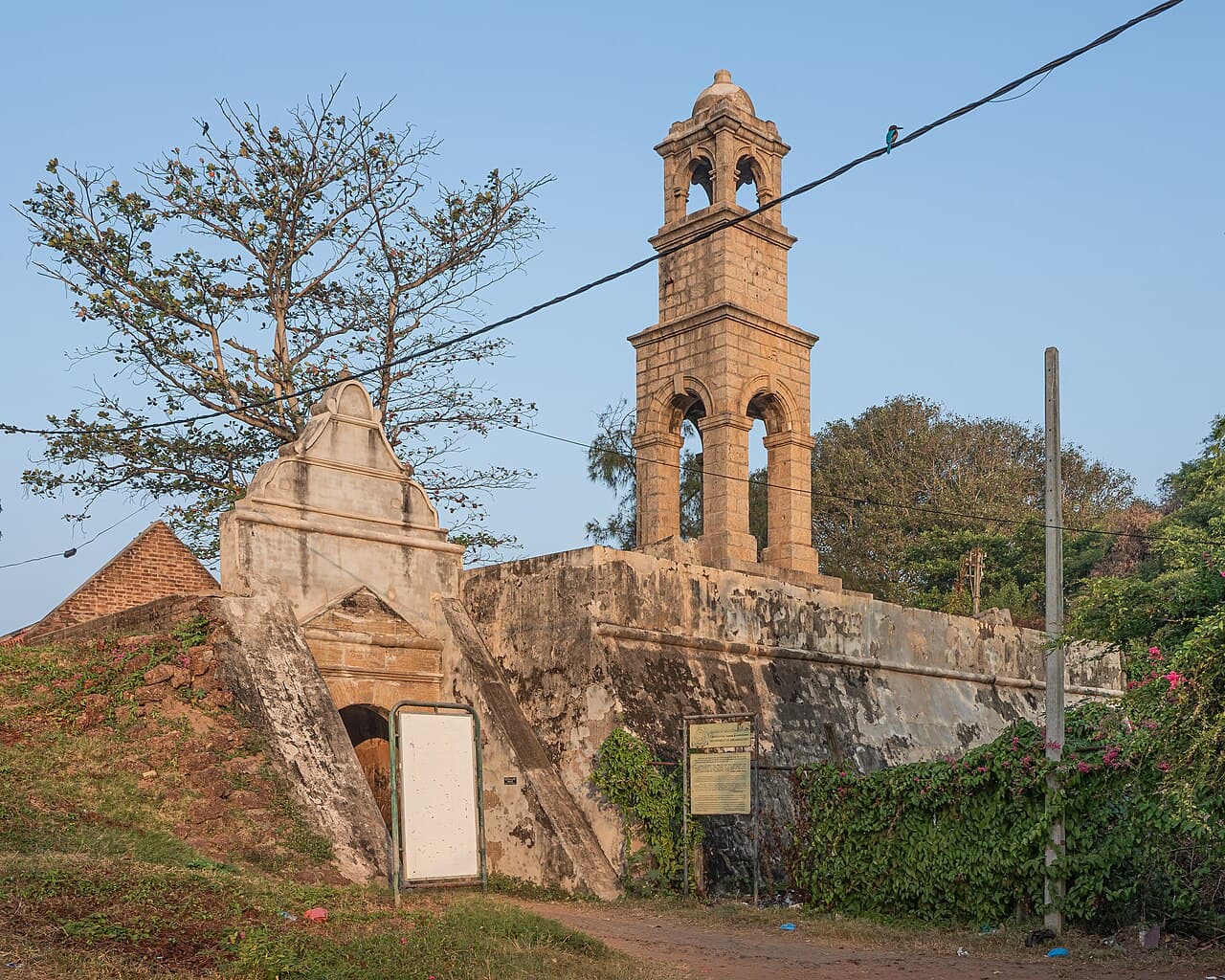
In February 1796, the fort was occupied by the British without resistance as part of their expansion in Sri Lanka. By the late 19th century, the British decided to demolish much of the fort to construct a prison using the stones from the original structure. Today, only a section of the eastern rampart remains, along with mounds marking the former northern and southern bastions and a recessed arched gateway. Above this gateway is a granite slab inscribed with the date 1678, topped by a decorative gable, which stands as a reminder of the fort's Dutch reconstruction phase.
The site continues to serve as a prison under the management of the Department of Prisons, illustrating the adaptive reuse of colonial military architecture in modern times.
Architectural features and strategic importance
Negombo Fort's design reflects the evolution of military architecture from the Portuguese to the Dutch colonial periods. The transition from a simple square fortification to a pentagonal bastioned fortress demonstrates the Dutch emphasis on stronger, more resilient defenses against artillery. The fort's position between a lagoon and sea inlet provided natural protection, while the dry moat and drawbridge added layers of defense.
The pentagonal shape with four bulwarks allowed for overlapping fields of fire, a key feature in bastioned fortresses that enhanced defensive capabilities. The absence of the fifth bulwark is a notable architectural anomaly, possibly reflecting economic or logistical limitations during construction.
Historical legacy and cultural significance
Negombo Fort is an important landmark in Sri Lanka's colonial history, illustrating the island's strategic maritime importance and the contest between European powers for control. The fort's layered history—from Portuguese origins through Dutch reconstruction to British occupation—provides insight into changing military technologies and colonial ambitions in South Asia.
Despite much of the structure being lost, the surviving elements, including the gateway and ramparts, serve as tangible connections to the past. The fort's continued use as a prison also highlights the complex legacy of colonial architecture adapting to contemporary needs.

Information
Loading map...
Visitor reviews
No reviews yet. Been here? Write the first review and help other travelers!
Write the first reviewVisited this castle? Share your experience
Your review helps other travelers and adds first-hand knowledge to our encyclopedia.