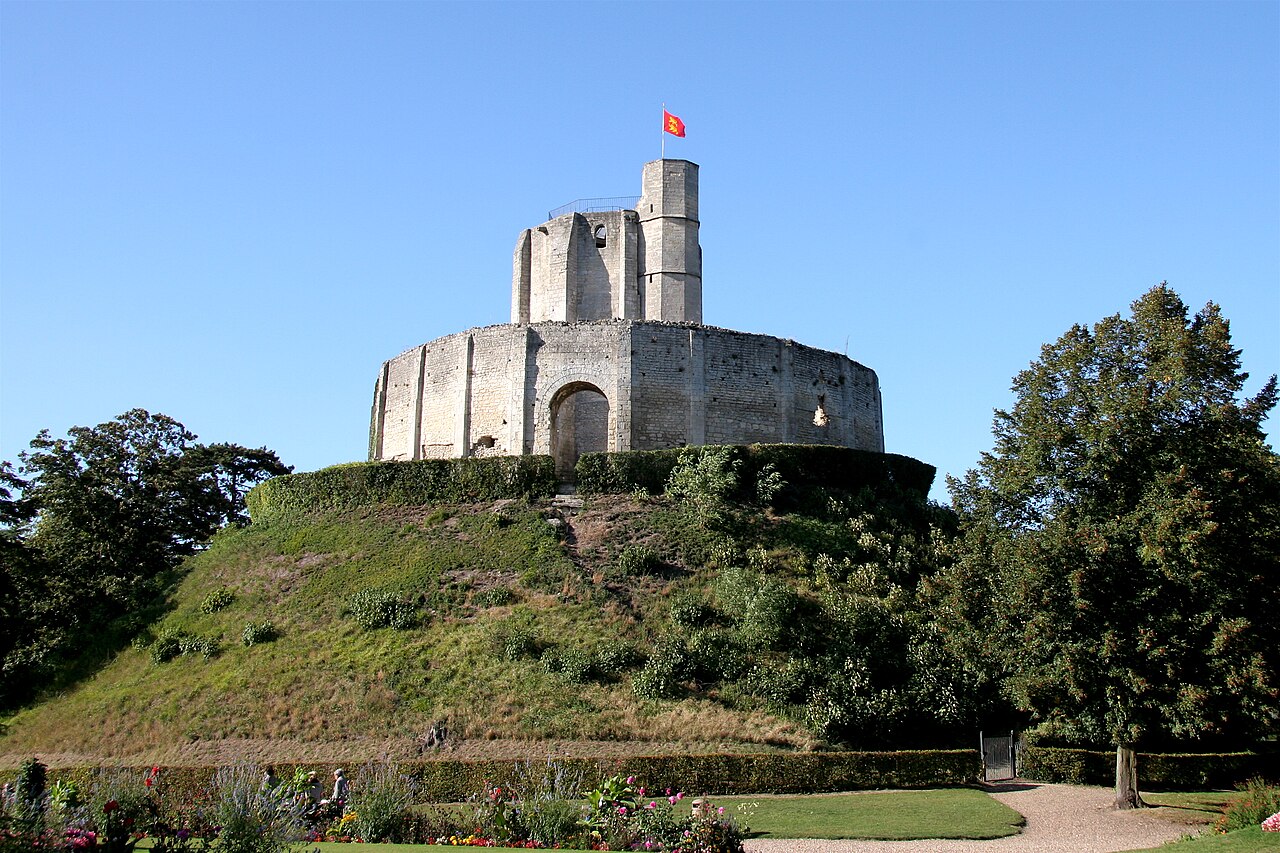
Neaufles Tower
Neaufles Tower, also known locally as Tour de Neaufles St. Martin or Tour de la Reine Blanche, stands near the village of Neaufles St. Martin in the Eure department of France. This imposing structure is the surviving keep of the former Neaufles Castle, a site with a history stretching back over a millennium. The tower is a significant relic of medieval fortifications in the Norman Vexin region, reflecting the turbulent history between Normandy and France.
The earliest known fortification at this location dates to 856, likely a wooden motte-and-bailey style fortification erected to defend local inhabitants against Viking incursions. Around 911, after the river Epte was established as a border between the Kingdom of France and the Duchy of Normandy, the Normans constructed the first stone castle near the Lévrière river, a tributary of the Epte. This strategic position underscored the castle's military importance as a frontier fortress.
Medieval origins and architectural evolution
In 1097, the castle underwent a major reconstruction under the direction of Robert of Bellême, 3rd Earl of Shrewsbury, commissioned by King William II of England. This phase saw the castle rebuilt in durable limestone and flint, materials typical of the region, enhancing its defensive capabilities. The castle's design featured a robust cylindrical keep, which is the part that survives today as Neaufles Tower. The walls of the keep are remarkably thick, measuring nearly 3 meters, and the tower itself rises to a height of 22 meters with a diameter of approximately 14 meters.
Following the Treaty of Gaillon in 1196, the castle and the surrounding Norman Vexin territory were ceded to the French crown. This shift in control marked a new chapter in the castle's history as it became part of the French defensive network against English-held Normandy.
The tower and queen blanche of navarre
One of the most notable historical figures associated with Neaufles Castle was Blanche of Navarre, Queen of France. After the death of her husband, King Philip VI, she retired to the castle in 1359. Blanche remained at Neaufles until her death in 1398. Her long residence at the castle earned the tower its alternate name, Tour de la Reine Blanche or the Tower of the White Queen. This association adds a significant cultural and historical dimension to the site.
Decline and dismantling in the early modern period
During the reign of King Henry IV of France in the late 16th century, the castle was largely dismantled as part of efforts to reduce the power of feudal lords and fortifications that could challenge royal authority. Only the keep, now known as Neaufles Tower, was spared. Further degradation occurred in 1647 when Cardinal Jules Mazarin ordered the dismantling of fortresses that threatened the centralized power of the monarchy. This campaign led to the ruinous state of the castle remains.
Architectural features of neaufles tower
The 22-meter high cylindrical tower is remarkable for its thick walls, which are nearly 3 meters thick, providing formidable defense against siege weaponry of its time. The tower is surrounded by earthworks, which delineate the outline of the original castle and its outer bailey. These earthworks are key to understanding the castle's original layout and defensive strategy.
Local legend speaks of an underground tunnel connecting Neaufles Tower to Gisors Castle, located approximately 4 kilometers away. While no archaeological evidence confirms this tunnel, the story reflects the strategic importance of these fortresses in the region.
Current status and accessibility
Today, Neaufles Tower stands on private farmland and is not open to the public. Despite its ruinous condition, it remains a striking historical monument in a peaceful rural setting. The tower's preservation as a solitary keep offers valuable insight into the military architecture of the Renaissance period and earlier medieval fortifications in northern France.
Though inaccessible, the tower is an important cultural landmark for the Eure region and continues to attract interest from historians and enthusiasts of medieval architecture. Its enduring presence highlights the layered history of territorial conflicts and noble residencies that shaped the Norman Vexin landscape.
Frequently asked questions (FAQ)
- Can I visit Neaufles Tower?
- Neaufles Tower is located on private farmland and is not open to the public, so visiting inside the tower is not possible.
- What is the historical significance of Neaufles Tower?
- Neaufles Tower is the last remaining keep of Neaufles Castle, linked to historic figures like Blanche of Navarre and reflecting medieval frontier defenses between France and Normandy.
- When was Neaufles Tower built?
- The current tower dates from the 16th century, rebuilt during the Renaissance period, though the site has medieval origins going back to the 9th century.
- Why is Neaufles Tower also called the Tower of the White Queen?
- The tower is nicknamed after Blanche of Navarre, Queen of France, who retired there after her husband's death and lived at the castle until 1398.
- Is there a tunnel connecting Neaufles Tower to Gisors Castle?
- Local legend suggests an underground tunnel links Neaufles Tower to Gisors Castle, but no archaeological evidence has confirmed this.
Information
Current owner
Private owner
Address
Near Rue de la Tour, Neaufles St. Martin, Eure, Normandy, France
Loading map...
Visitor reviews
No reviews yet. Been here? Write the first review and help other travelers!
Write the first reviewVisited this castle? Share your experience
Your review helps other travelers and adds first-hand knowledge to our encyclopedia.