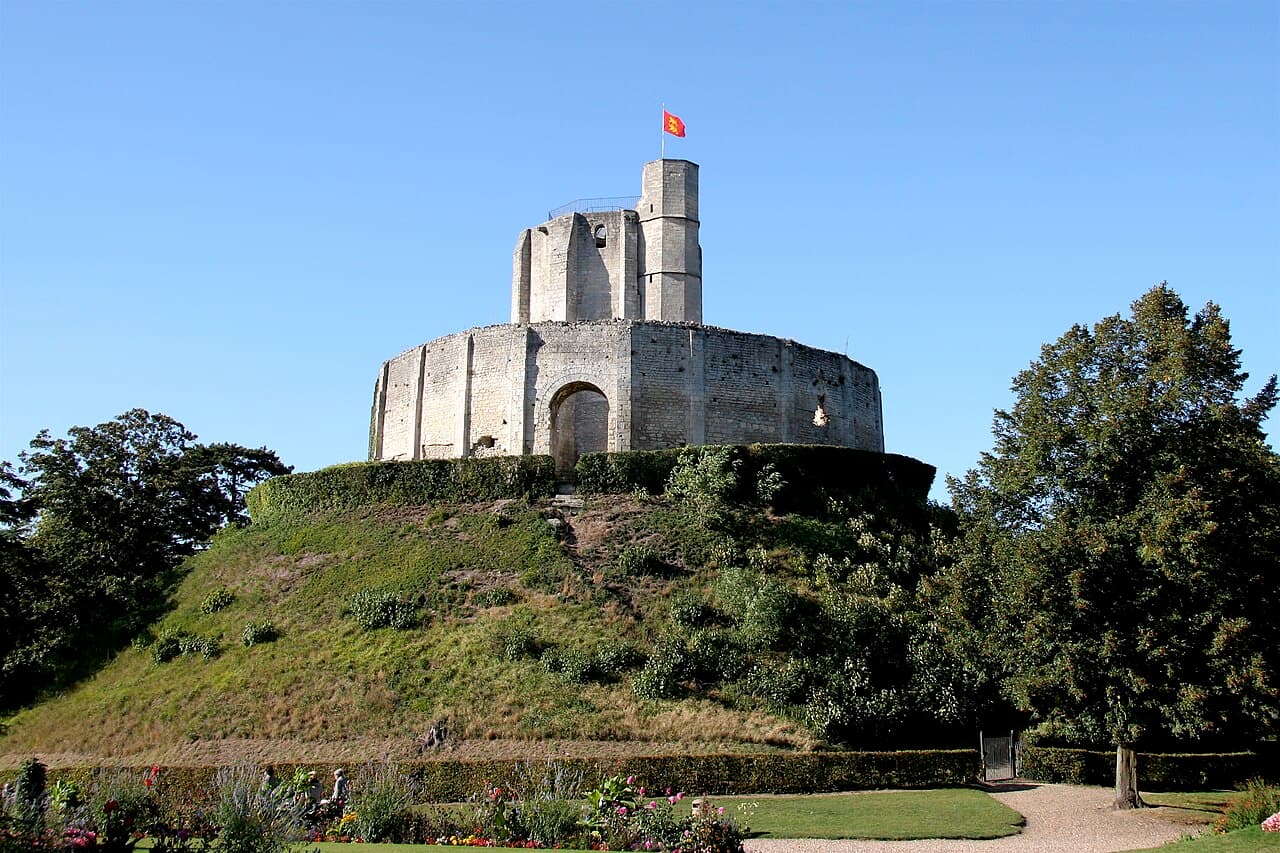
Gisors Castle
Gisors Castle, or Château de Gisors, is a significant high medieval hill castle located in the town of Gisors in the Eure department of Normandy, France. This fortress played a crucial role in the turbulent history of the Anglo-Norman and French kingdoms, serving as a military stronghold, royal meeting place, and later, a prison with deep connections to the Knights Templar.
The castle was originally constructed in 1097-1098 by Robert of Bellême, 3rd Earl of Shrewsbury, under the orders of William II of England. Its initial form was a wooden keep atop a 15-meter-high motte, surrounded by a palisade, strategically positioned near the border between the Anglo-Norman territories and the French crown. This location made Gisors a vital frontier fortress during the High Middle Ages.
Early construction and strategic significance
The early wooden fortification was soon recognized as insufficient for the ongoing conflicts in the region. After a rebellion in 1120 and a siege by Norman lords, Henry I of England ordered substantial rebuilding beginning in 1123. The wooden keep was replaced by a remarkable octagonal stone keep, one of the best-preserved examples of a shell keep in Europe. This keep was surrounded by a circular stone curtain wall, and a rampart formed the lower bailey, enhancing the castle's defensive capabilities.
Gisors Castle was also a diplomatic venue, hosting meetings between English and French monarchs. Notably, in 1113, Henry I met Louis VI of France here, and later in 1158, Henry II of England and Louis VII of France convened at the castle to arrange a royal marriage alliance. During this period, the castle was entrusted to the Knights Templar from 1158 to 1160, reflecting its strategic and symbolic importance.
Fortification enhancements and royal conflicts
Between 1170 and 1180, the castle underwent further fortifications. The keep was raised by two additional floors, the moat was expanded, and the wooden ramparts of the lower bailey were replaced with a stone enclosure flanked by eight towers, significantly strengthening the castle's defenses.
In 1188, another royal meeting took place at Gisors between Henry II and Philip II of France, resulting in a truce. However, the castle's control shifted during the reign of Richard I "the Lionheart". While Richard was imprisoned in Austria in 1193, Philip II seized Gisors and enhanced it by adding a prison tower (the Prisoner's Tower) and a barbican. After Richard's release, he signed the Treaty of Gaillon in 1194, which placed the castle under French control.
The castle as a prison and its decline
Following its transfer to the French crown, Gisors Castle lost much of its military importance as a border fortress. It was repurposed primarily as a prison, most famously holding Jacques de Molay, the last Grand Master of the Knights Templar, during the early 14th century trials from 1310 to 1314.
During the Hundred Years' War, the castle was briefly captured by the English under Thomas of Lancaster in 1419 but was retaken by the French in 1449. After this period, Gisors gradually fell into disuse and was decommissioned as a fortress in 1591. In the 16th century, earthen ramparts were added, reflecting changing military technology and the castle's reduced defensive role.
Architectural features and preservation
The castle's most distinctive architectural feature is its octagonal stone keep, which sits atop the motte and is surrounded by a stone chemise, a defensive wall replacing the original wooden palisade. The outer bailey is enclosed by a stone curtain wall with multiple flanking towers, demonstrating the evolution of medieval military architecture.
The Prisoner's Tower, a cylindrical keep added in the early 13th century, served as a dungeon and is a testament to the castle's later function as a prison. The barbican and other fortifications added by Philip II further enhanced the castle's defensive capabilities.
Today, the castle is restored and recognized as a monument historique by the French Ministry of Culture since 1862. The site functions as a public park, with the inner castle on the motte as its focal point. While the interior of the keep is not generally open to visitors, the ruins and grounds offer insight into the castle's layered history and architectural significance.
Legend and cultural significance
Gisors Castle is steeped in legend, notably the myth that it houses the hidden treasure of the Knights Templar. This legend spurred archaeological interest and some damaging excavations in the mid-20th century, although no treasure was found. Despite this, the castle remains a symbol of medieval power struggles and the enigmatic history of the Templars.
The castle's historical role as a key fortress in the Norman Vexin, its architectural innovations such as the octagonal shell keep, and its association with royal diplomacy and the Templars make it a significant heritage site. It offers valuable insights into the military, political, and cultural dynamics of medieval Normandy and France.
Visiting information
Visitors to Gisors Castle can explore the extensive grounds and enjoy views of the surrounding landscape from the motte. The castle's location next to Place de Blanmont in the town of Gisors makes it accessible for those interested in medieval history and architecture. While access to the interior keep is restricted, the site provides ample opportunity for historical exploration and photography.
Historical meetings and treaties
The castle's role as a diplomatic venue is notable. The 1113 meeting between Henry I and Louis VI, the 1158 meeting arranging a royal marriage, and the 1188 truce between Henry II and Philip II underscore its importance beyond military functions. These events shaped the political landscape of medieval France and England.
Frequently asked questions (FAQ)
- How do I visit Gisors Castle and what can I see?
- Gisors Castle is open to the public as a park with access to the castle grounds and ruins. Visitors can explore the motte, outer walls, and towers, but the interior of the keep is usually closed. The site offers scenic views and historical displays.
- What is the historical significance of Gisors Castle?
- Gisors Castle was a key fortress in the Anglo-Norman and French conflicts, hosting royal meetings and serving as a prison for the Knights Templar. It reflects medieval military architecture and the political struggles of Normandy.
- When was Gisors Castle built and by whom?
- The castle was originally built in 1097-1098 by Robert of Bellême on the orders of William II of England. It was later rebuilt in stone by Henry I of England, who added the notable octagonal keep.
- Is there a connection between Gisors Castle and the Knights Templar?
- Yes, the castle was entrusted to the Knights Templar between 1158 and 1160 and later served as the prison for Jacques de Molay, the last Grand Master of the Order, during the early 14th century.
- Why is the octagonal keep significant?
- The octagonal keep at Gisors is one of the best-preserved examples of a shell keep in Europe. Its unique shape and construction represent important developments in medieval castle architecture.
Photo gallery

Information
Opening hours
Variable, generally daylight hours
Ticket prices
Free
Current owner
Municipality
Website
Visit websiteAddress
Next to Place de Blanmont, Gisors, Eure, Normandie, France
Sources & official resources
Verify the information above using these authoritative references.
Loading map...
Visitor reviews
No reviews yet. Been here? Write the first review and help other travelers!
Write the first reviewVisited this castle? Share your experience
Your review helps other travelers and adds first-hand knowledge to our encyclopedia.



