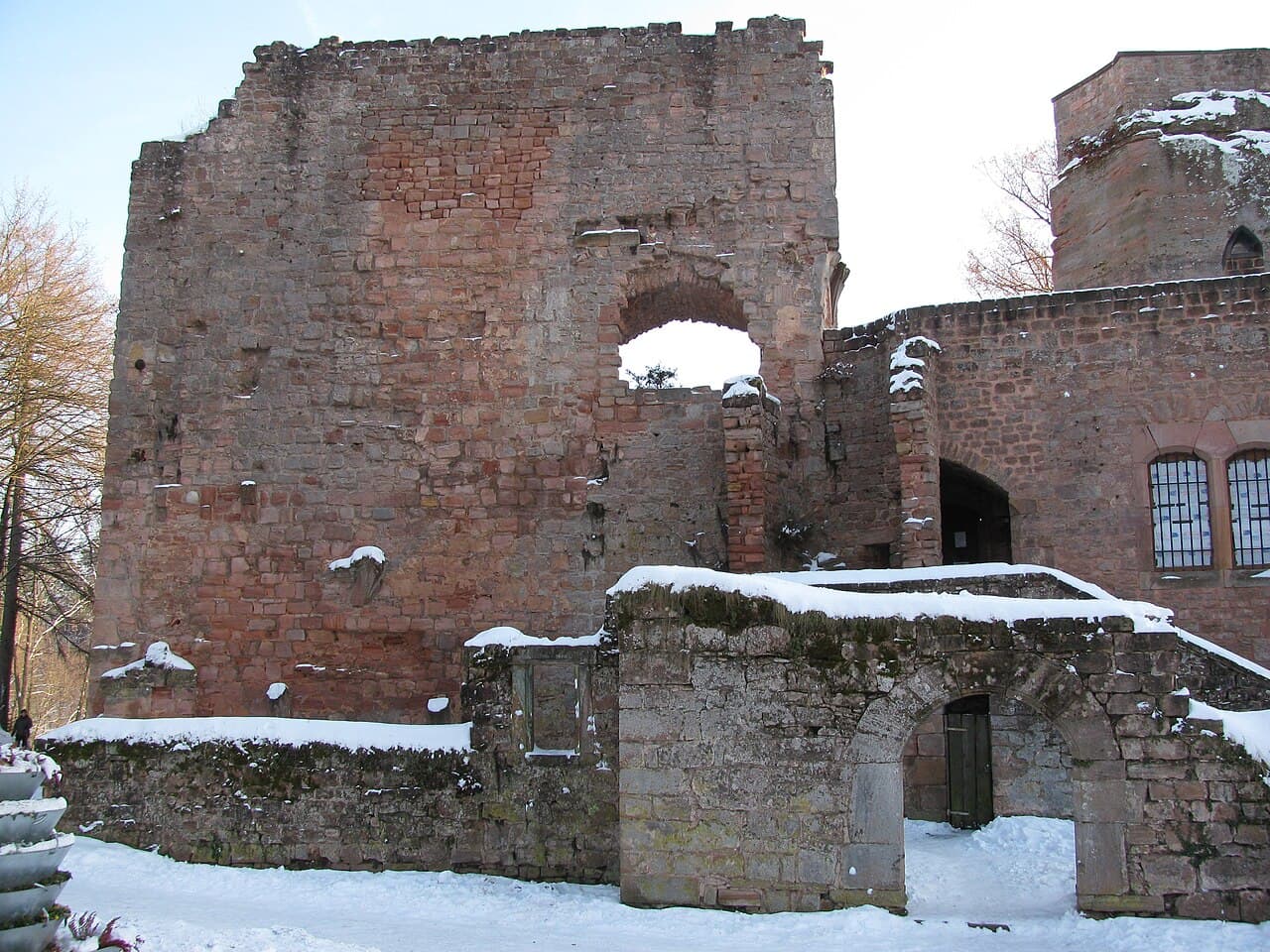
Nanstein Castle
Nanstein Castle is a remarkable medieval hill castle located in Landstuhl, Germany, perched atop a commanding 330-meter-high hill crowned by a distinctive 15-meter red sandstone rock formation. Constructed around 1162 under the auspices of Holy Roman Emperor Frederick I Barbarossa, the castle was part of a strategic imperial defense system designed to secure the southwestern territories of the empire. Serving initially as the seat of an imperial ministerial representative, Nanstein Castle played a pivotal role in regional governance and military oversight during the High Medieval period.
Historical significance and ownership evolution
Throughout the late Middle Ages, Nanstein Castle transitioned from an imperial fief to a Ganerbschaft, a form of joint hereditary ownership shared among several noble families. This arrangement led to uncoordinated expansions that gradually compromised the fortress's defensive integrity. A major turning point came in 1482 when the influential Sickingen family acquired a stake in the castle. By 1518, the renowned knight Franz von Sickingen consolidated full control over the castle and embarked on extensive modernization efforts.
The sickingen era and military modernization
Franz von Sickingen, a prominent leader among the imperial knights, transformed Nanstein into a "Kanonenburg", a fortress adapted to withstand the emerging threat of firearms and artillery. His refortification included the construction of robust bastions, artillery towers, and reinforced walls designed to resist cannon fire. Despite these upgrades, the castle became a focal point during the Knights' Revolt of 1523, when it was besieged by a coalition of three imperial princes. After a brief but intense bombardment lasting two days, the castle fell, and Franz von Sickingen was mortally wounded, marking a symbolic end to the era of medieval castle warfare in the Palatinate region.
Post-siege reconstruction and decline
Following the siege, Sickingen's heirs reclaimed Nanstein as a fief in 1542 and initiated reconstruction efforts that incorporated Renaissance architectural elements. The castle complex expanded to include not only the main fortress but also a shared city wall with the adjacent town of Landstuhl, reflecting its dual military and civic functions. The reconstruction, completed by Reinhard von Sickingen in 1595, exemplified the evolving architectural trends of the late 16th century.
However, the castle's military significance waned in the 17th century. In 1668, Elector Charles I Louis forcibly expelled Lotharingian troops occupying Nanstein and ordered the partial demolition of its fortifications to prevent its further military use. The fortress suffered additional damage during the Nine Years' War (1689) when French forces targeted the region.
Architectural features and castle layout
Nanstein Castle is notable for its integration with the natural red sandstone outcrop, which forms part of its foundation and defensive structure. The castle complex originally spanned approximately 125 meters by 100 meters around the year 1600, though the present ruins cover roughly 100 by 50 meters. It comprises a central main castle and an extensive outer bailey divided into northern and southern sections.
Defensive elements and water supply
A standout feature of Nanstein is its nineteen deep wells, each approximately 120 meters deep, ensuring a reliable water supply during sieges—an essential aspect of medieval military architecture. The southern outer bailey retains significant remnants, including the main gate, a lower ring wall with a distinctive star-shaped bastion, an adjoining town wall, and parts of the zwinger, a narrow enclosed killing zone designed to trap attackers.
Northern bailey and internal structures
The northern outer bailey contains remains of guardhouses and the castle chapel, highlighting the complex's defensive and religious functions. Access to the main castle is via a modern staircase from the northern section. Within the courtyard, the knights' hall once stood prominently, while a vaulted passage leads to a stair tower dating from 1518. A somber highlight is the chamber believed to be Franz von Sickingen's death chamber, carved deep into the sandstone and noted for the constant dripping of water, adding a poignant atmosphere.
Notable bastions and memorials
The castle features two rounded bastions: a large artillery tower known as the batterieturm and a smaller round bastion adorned with a heraldic well basin from 1560 bearing the coat of arms of the Kranich von Kirchheim family. The batterieturm has been partially reconstructed to reflect its early 16th-century form, illustrating the castle's adaptation to cannon warfare. A statue of Franz von Sickingen, erected around 1900, stands as a prominent modern memorial on the site.
Preservation and cultural importance
From the mid-19th century onward, Nanstein Castle has been the focus of conservation and archaeological efforts aimed at stabilizing and preserving its ruins. These initiatives have ensured that the castle remains a significant cultural and historical landmark, attracting visitors interested in medieval architecture, military history, and the legacy of the imperial knights.
Today, Nanstein Castle offers panoramic views over the surrounding moorlands and hills, providing a tangible connection to the region's turbulent past. Its layered history, from its origins under the Hohenstaufen dynasty to its role in the Knights' Revolt and Renaissance reconstruction, makes it a compelling site for both historians and tourists.
Frequently asked questions (FAQ)
- How do I get to Nanstein Castle in Landstuhl?
- Nanstein Castle is located on a hill above Landstuhl, Germany. Visitors can reach the castle via marked hiking trails from the town center, with a modern staircase providing access to the main castle area.
- What is the historical significance of Nanstein Castle?
- Nanstein Castle was built in 1162 under Emperor Frederick I Barbarossa and played a key role in regional defense. It is famous for its association with Franz von Sickingen and the Knights' Revolt of 1523.
- Can I visit the interior of Nanstein Castle?
- While Nanstein Castle is largely in ruins, visitors can explore the castle grounds, including the outer bailey, chapel remains, bastions, and the courtyard. Some interior areas are accessible via staircases, but caution is advised due to uneven terrain.
- When is the best time to visit Nanstein Castle?
- The best time to visit Nanstein Castle is during late spring to early autumn when weather conditions are favorable for hiking and outdoor exploration of the ruins.
- Is there an entrance fee to visit Nanstein Castle?
- Visiting Nanstein Castle is generally free of charge, making it an accessible historical site for tourists and locals alike.

Information
Sources & official resources
Verify the information above using these authoritative references.
Loading map...
Visitor reviews
No reviews yet. Been here? Write the first review and help other travelers!
Write the first reviewVisited this castle? Share your experience
Your review helps other travelers and adds first-hand knowledge to our encyclopedia.



