Burg Perlenberg
Burg Perlenberg is a notable hill castle ruin located near the municipality of Bann in the German state of Rhineland-Palatinate. Constructed in the 12th century during the reign of the Staufer dynasty, this castle played a significant role in the defensive network protecting the nearby imperial palace at Lautern. Its strategic position allowed control over the vital road connecting Kaiserslautern and Landstuhl, two important regional centers during the High Medieval period.
Historical context and significance
The castle was built as part of the broader efforts by the Staufer rulers to consolidate their power in the Holy Roman Empire. Burg Perlenberg's location atop the Kleiner Berg at an elevation of 371 meters provided commanding views of the surrounding landscape, which was crucial for early warning and defense. The castle's role was primarily military, serving as a watchpoint and stronghold to secure the imperial road and nearby territories.
By the 16th century, Burg Perlenberg had fallen into disuse and was recorded in a 1542 document under the name "Birleberg," reflecting territorial disputes between the Electoral Palatinate and the noble Sickingen family. The name "Perleburg" emerged later in historical references, indicating the evolution of the castle's identity over time.
Architectural features and remains
The bergfried
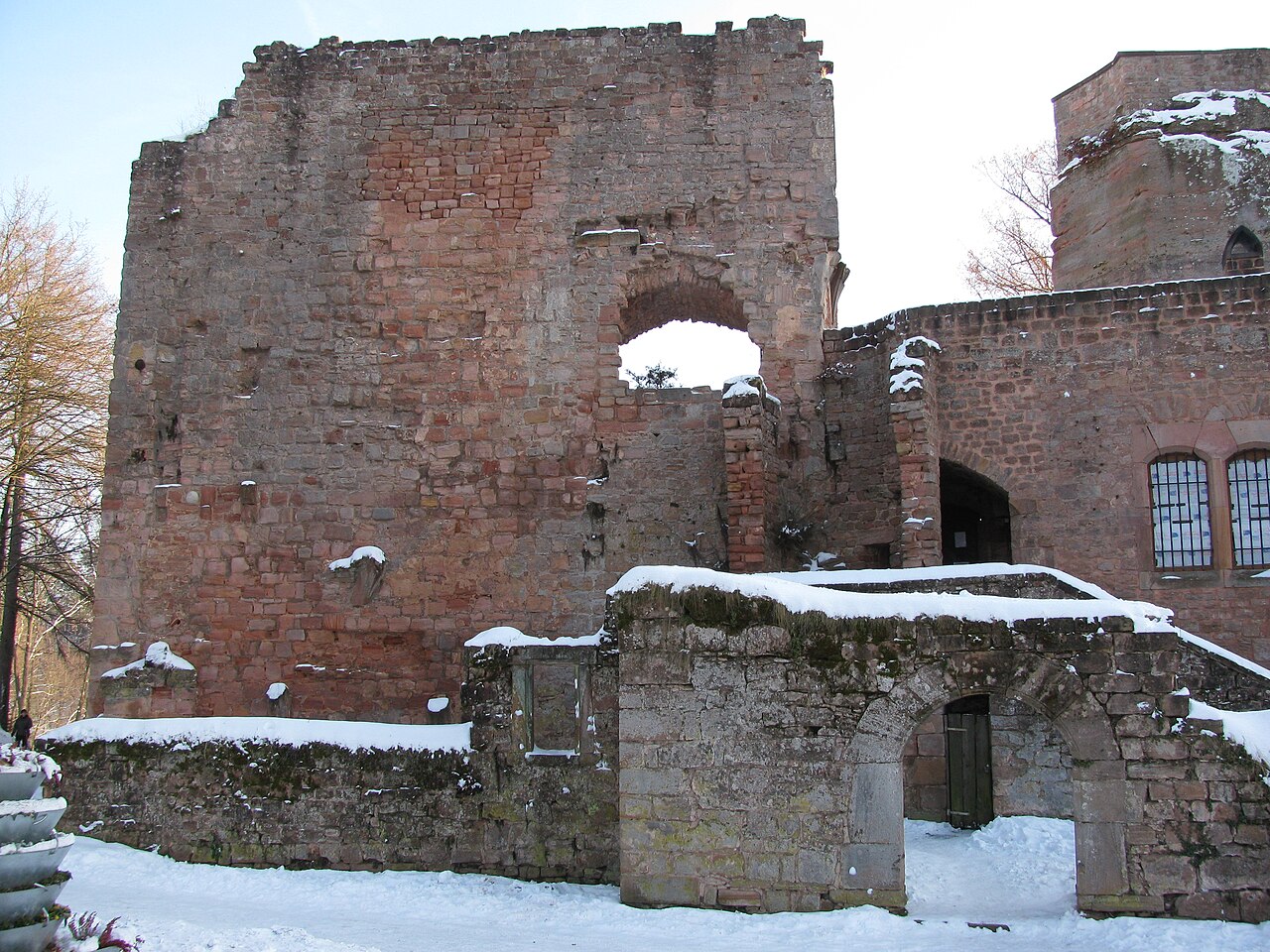
The most prominent surviving feature of Burg Perlenberg is the square bergfried, a defensive tower typical of medieval German castles. This main tower was constructed using finely cut rusticated ashlar masonry, characterized by large rectangular stone blocks with rough faces and smooth edges, showcasing the high-quality craftsmanship of the Staufer era. The bergfried measures approximately nine meters on each side, with walls about 1.5 meters thick, providing formidable defense.
The tower's base features a carefully shaped profile similar to the shield wall design found at other Staufer castles such as Landeck and Wildenberg. This architectural detail reflects a common construction approach during the High Medieval period, emphasizing both strength and aesthetic precision.
Other structural elements
No other substantial structural remains have been identified at the site, suggesting that either the castle was never fully developed beyond the bergfried or that other buildings have not survived the centuries. The ruin stands on a small plateau surrounded by steep slopes and dense forest, which today forms part of a protected nature reserve.
Archaeological investigations and preservation
Interest in Burg Perlenberg's ruins was revived in the early 20th century when archaeologist Christian Mehlis conducted the first systematic excavation in 1901. His work uncovered important details about the castle's construction and historical context. However, some of the castle's stones were quarried after his investigation, continuing until around 1913, which likely contributed to the loss of additional structural elements.
Further archaeological excavations and preservation efforts were undertaken between 1959 and 1963, enhancing understanding of the site and stabilizing the remaining ruins. Today, Burg Perlenberg is owned and maintained by the state of Rhineland-Palatinate, ensuring its protection as a cultural heritage site.
Local legends and cultural significance
Local tradition holds that an underground passage once connected Burg Perlenberg to the Deutschherrenkomturei Einsiedeln, a nearby commandery in Kaiserslautern. Although this story has become part of the castle's lore, no archaeological evidence has been found to confirm the existence of such a tunnel. This legend contributes to the mysterious allure surrounding the castle ruins.
Access and environment
The ruins of Burg Perlenberg are accessible via an unmarked steep path starting near Einsiedlerhof and passing by the Kolbenwoog pond. The ascent leads to the castle's hilltop, which was once prized for its expansive views. Today, the summit plateau is largely enclosed by tall trees, limiting the panoramic vistas but preserving the secluded and natural character of the site.
The surrounding forest reserve and steep slopes enhance the castle's isolated setting, reflecting its original strategic purpose of controlling and monitoring the surrounding region from a defensible position.
Frequently asked questions (FAQ)
- How do I get to Burg Perlenberg?
- Burg Perlenberg is reached by an unmarked steep hiking path starting near Einsiedlerhof and passing by Kolbenwoog pond. Visitors should be prepared for a moderately challenging ascent through forested terrain.
- What is the historical significance of Burg Perlenberg?
- Burg Perlenberg was built in the 12th century as part of the Staufer dynasty's defensive network to protect the imperial palace at Lautern and control the road between Kaiserslautern and Landstuhl.
- What remains of Burg Perlenberg can I see today?
- Today, visitors can see the ruins of the square bergfried, a main defensive tower built with finely cut rusticated ashlar masonry, which is the primary surviving structure of the castle.
- Is there evidence of underground tunnels at Burg Perlenberg?
- Local legend speaks of a tunnel connecting Burg Perlenberg to the Deutschherrenkomturei Einsiedeln, but no archaeological evidence has been found to support this claim.
- Who owns and maintains Burg Perlenberg?
- The ruins of Burg Perlenberg are owned and preserved by the state of Rhineland-Palatinate, which ensures its protection as a cultural heritage site.
Information
Current owner
State of Rhineland-Palatinate
Loading map...
Visitor reviews
No reviews yet. Been here? Write the first review and help other travelers!
Write the first reviewVisited this castle? Share your experience
Your review helps other travelers and adds first-hand knowledge to our encyclopedia.