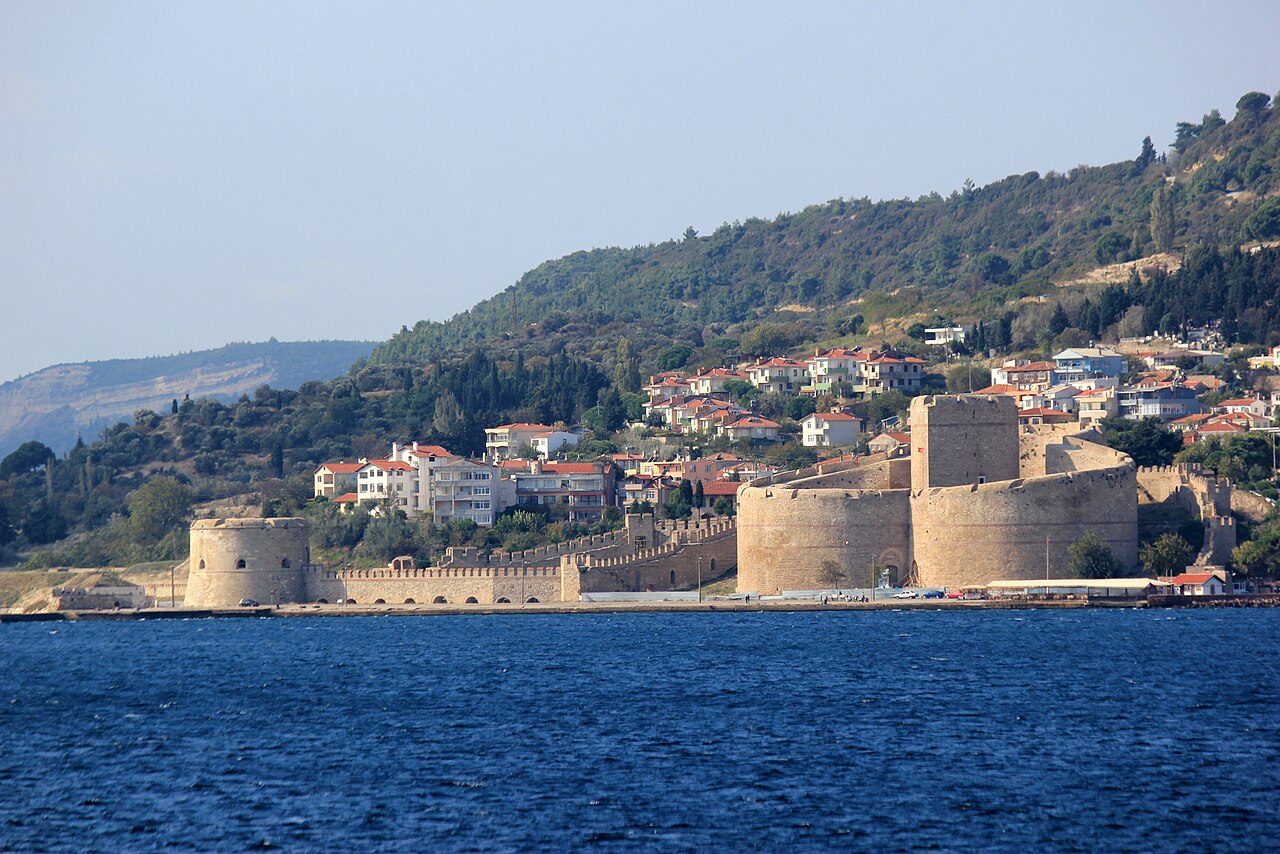
Namazgâh Bastion
Namazgâh Bastion, locally known as Namazgâh Tabyası, is a significant 19th-century fortification situated on the European shore of the Dardanelles Strait, south of the village of Kilitbahir in the Çanakkale province of Turkey. This strategic location has historically been vital for controlling naval access between the Aegean Sea and the Sea of Marmara, making Namazgâh Bastion an important element in the defense system of the Dardanelles.
Historical background and construction
The bastion was constructed during the reign of Sultan Abdulaziz between 1861 and 1876, a period marked by the Ottoman Empire's efforts to modernize its military defenses in response to evolving naval threats. Built adjacent to the medieval Kilitbahir Castle, the bastion was designed to complement the older fortress, effectively extending its defensive capabilities with contemporary military architecture of the late 19th century.
Its proximity to Kilitbahir Castle is so close that the bastion appears as a modern extension of the medieval structure, blending historical fortifications with newer military technology. In 1892, Namazgâh Bastion underwent modernization to upgrade its armaments and fortifications, reflecting advancements in artillery and coastal defense strategies.
Architectural features and military significance
The bastion's design reflects the military engineering principles of the late Ottoman period, focusing on coastal defense. It was equipped with a combination of long-range and short-range coastal cannons, including two long-range guns and fourteen short-range artillery pieces. These weapons were positioned to cover the critical maritime approaches through the Dardanelles Strait.
During the Gallipoli Campaign of World War I, Namazgâh Bastion served as the headquarters of the 4th Heavy Artillery Regiment. Its artillery played a crucial role in the Ottoman defense against the Allied naval and land forces attempting to secure control over the strait. The fort's strategic placement allowed for effective surveillance and firing coverage, contributing to the overall defense network that protected the Ottoman Empire's vital waterways.
Current status and visitor experience
Today, Namazgâh Bastion is freely accessible to the public, offering visitors a chance to explore a well-preserved example of 19th-century Ottoman military architecture. The central bonnet of the bastion houses a small museum that provides historical context about the fort's role in the defense of the Dardanelles and its involvement in World War I. Entry to the museum requires a small fee.
The site presents a unique opportunity to experience both the medieval heritage of Kilitbahir Castle and the more recent military history embodied in Namazgâh Bastion. Its location on the Dardanelles shore offers scenic views and insight into the strategic importance of this narrow waterway throughout history.
Architectural and historical context
Namazgâh Bastion exemplifies the transition in military architecture from medieval fortresses to modern coastal artillery forts. Its construction during the late Ottoman period reflects the empire's adaptation to new warfare technologies and the ongoing need to defend critical maritime passages. The bastion's integration with Kilitbahir Castle underscores the layered defensive strategies employed over centuries in this region.
The fort's preservation and current use as a museum highlight the cultural and historical value attributed to Ottoman military sites in Turkey. Visitors can appreciate the blend of medieval and 19th-century fortification techniques, the evolution of artillery deployment, and the broader historical narratives of the Dardanelles campaigns.
Frequently asked questions (FAQ)
- How do I get to Namazgâh Bastion from Çanakkale city?
- Namazgâh Bastion is located near Kilitbahir village on the European side of the Dardanelles. Visitors can reach it by car or local ferry from Çanakkale city, followed by a short walk to the site.
- What is the historical significance of Namazgâh Bastion?
- Namazgâh Bastion played a key role in the defense of the Dardanelles Strait during the late Ottoman period and World War I, serving as the headquarters for the 4th Heavy Artillery Regiment during the Gallipoli Campaign.
- Can I visit the museum inside Namazgâh Bastion?
- Yes, the central bonnet of Namazgâh Bastion houses a small museum with exhibits on the fort's history and military role. There is a small entry fee to visit the museum.
- What architectural style is Namazgâh Bastion built in?
- Namazgâh Bastion reflects a mixed architectural style combining late Ottoman military engineering with elements influenced by the adjacent medieval Kilitbahir Castle.
- Is Namazgâh Bastion accessible year-round?
- The bastion is generally open daily from 09:00 to 18:00, making it accessible throughout the year, though visitors should check for any seasonal changes or special closures.
Information
Opening hours
09:00-18:00, daily
Ticket prices
Small fee for museum entry
Current owner
State museum
Address
Yalı Cd., Kilitbahir, Çanakkale, Turkey
Loading map...
Visitor reviews
No reviews yet. Been here? Write the first review and help other travelers!
Write the first reviewVisited this castle? Share your experience
Your review helps other travelers and adds first-hand knowledge to our encyclopedia.